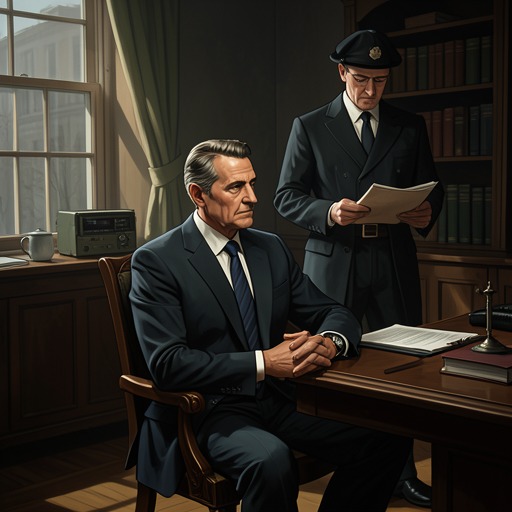
Richard Doss Allegedly Hires a Hitman to Kill Mate
Dr. DeathRichard Doss Allegedly Hires a Hitman to Kill Mate centers on a murder-for-hire accusation that transforms Doss from a grieving husband into the leading suspect in Eldon Mate’s killing. The account comes from Quentin Goad, an imprisoned armed-robbery defendant, and is strengthened by witnesses who saw Doss meet him and pass him an envelope. Yet Goad admits that he took the money as part of a scam, so the evidence points toward an arrangement without resolving whether Doss’s plan ever advanced beyond an offer.
The Alleged Arrangement and Goad’s Account
Goad was being held at County awaiting trial for armed robbery when Milo Sturgis presented him to Alex Delaware as a possible link to Mate’s murder. Goad also worked in construction, specializing in roofing and sheet-metal jobs, and had done work for Doss. According to Sturgis, Doss regularly hired formerly incarcerated workers and paid them under the table, a practice that could explain both Goad’s access to him and the difficulty of distinguishing a criminal payment from ordinary work-related cash.
Goad said that about two months earlier he had been roofing a large shopping center in San Bernardino that Doss had bought cheaply and was renovating. He alleged that Doss offered him $5,000 to kill Mate, specifying that the killing should be nasty and bloody so investigators would attribute it to a serial killer. The proposed payment was divided into $1,000 up front and $4,000 after the job. Goad said he accepted the advance but never intended to carry out the murder: he regarded the offer as an opportunity to cheat Doss and leave for Nevada, where he hoped to escape the pressure of having two prior strikes against him in California.
Goad’s explanation makes him both the source of the accusation and a compromised witness. He claimed that Doss later pressed him for a progress report, about three weeks after the initial approach, and that he answered by saying he was watching Mate and waiting for the right opportunity. Goad denied that this was true; he described the supposed surveillance as part of his con. The distinction mattered to the investigation: if Goad was telling the truth about the offer, Doss had sought a hired killer, but Goad’s account did not establish that he had stalked Mate or attempted the murder himself.
Witnesses, Money, and the Limits of Corroboration
The allegation did not rest on Goad alone. Milo Sturgis told Alex Delaware that three patrons and a bartender remembered a serious, face-to-face meeting between Goad and Richard Doss in a San Fernando bar frequented by ex-convicts. Doss stood out in the room: his expensive black clothes made him conspicuous among the bar’s clientele. A waitress said she saw him pass Goad a large envelope. She did not see cash itself change hands, leaving a gap between the witnesses’ observation and the payment Goad described, but the encounter gave investigators independent grounds to take his story seriously.
Sturgis also said police had recovered two of the ten hundred-dollar bills Doss allegedly gave Goad. Goad claimed to have spent eight bills and kept the remaining two for Greyhound fare, money to carry him until he could attempt a robbery. Police had taken Doss’s fingerprints and were checking the recovered bills, but the result was not yet known. The cash therefore offered a potentially testable link, not a completed forensic confirmation. Sturgis’s suspicion that Doss might have paid other former convicts for illicit work drew force from his reported practice of hiring them off the books, while also complicating any attempt to interpret a payment between employer and worker as proof of murder solicitation.
Goad’s arrest supplied another measure of his reliability. About a month before the interview, he had tried to rob a San Fernando hamburger restaurant shortly before closing, taking a .22 and a paper bag and getting as far as putting the money inside. A security guard subdued him and shot him in the leg; the wound was superficial, and he spent two weeks receiving treatment at County General Hospital before being transferred to the Twin Towers jail. The gun was not loaded. The failed robbery fit Goad’s own account of a man seeking money to leave California, but it also underscored how little confidence investigators could place in his claims. He was an armed-robbery defendant with an obvious incentive to deceive, and the proposed killing remained an allegation supported by circumstantial corroboration rather than a completed attempt.
The Claimed Motive Against the Crime Scene
Goad said Doss justified the proposed killing by accusing Mate of having murdered Doss’s wife: in Goad’s account, Doss insisted she had not really been sick and that Mate, as her doctor, should have talked her out of ending her life. He reportedly framed killing Mate as a public service. This was Goad’s report of Doss’s rationale, not independent proof of either the accusation or Doss’s motive; still, it gives the alleged contract a specific grievance, tying it to Mate’s role in the wife’s death rather than to a financial dispute. The contrast with the crime scene sharpens the accusation without identifying the killer. Mate had been butchered in his van near Doss’s home. Investigators found no blood outside the vehicle, though the front seats were heavily bloodstained, and inferred that the killer had worked in the confined space, then changed clothes and carefully removed traces. Cardboard cut to cover the windows was streaked with arterial blood, while a mattress lay beneath Mate. The scene suggested that Mate had arrived prepared to assist someone’s death, only for the roles to be reversed. That reconstruction lends a grim context to the revenge Goad attributed to Doss, but it does not establish that Doss arranged the killing or that the alleged contract produced the murder.
The Crime Scene and the Investigation’s Wider Course
The physical evidence at the murder site did not independently connect Richard Doss to the killing. Milo Sturgis considered whether the killer had arrived with Eldon Mate or had parked farther down the road, but investigators had found no other tracks, and no one had reported seeing another vehicle. The van itself had sat there for hours without attracting notice. With so little reliable evidence about how the killer reached or left the scene, the forensic uncertainty left room for the murder-for-hire allegation without confirming it.
The investigation later moved beyond Doss’s alleged approach to Quentin Goad. Milo Sturgis met Alex Delaware below the murder site, and the two followed a lead involving Tanya Stratton’s vehicle registration and address. Their search took them to a remote cabin, reached by a winding dirt track and screened by trees; the old sycamores there recalled the tree where Alice Zoghbie and Roy Haiselden had been propped. The visual echo redirected attention toward the broader pattern of killings and Paul Ulrich, rather than furnishing proof that Doss’s alleged contract had produced Mate’s death. The accusation remained consequential, but it was one contested strand in an investigation whose physical clues and changing leads continued to point elsewhere.