Skin as canvas
Dr. DeathSkin as canvas is both a literal description of Donny Salcido Mate’s tattooed body and a central idea in his fraught relation to art, identity, and his father, Eldon Mate. Donny treats skin not as a surface to get beyond but as the material boundary that keeps a person present. His tattoos make that belief visible; his helplessness when he cannot touch his skin gives it an immediate, bodily urgency. The image also links his artistic practice to the repeated rejection he experiences from his father and to a murder that makes artistic creation and violence difficult to disentangle.
The body as artwork
Donny’s tattoos cover his torso, continue around his back, and run down both arms in blue coils. Within them, other images emerge: a fanged cobra, a naked woman with a sad mouth, and an open eye shedding a single tear. Gothic lettering names “Donny, Mamacita, Big Boy.” The body is not a blank support for one coherent picture; it carries a jumble of images and inscriptions, layered across different areas and partly concealed by bandages.
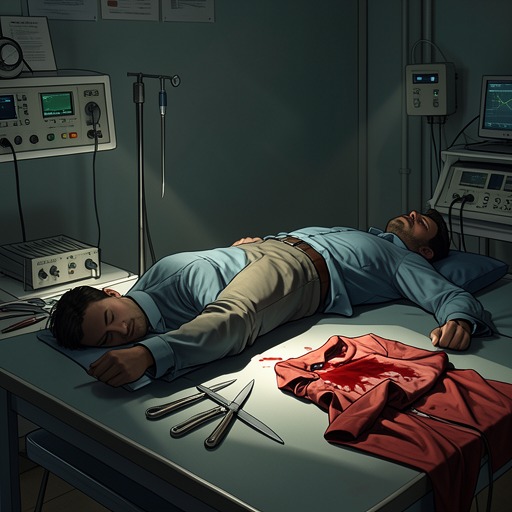
The scene presents the tattoos alongside the physical evidence of Donny’s condition. He lies bare-chested in a small hospital room, shackled with leather cuffs, with bruises around his eyes and a swollen lower lip. Bandages stripe his arms, dried blood crusts their edges, and gauze covers his forehead and chin. The contrast makes the skin’s double role plain: it is at once the medium of his art and the vulnerable surface marked by injury. Alex Delaware recognizes technical skill in the tattoos, yet their accumulation unsettles him; he thinks the jumble makes him want to rearrange Donny’s skin. The impulse registers how art, on this body, cannot be viewed at a safe distance from flesh.
A nurse calls Donny “A walking canvas,” making the artistic metaphor casual, almost cheerful. Her remark contrasts with the scene’s restraints, injuries, and isolation. The phrase fits what is visible, but it also reduces a suffering person to an artwork for someone else to look at. Donny’s own account resists that easy spectatorship: for him, skin is not merely something to display or interpret, but the necessary medium of feeling real.
Touch, presence, and the skin’s boundary
When Alex Delaware asks about his behavior, Donny says that he does not know why he acts as he does. He then turns the conversation toward the shrinks who told him to look inward and get past the surface. Their advice, as he recounts it, dismisses the very thing he experiences as essential. He answers with a compact declaration: “The skin is all. The skin holds it all in.” The repetition gives the claim its force: skin is not an exterior disguise that conceals a more authentic self somewhere inside; it is what contains and secures that self.
His request to have the restraints removed makes this belief concrete. Donny says he needs to touch his skin, and that without being able to touch it he feels as if he is not there. His words connect bodily sensation to presence rather than to vanity or the appreciation of his tattoos. Bound by cuffs and a sheet in a room designed for medical observation, he is separated from the surface he experiences as his own anchor. Alex tells him that this will happen in time; Donny moans and turns his head away. The exchange leaves the need unresolved in the moment: the room can observe his body, but its restraints prevent the contact he says he needs.
Art, time, and repetition
The idea of skin as canvas also draws together Donny’s tattoos and his paintings. Alex tells him he has seen his other work and names “The Anatomy Lesson” and “Zero Tollrance.” At the mention of those works, Donny’s body jerks, but he says nothing. The reaction is small and involuntary; it makes the artworks’ connection to him palpable without offering a full explanation of what he thinks about them.
Their conversation turns to time. Donny rejects the comfort of ordinary continuation, insisting that when people die, time does not simply go on: “Time dies, everything freezes.” Asked what happens to time when he paints, he smiles and answers, “Eternity.” Asked what happens when he is not painting, he replies, “I’m too late.” The contrast presents painting as a temporary escape from lateness and loss, not as a cure for them. The artwork holds a moment beyond ordinary time, while the unpainted interval confronts him with what cannot be recovered.
That opposition is sharpened by the account of his practice outside the hospital. Donny has drifted from squat to squat and numbed pain with drugs, anticonvulsants, anger, and art. The narration describes him as assaultive, deeply disturbed, bright, manipulative, combative, and pigheaded, holding these qualities together rather than reducing him either to an artist or to a patient. His skin art belongs to the same unstable arrangement: a means of expression and a material refuge, but also part of a life organized around pain and anger.
The father’s portrait and the threat of violence
The canvas metaphor becomes most consequential in Donny’s relation to Eldon Mate. Donny repeatedly painted his father’s portrait, offering his best work and being rejected again and again. The repetition makes the portrait more than a single artistic subject: it becomes a recurring effort to reach a father who refuses the offering. The account describes Donny as painting his father’s portrait over and over, then returning to the pattern of giving and rejection. Art preserves the relationship’s terms but does not repair them.
The narrator considers whether the violence against Eldon can be read through that family history. Earlier, he questions whether the concentric squares carved into Eldon’s belly can be equated with Donny’s skin art; he concedes that there may be some concordance, while acknowledging that many killers carve. The evidence does not make the bodily marks proof that Donny committed the murder. Instead, the resemblance feeds a suspicion that art and violence may share a vocabulary of marking the body. The thought of Donny as a self-proclaimed “Rembrandt of the flesh” leads to the question of whether carving could turn hatred of his father into an effort to become him. The narrator concludes that Donny had considered patricide, but consideration is not confirmation of the killing.
Significance
Skin as canvas binds together several tensions the narrative keeps open. The tattoos are technically accomplished but visually jumbled; they make Donny’s body an artwork while exposing it to injury, restraint, and other people’s inspection. His insistence on touching his skin defines it as a condition of presence, even as the body becomes the surface on which anger, artistic ambition, and pain converge. Painting offers him “Eternity,” yet his repeated portraits of Eldon lead back to rejection rather than reconciliation.
The concept therefore does not settle whether Donny’s art is a refuge, a symptom, or a language for violence. It shows how each possibility presses against the others. The body holds the artwork, but also the wounds and the family history that give the work its charge; the skin that Donny says holds everything in cannot contain the consequences of his father’s rejection or resolve the question of murder.