St. Michael's Medical Center
Dr. DeathSt. Michael's Medical Center is both a major hospital in Los Angeles and the institutional archive through which Alex Delaware tries to understand Joanne Doss's prolonged, unexplained decline. Its records document the breadth of the effort to find a physical cause, but end without a diagnosis: extensive testing is recorded as negative, while a suggested psychiatric consultation was refused.
Setting and institutional layout
The hospital's limestone-and-mirrored complex fills several square blocks on Wilshire in Santa Monica, about half a mile east of the beach. The scale of the buildings gives the medical inquiry a tangible setting, but Alex has to ask for directions to locate the relevant offices. Medical Records and Human Resources occupy adjoining buildings on the north side of the complex.
Alex visits while investigating Joanne's illness. A staff member directs him to the offices, and he first enters Human Resources, where he consults a staff roster. Its professional listings include doctors as well as social workers, physical therapists, occupational therapists, and respiratory therapists. He scans the names and photographs for anyone resembling the different faces associated with the supposed Dr. Death, but finds no match. The roster offers a small institutional contrast to the uncertainty surrounding the case: it is an orderly directory, yet it does not identify the elusive figure Alex is seeking.
Joanne Doss's treatment and medical chart
Richard Doss identifies St. Michael's as the hospital where Joanne took her medical tests. When Alex asks whether he may look at her records, Richard questions the reason for the request; Alex explains that he is still trying to understand what was wrong with her. The inquiry follows a long course of symptoms and medical attention. Richard says Joanne experienced joint pain, headaches, skin sensitivity, and fatigue, and that he took her to doctors after she withdrew from social life and spent increasing amounts of time in bed.
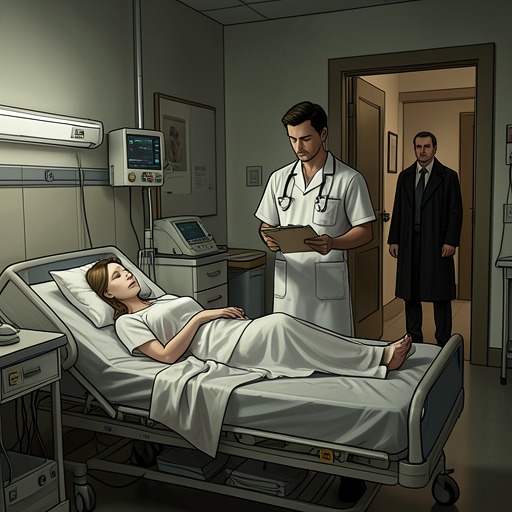
The chart Alex eventually receives is about an inch thick. Joe Safer's faxed authorization allows him to read it on the premises, but not to photocopy it, so the hospital retains control of the original record. Its multicolored laboratory reports, boxed results, and scattered physician handwriting preserve a sequence of attempts to explain Joanne's suffering. Fifteen doctors had investigated her condition. The recorded work included blood tests, urinalysis, X-rays, CAT scans, PET scans, MRIs, and the lumbar punctures Richard had described.
The chart's repeated test results do not supply the explanation Alex is looking for. Its operative word is “negative”: spinal fluid is clear, and a range of measured values, including BUN, creatinine, calcium, phosphorus, iron, total protein, albumin, and globulin, is reported as normal. The findings show how much was examined; they do not establish that Joanne's symptoms were unreal or resolve what caused them.
Diagnostic uncertainty and competing explanations
Richard's account supplies a family interpretation that differs in tone from the chart's clinical record. He describes Joanne's disengagement, weight gain, and withdrawal from activities, and says her decline made her seem like a stranger to him. Elsewhere, he characterizes what happened as a psychological problem and argues that depression, rather than an unknown physical illness, explained her behavior. The medical file, by contrast, records extensive investigations without a physical diagnosis. These accounts do not settle the cause; they show how uncertainty is reframed as it moves between medical testing and family judgment.
The final notation in the chart says psychiatric consultation was suggested, but Joanne refused. The record does not document a completed psychiatric assessment or a resulting diagnosis. That refusal is therefore a boundary in the surviving evidence, not proof that the physical complaints had no basis. The difference matters: a proposed avenue of care appears in the file, but the chart cannot say what might have followed had Joanne accepted it.
Narrative significance
St. Michael's functions less as the scene of a breakthrough than as the place where the limits of the investigation become legible. Its staff roster fails to connect the hospital to the suspected Dr. Death, while Joanne's chart gathers the accumulated work of fifteen doctors without naming a cause. The contrast between a substantial medical record and its inconclusive ending sharpens Alex's task: he must distinguish what was tested, what the results actually show, and what remains unknown about Joanne's illness.