Stratton Sisters' Malibu Mountain Cabin
Dr. DeathThe Stratton Sisters' Malibu Mountain Cabin is a secluded, neglected family property in the hills west of Malibu, remembered as a quiet retreat and found during the search for Paul Ulrich. Its isolation first makes it a plausible refuge for Tanya Stratton; when Alex Delaware and Milo Sturgis reach it, the cabin and the objects inside acquire a darker significance in the investigation.
Location and Family History
The land lies in western Malibu, across the Ventura County line and into the hills, in an area Kris Lamplear likens to Agoura. She estimates it at five or six acres but admits she does not know its exact size. Her parents bought it years earlier, intending that her father build a house there. He never did. The sisters inherited an undeveloped parcel with only a small cabin and an unreliable approach, rather than the finished family home once contemplated.
The property’s remoteness is practical as well as atmospheric. Kris describes a cabin without a telephone, an unpleasant bathroom, and a tiny septic tank. Electricity lines are often down, and the road regularly washes out. The place is not presented as a comfortable vacation house: it is an inconvenient, partly deteriorated refuge whose appeal depends on wanting distance and quiet. Kris says she would have sold it long ago, in part because the land might now be worth money, but Tanya likes it.
Tanya’s attachment is associated with solitude and endurance. Kris recalls that Tanya went to the cabin while recuperating from chemotherapy, though she is uncertain whether Tanya sought quiet or wanted to demonstrate her toughness. Kris also describes her as stubborn. That recollection gives the property a history beyond its neglect: it has served Tanya as a place apart during illness, even while its isolation and poor facilities make it a difficult retreat.
The Search and Approach
When asked where Paul might go by himself, Kris says she does not know his destinations but suggests Malibu because Tanya likes to go there. The suggestion is tentative, not a report that either sister knows Paul is at the cabin. Kris guesses that Paul might like the setting, then distinguishes this from what she knows about him: he enjoys driving for its own sake. The property therefore enters the search through a possible connection to Tanya and a guess about Paul, not through a confirmed sighting.
Alex Delaware and Milo Sturgis follow the lead into the mountains, looking for an unmarked road and an address Kris said would be on the mailbox. The first time, Milo drives past the entrance and has to circle back. The cabin lies nearly five miles from the ocean, beyond its nearest neighbor and after roughly a mile of state land. Its mailbox is set back from the road, partly concealed by plumbago vine. The rusty box has lost its door, and most of its gold-foil address numerals have disappeared; only three curled digits remain. It is empty.
The approach continues on foot after Milo backs out and parks on the road. The dirt track narrows into something closer to a path, bending left and running in an S through dense vines, shrubs, and trees. At its end is an egg-shaped parking area edged in part by large circular rocks, a crude boundary long disrupted by the elements. The site’s obscurity is not just a matter of distance: the missing address, concealed entrance, rough path, and enclosing greenery make the property difficult to identify and reach.
The Cabin and Its Occupants
Two cars establish that the cabin is occupied: Paul Ulrich’s navy BMW and Tanya Stratton’s copper-colored Saturn. The vehicles also overturn one strand of Ulrich’s account. He had described another dark BMW stationed on Mulholland, leading Alex to wonder whether Richard Doss or Eric Doss had been at the wheel. At the cabin, Alex recognizes that the supposed car had existed only in Ulrich’s lie. The location thus does more than place Ulrich and Tanya together; it helps Alex reassess a detail that had directed suspicion elsewhere.
The building stands beyond the cars at the rear of the property, pressed against a mountain wall and nearly swallowed by brush. Its roof is tar paper; its clapboard siding, once white, has become murky and weather-stained. Low branches crowd the front, one reaching to within a foot of the door. The open entrance is screened by a dirty screen door. Above the cabin, sycamores partly obscure a ridge crowned with pines, with more state land beyond and no neighbors close enough to pry. The setting combines a plainly shabby structure with substantial seclusion.
Alex and Milo approach cautiously, using the trees for cover. Tanya comes out, stretches and yawns, then opens the trunk of her car. She wears a tan long-sleeved shirt, jeans, white sneakers, and a red bandanna over her hair. A tan male arm appears at the cabin door, holding the screen open, though Ulrich himself does not come into view. A good-looking golden retriever bounds out and runs to Tanya. The scene places her, Ulrich’s presence, and the dog within the cabin’s small domestic orbit, while keeping the man himself unseen at that moment.
Investigation and Significance
After the shooting, sheriffs from the Malibu substation take time to assemble a group of deputies to travel up to the ridge. They arrive wary of a shooter who might still be nearby. While the officers gather, Milo inspects the cabin. There are no obvious trophies and little inside. A more careful search later that day produces almost nothing of evidentiary value besides a doctor’s bag.
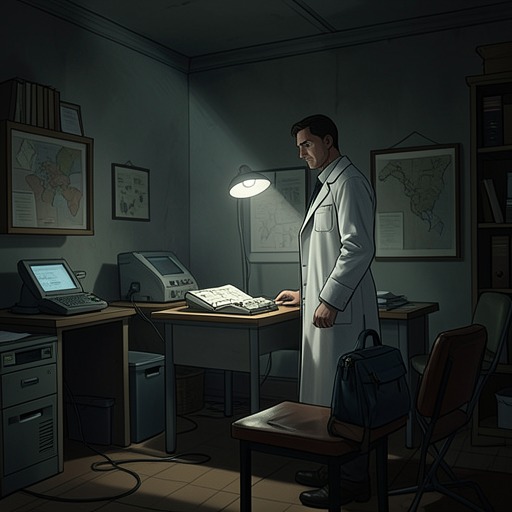
The bag is old leather, burnished with age, with the gold initials EHM above its clasp. Inside are scalpels, scissors, other metal instruments, a coil of intravenous tubing, sterile-packed hollow needles in several gauges, rolls of gauze, disposable hypodermic injectors, and small labeled ampules. Two of the listed substances are thiopental and potassium chloride. The bag’s contents give the apparently empty cabin a direct connection to medical practice and to the investigation’s central questions about death; the initials, meanwhile, point toward Eldon H. Mate.
Tanya says she has never seen the bag, and Alex believes her. He suspects Ulrich kept it hidden from her and brought it out only when he was ready to use it. That distinction matters: the cabin is Tanya’s favored retreat, but the medical equipment found there is not thereby hers or known to her. A sheriff’s detective takes custody of the bag without asking what EHM stands for, and Milo does not volunteer the answer. The secluded property consequently becomes both a place of apparent refuge and a site where concealed evidence emerges, while the investigators’ knowledge remains unevenly distributed among themselves and the authorities.