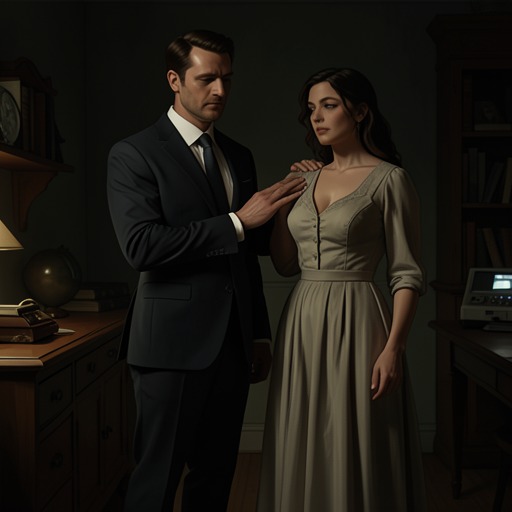
Tanya Stratton and Kris Lamplear
Dr. DeathTanya Stratton and Kris Lamplear are sisters whose affection is expressed through a persistent tension: Kris feels responsible for keeping Tanya safe, while Tanya insists on managing her own life. After their parents’ deaths and Tanya’s treatment for Hodgkin's disease, Kris’s worry has a concrete cause, but she also understands that care can become intrusion. Their relationship is neither estranged nor frictionless; it rests on a close bond negotiated through privacy, independence, and the fear of losing one another.
Family Bond and Shared History
Kris identifies herself as Tanya’s protective older sister and describes the two of them as the family left behind after their parents died. That shared loss gives Kris’s concern its emotional force: she wants to know where Tanya is because there is no longer a larger family to rely on, and she believes Tanya knows how much she worries. Yet Kris does not present their closeness as a license to direct her sister. She can imagine welcoming Tanya into her own home, but she hesitates to ask for comparable access to Tanya’s life.
Their parents’ history is also material and local. They bought several acres in the Malibu mountains years earlier, when their father intended to build a house there; he never did. The land passed into joint ownership by the sisters and contains only a small, run-down cabin. This inheritance gives them a place in common, but does not erase the differences in how they use it or what they expect from one another.
Illness, Care, and Worry
Kris’s concern intensifies after Tanya’s Hodgkin's disease and the treatment that followed. The doctors said the illness was curable and that Tanya had a good chance of being cured, but radiation and chemotherapy were heavy and changed her. Kris says she believes Tanya will be all right, while admitting that she remains protective. Her reassurance does not cancel the worry: Tanya has been through a serious illness, and Kris still wants to know where she goes.
Kris associates time outdoors with Paul Nelson Ulrich’s efforts to help Tanya recover and stay in remission. Paul belongs to outdoor organizations, watches birds, and encourages Tanya to exercise and get up early; Kris characterizes this as his attempt to help her heal. She is not persuaded that outdoor activity can guarantee recovery, but her account shows how closely she watches the people and routines around her sister. The concern is practical as well as emotional: when Tanya and Paul cannot be located, Kris tries to work out where they might have gone.
Independence and Boundaries
Kris repeatedly recognizes that Tanya does not want to be treated as incapable. Even during treatment, Tanya told people she could do things for herself and did not want to be treated like a cripple. Kris remembers this as a durable feature of her sister’s character, not merely a temporary reaction to illness. Her own instinct is to offer support, but she knows that insisting on it could disregard the autonomy Tanya is trying to preserve.
The question of house keys makes that boundary tangible. Kris does not have a key to Tanya’s home and says she would never ask for one, anticipating that Tanya would not take well to the request. At the same time, Kris would be comfortable with Tanya having a key to her own house. The asymmetry is revealing: Kris is willing to make access available, but avoids demanding reciprocal access when she expects it would feel intrusive. Their affection therefore operates less through unrestricted closeness than through Kris’s effort to respect a limit she finds difficult.
The Malibu Property and the Search
The sisters’ shared land in the Malibu mountains is a rare point where Kris’s concern and Tanya’s preference meet. Kris describes the property as roughly five or six acres, with a small cabin, no telephone, an unpleasant bathroom, a tiny septic tank, unreliable electricity, and a road that frequently washes out. She sees little practical appeal in it and says she would have sold it, but Tanya likes the quiet. Tanya went there while recuperating from chemotherapy, perhaps also to demonstrate her toughness, as Kris understands it.
When asked where Tanya might go, Kris suggests Malibu but distinguishes the mountain property from the beach. She gives directions to the cabin, even though she rarely visits it and considers it inconvenient. The place becomes important because Kris knows a preference that might help locate Tanya, not because she assumes she can control her sister’s movements. Once she has shared the information, she worries that Tanya will realize she had been checking up on her. Kris also notes that Tanya listed her as an emergency contact at work, a more formal sign of trust that offers a route to reach her without requiring a house key or constant access.
What the Relationship Reveals
Kris’s conversation with Milo Sturgis and Alex Delaware presents sisterly care as a negotiation rather than a simple rescue. She is anxious about Tanya’s health and whereabouts, knows her habits well enough to identify the mountain cabin as a possibility, and is willing to help others find her. At the same time, she is careful about what she asks of Tanya and expects her sister to protect her independence. The details of the key, the emergency contact, and the cabin give that balance concrete form.
The relationship also supplies a personal measure of Tanya’s recovery: illness has made Kris more alert to danger, but it has not persuaded her that Tanya should be treated as helpless. Kris’s care remains active and sometimes anxious; Tanya’s autonomy remains a boundary Kris tries to honor. Their bond is visible precisely in this effort to stay connected without turning concern into command.