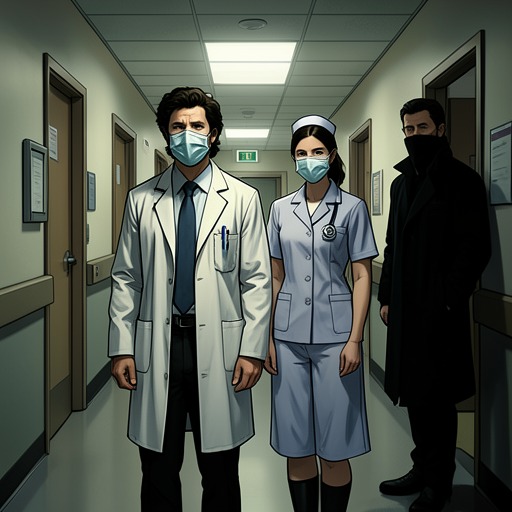
Therapeutic care as a mask for violence
Dr. DeathTherapeutic care as a mask for violence is a recurring ethical tension in the novel: treatment, mercy, and relief can be difficult to distinguish from judgment and harm when one person assumes authority over another’s suffering. The tension is not resolved by medical language or benevolent intent. It sharpens around Joanne Doss’s unexplained decline and Eldon H. Mate’s assisted deaths, then acquires a literal, material edge in a doctor’s bag containing drugs and instruments. The question is not simply whether an act is called care, but who defines the need, who makes the decision, and what that decision hides.
Care, illness, and contested explanations
Richard Doss describes Joanne’s illness as a long failure of modern medicine. He recalls her joint pain, headaches, skin sensitivity, and fatigue, followed by social withdrawal and prolonged periods in bed. Her weight rose from 110 to 210 pounds in less than a year. Richard says that doctors subjected her to extensive tests, including scans and lumbar punctures, without finding a cause. The account makes care visible as a sequence of medical investigations, but it also places Joanne’s experience within her husband’s interpretation of it: he presents her disengagement and eating as defining features of her decline, and admits that he came to feel she was no longer his wife in practical terms.
The difference between the illness as lived and as interpreted becomes especially stark in a washed-out Polaroid. Joanne appears in a king-size bed among piled pillows, her face swollen and features compressed. The image records a body transformed, while the description alone cannot explain why it changed. Later, Alex Delaware examines laboratory records from fifteen doctors, including blood work, urinalysis, X-rays, scans, and the lumbar punctures Richard mentioned. The operative result is negative. That finding establishes that the tests did not identify a cause; it does not make Joanne’s suffering unreal. Against this uncertainty, Richard’s diagnosis of psychological withdrawal and his claim that psychiatric treatment might have saved her stand as a family judgment, not a medical conclusion demonstrated by the records.
Mercy as a family inheritance
For Guillerma Salcido Mate, care and the end of suffering are bound together by the memory of her father’s death. She recalls that he developed lung cancer after smoking throughout his life; the disease spread to his bones and spine, and he died in severe pain. She says that the experience made a deep impression on Eldon H. Mate. She had once imagined becoming a registered nurse and working alongside him, but, after he left her and Donny, she had to keep working and did not finish school. Her later work caring for elderly people gives her a practical understanding of nursing, while her religious conviction offers a different account of what makes life bearable. Her recollection supplies a compassionate history for Mate’s interest in ending suffering without proving that every later act of his was compassionate.
Alex Delaware recognizes the ethical force of relief from pain through his own experience on a hospital committee dealing with children in final-stage illness. He remembers that physicians and nurses sometimes gave a slightly larger dose of morphine to dying children, who then stopped breathing after their parents had said goodbye. He can understand such acts as compassion toward patients who were already dying and families facing a painful vigil. Yet he distinguishes that memory from Mate’s use of the Humanitron, which he associates with gloating and publicity. The contrast does not settle the moral question by technique alone; it turns on the gap Alex perceives between relieving another person’s suffering and taking satisfaction in exercising the power to end it.
The language of humane intervention
Other characters use the language of mercy in ways that expose how readily it can close down inquiry. Stacy Doss describes the family dog as sick and says putting it out of its misery was humane, something people do routinely. Eric Doss had never told her before that he had done it; when he finally did, she says, he laughed about it. Her account does not establish that ending an animal’s suffering is inherently cruel. It shows how the same justification can carry different emotional meanings, and how laughter and delayed disclosure unsettle the assurance that an act described as merciful is therefore uncomplicated.
The family’s responses to uncertainty also connect care with control. Stacy describes her father as driven to anger when confronted with what he cannot control, a pattern she calls a masculine impulse to crush the problem. When Joe Safer asks whether Eric poses a danger to himself or others and raises the possibility of a seventy-two-hour hold, Alex acknowledges that the risk may exist but refuses to make that determination for him because of his conflict of interest. The exchange makes restraint part of ethical care: intervention may be necessary, but the person with compromised professional judgment should not claim the authority to impose it.
Medical objects and concealed violence
The idea acquires a physical counterpart after Paul Ulrich is shot at the cabin of Tanya Stratton. A later search finds little of evidentiary value beyond an old, burnished leather doctor’s bag marked with Eldon H. Mate’s initials. Tanya says she has never seen it; Alex believes Ulrich kept it hidden and brought it out only when he was ready to use it. Inside are scalpels, scissors, needles, gauze, hypodermic injectors, and small ampules. Among the labeled drugs are thiopental and potassium chloride. Their presence connects recognizable medical equipment to a lethal context, although the discovery by itself does not establish precisely how every item was used.
The cabin scene also complicates any assumption that care is legible from a caregiver’s manner. Tanya had met Ulrich while she was in hospital receiving chemotherapy; he volunteered there and spent time with her, including feeding her ice chips when she could not keep food down. She questions what motivated his attention but says that Tanya makes her own decisions, leaving open the distinction between suspicion and proof. In the aftermath of Ulrich’s death, Milo Sturgis finds more than a hundred pieces of jewelry in one box in Ulrich’s storage locker, some traceable to dead people and others not. The objects do not explain the motives behind his acts, but they make the image of the helpful medical volunteer harder to accept as a complete account.
Ethical significance
The novel places compassionate practices, unresolved illness, family explanations, and lethal instruments beside one another rather than treating medical care as automatically benign or assisted death as automatically equivalent to murder. Its evidence repeatedly limits certainty: Joanne’s tests are negative, the family’s explanations conflict, and the doctor’s bag is incriminating without clarifying every use. That uncertainty is central to the concept. A claim of mercy can express genuine attention to suffering, as the recollections of the dying children and Guillerma’s father suggest; it can also become a means of imposing one person’s judgment on another or concealing violence. Care is most ethically trustworthy here when it remains answerable to the suffering person, acknowledges what is not known, and recognizes the limits of the caregiver’s authority.