Zero Tollrance
Dr. DeathZero Tollrance is the artist identity adopted by Donny Salcido Mate, the estranged son of Eldon Mate. His painting of Eldon as both the anatomist and the body on the table brings the murder investigation into contact with Donny’s own history: a life of unstable drifting, anger, and art repeatedly offered to a father who rejected him. The work is at once a possible crime-related clue and a starkly personal image of their relationship.
Identity and Introduction
The name Zero Tollrance first appears in connection with an unsigned oil painting left at the rear door of Primal Images, an art gallery on Colorado Avenue in Santa Monica. Wrapped in brown paper, it was described as a copy of Rembrandt’s The Anatomy Lesson, altered so that the murdered Eldon Mate occupied both roles: the cadaver being dissected and the dissector examining him. The gallery owner, Grant Kugler, considered it competent but not masterful, and wondered why it had been left there. The painting’s resemblance to details of the crime scene drew police attention, and it was taken into custody.
The artist’s identity initially remained uncertain. A follow-up inquiry into a Colorado exhibition found that no one knew Zero Tollrance, no lease existed for the industrial building where the show had been held, and the artist may have been squatting there. The critic who had written about the exhibition recalled a man who looked like a bum, did not speak, pointed to his canvases, and walked away. He had taken Tollrance for a nut and classified the work as outsider art. The critic had seen little audience interest, no buyers, and never heard from the artist again; the fate of the other paintings was unknown.
The Painting and the Investigation
When the painting was examined in the Robbery-Homicide room, its subject was unmistakable. In muted browns and blacks, with only a slight wash of pink at the dissected arm, the composition recast Eldon as both the soft-faced corpse and the black-robed dissector. Seven elaborately dressed men looked down at the body with academic detachment. The painted dissector probed the torn arm with a scalpel, wearing an expression of boredom.
The contrast with Rembrandt’s original sharpened the violence rather than softening it. The copy’s angry, swirling brushwork and thick impasto made the scene feel blunt and forceful; sharp peaks of paint rose from the canvas. Its image also echoed the murder scene closely enough to prompt questions about who had made it and why it had been abandoned. Its artistic limitations did not make it less revealing: even a middling talent had made the double likeness clear.
The investigation considered several possibilities before identifying the artist. One was that Tollrance was simply a starving artist using a notorious murder to revive a stalled career. In that scenario, the painting was a publicity stunt, and an appearance on television with an agent or publicist would have supported the explanation. Another possibility was that the bearded man Mrs. Krohnfeld had chased away was Donny Salcido Mate. The prospect that the artist was Eldon’s son connected the painting’s familial subject to the case, but at first it remained a possibility rather than an established fact. The painting’s presence in police evidence kept both its physical resemblance to the crime and its uncertain purpose in view.
The Artist Revealed
The identification comes through Alex Delaware’s recognition of Donny’s other artwork. When Alex names The Anatomy Lesson and the other masterpieces as Zero Tollrance’s work, Donny’s body jerks, but he does not answer. Alex then offers an interpretation of the chosen name: Donny has zero tolerance for stupidity and does not suffer fools. The explanation links the pseudonym to a combative, uncompromising disposition, though it is Alex’s reading of the name rather than a statement Donny confirms. Donny whispers something, but the words are not made clear.
The later view of Donny at Hollywood Mercy places that silence beside a more explicit, if still complicated, assessment. He is asleep, breathing evenly, and appears at peace in that moment. Alex nevertheless leaves with a divided impression: Donny is assaultive and deeply disturbed, but also bright and manipulative, combative and pigheaded. The account does not reduce him to one of those qualities. His evident artistic ability coexists with instability and antagonism, while the calm of sleep briefly contrasts with the anger associated with his waking life.
Father, Rejection, and Repeated Images
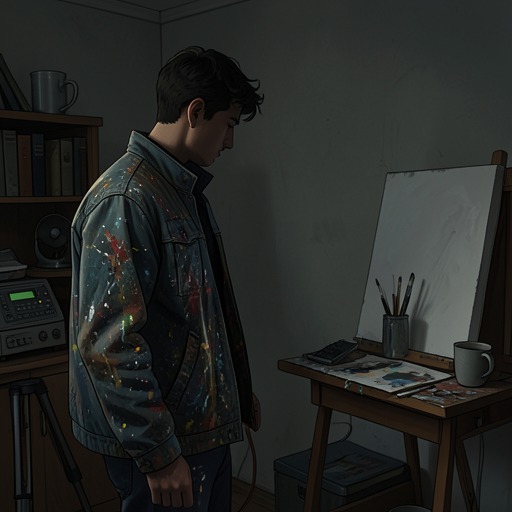
Donny’s art is bound to his estrangement from Eldon. He had turned himself into a walking canvas and drifted from squat to squat, numbing his pain with drugs, anticonvulsants, anger, and art. He painted his father’s portrait again and again, offering his best work and receiving rejection over and over. The repeated act gives the painting’s double figure a personal force beyond its reference to the murder: Eldon is not only the victim represented on the table but also the artist’s chosen subject and the recipient of an unanswered offering.
That repetition clarifies why the identity behind Zero Tollrance matters. The painting’s harsh depiction can be read through its opposition of roles: Eldon appears as both the object exposed to dissection and the figure wielding the scalpel. The composition does not, by itself, establish Donny’s part in the murder or explain why the work was left at the gallery. It does establish that the artist’s attention returned to his father, and that this image of Eldon entered the investigation as a concrete object bearing both crime-scene echoes and the marks of a long, rejected artistic address. Zero Tollrance therefore becomes more than an anonymous outsider artist: the name conceals a son whose recurring portraits make art the means by which he keeps offering himself to a father who will not accept him.