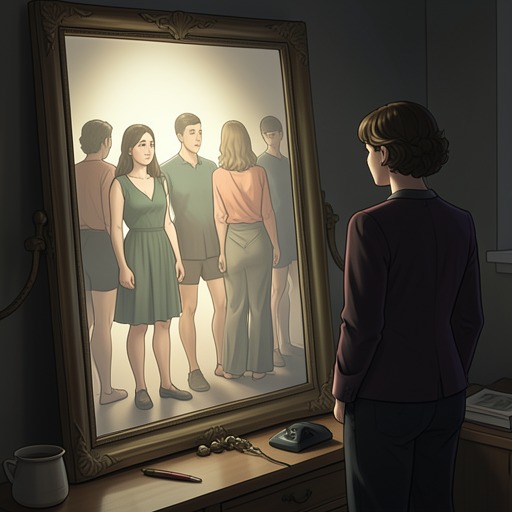
“Beautiful and fat”
Dumplin'“Beautiful and fat” is the central contradiction Willowdean Dickson begins to challenge: the assumption that fatness and beauty cannot describe the same person. The phrase gathers the book’s tension between naming her body plainly and seeing it through other people’s judgments. Its force lies not in a settled confidence, but in the possibility Willowdean tests—in intimacy, in front of a mirror, and under the pageant lights—that neither word has to cancel the other.
Naming the Body
Willowdean resists the discomfort attached to the word fat by using it herself. She reasons that her body is the first thing people notice, and that fat describes her as directly as other visible features describe other girls. The difficulty is not that the word is inaccurate; it is that listeners respond as if it were an insult. Her declaration, “I am fat. It’s not a cuss word. It’s not an insult,” distinguishes description from condemnation and refuses to let other people’s unease determine the terms of her self-understanding.
That insistence coexists with a wry defense of her shape. When the polyester work pants will not stretch over her hips, Willowdean blames the garment rather than treating her hips as a nuisance. She imagines that, in 1642, wide birthing hips might have been worth many cows. The joke makes room for a different valuation of a body that clothing is built not to accommodate: the pants fail to fit, but the failure need not define her hips as a defect.
Images That Make Fatness a Problem
The phrase gains its stakes from the narrow roles Willowdean sees assigned to fat people on television and in movies. She says those portrayals allow a fat character to appear only as someone miserable with herself or as a jolly best friend, and insists she is neither. Watching an MTV weight-loss program about Priscilla, a teenager from Bridgeport, Connecticut, she sees the show frame ordinary activities such as walking and eating as evidence of a problem to be corrected. Its title presents hatred of a fat body as the premise of transformation.
The program’s scenes turn that premise into spectacle. Priscilla is pushed through a school-track workout until she vomits on the bleachers in front of the boys’ soccer team. When she refuses to enter a gym, the trainer insults her; Priscilla cries that she wants to be healthy but also happy. Willowdean stays to see what happens, even as the show unsettles her. She does not have to look at her mother to know that her eyes are watering: the moment when Priscilla is urged to stop standing in the way of becoming thinner is her mother’s favorite part of a weight-loss show. The scene reveals how readily a demand for thinness can present itself as encouragement, even inside Willowdean’s own home.
Desire and the Question of Both
The phrase becomes intimate when Bo Larson tells Willowdean that she is beautiful and speaks of the connection he feels with her. His affirmation does not instantly erase her fear that her body will remain a reason for other people to whisper. As he meets her on the sloping driveway, she hears his praise, but her own thought answers with the word fat. The question that follows—whether she can be both—registers the gap between being told she is beautiful and being able to believe that fatness does not disqualify her from beauty.
Willowdean touches Bo Larson’s cheek and kisses him again, but she cannot make the kiss into an uncomplicated resolution. She says she cannot continue, knowing that her refusal concerns more than just the two of them, and leaves with her bag while he remains in the driveway. The moment makes the expression a live conflict rather than a slogan: his desire offers one answer to the judgment she anticipates, but it cannot by itself settle her struggle with that judgment.
The Body in Public
At the pageant, Willowdean’s attention fixes on her thighs: their cellulite, the way they rub together, and the chafing that follows. She can be forgiving of her general softness and still find herself distressed when she sees her naked body in a mirror. The passage makes clear that self-acceptance does not require pretending discomfort has vanished; her body can remain a source of frustration even as she refuses the conclusion that it should be hidden.
When her turn comes in the swimsuit round, Willowdean takes a breath and smiles, remembering her mother’s encouragement. She says she may be uncomfortable, but she will not be ashamed. Unlike the earlier day at the pool, she does not hurry away: nobody boos, the audience does not go blind, and the world does not end. Her conclusion is practical as well as defiant: a swimsuit is not a prize that a person must earn by meeting a beauty standard. The public appearance does not make every private doubt disappear, but it lets Willowdean test the possibility contained in “Beautiful and fat” with her body visible, rather than waiting to feel perfectly confident before she takes her place.