Amanda Lumbard
Dumplin'Amanda Lumbard is a friend of Millie Michalchuk who enters the Miss Teen Blue Bonnet Pageant with her and turns a skill associated with ordinary play into a striking talent performance. Her uneven legs and corrective shoes attract attention and invite ridicule, but they do not define the limits of her interests or abilities. The novel gives her both the experience of being stared at and the space to act with humor, curiosity, and unmistakable athletic command.
Identity and Background
Willowdean Dickson first sees Amanda Lumbard and Millie Michalchuk as a conspicuous pair whom other people might target for mockery. Amanda’s legs are uneven, and as a child she limped before she received corrective shoes; with each step, her hips moved up and down. Willowdean remembers that Amanda did not seem bothered, even as other people stared. The ridicule nevertheless followed her: Patrick Thomas compared her thick shoes to Frankenstein. The nickname exposes how quickly a visible aid can become a pretext for turning someone into a joke, while Amanda’s own apparent composure resists the idea that observers get to define her experience for her.
Amanda Lumbard’s clothes often connect her to daily life rather than pageant polish. At Harpy’s Burgers & Dogs, she wears soccer shorts and a T-shirt bearing an image of her younger brother in his Little League uniform, the sort of shirt a parent might wear to a child’s game. When she comes to sign up for the pageant, she is concerned that her mother will be angry if she is late picking up her brother. The detail situates her participation alongside ordinary family responsibilities, rather than presenting the contest as the only thing in her life.
Friendship and Social World
Amanda Lumbard and Millie Michalchuk move through Clover City together, and their friendship is visible in the small gestures surrounding the pageant: Millie is nearby when Amanda signs up, encourages her before the talent audition, and pats her on the back as she prepares to perform. Their closeness does not mean that they are identical. Amanda’s interests and particular strengths emerge in her own choices, especially her determination to build a talent around soccer.
Amanda also joins Willowdean Dickson and Hannah Perez in the group that gathers around the contestants. At Frenchy’s, when they discuss possible talents, Amanda describes wanting to do something with soccer, perhaps a trick. She is not on a team; she kicks the ball around with her brothers. The distinction matters: her talent grows from something she enjoys and practices informally, not from a credential or an established place on a team. She bounces her legs so vigorously while talking that the table shakes, an energetic physical detail that contrasts with the assumptions others might make from her corrective footwear.
Her curiosity also comes through during the group’s visit to The Hideaway. Seeing men she assumes are gay prompts Amanda to wonder how they get their eyebrows so perfectly shaped. The question is comic, but it also records her entering a world that feels unfamiliar to Willowdean Dickson, who reflects on how small her own experience has been. Amanda’s response is direct and inquisitive rather than fearful; she looks closely at the people around her and asks what she wants to know.
Entering the Pageant
Amanda Lumbard joins Millie Michalchuk and Willowdean Dickson in deciding to sign up for the Miss Teen Blue Bonnet Pageant. At the registration scene, Amanda is already thinking about the practical consequence of being late to collect her younger brother. Her participation therefore begins not as an abstract declaration but as a choice she fits into the demands of her everyday life.
The group later discusses what each contestant might contribute. Amanda suggests a soccer-based trick, and Millie identifies her soccer moves as a strength when she wears corrective cleats. Millie’s way of framing the contestants emphasizes ability rather than a single ideal of pageant perfection: Amanda has something particular to offer, even if her performance does not resemble a conventional singing or dancing act. Amanda’s talent idea is not presented as a way to conceal her legs or footwear. Instead, it makes her practiced control of the ball the center of attention.
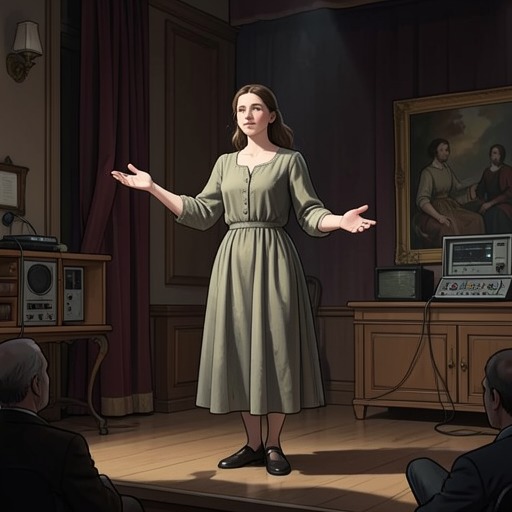
At the audition, Amanda Lumbard steps onstage in more athletic-looking shoes. Their heels remain thicker on one side, so the footwear still registers as adapted to her body, but it also belongs naturally to the soccer performance she is about to give. She retrieves a ball from a duffel bag and begins without a lengthy introduction. Dribbling it between her knees, heading it, and kicking it over her head, she keeps the ball from touching the ground. Willowdean Dickson recognizes that Amanda is doing something she herself could not manage, despite having legs of equal length. Amanda finishes, tucks the ball beneath her arm, collects her bag, and walks offstage. The sequence shifts attention from the shoe that once furnished a cruel nickname to the remarkable coordination of the person wearing it.
Access, Confidence, and Recognition
Amanda Lumbard’s pageant experience includes limits that the contest’s conventions make visible. During training, she thanks Lee Wei for helping the contestants and adds that she cannot wear heels. Lee Wei answers that heels are unnecessary because Amanda is already fierce on her own. The exchange does not erase the practical restriction or pretend that conventional pageant expectations fit every body. Instead, it contests the assumption that a contestant must meet those expectations in order to possess confidence and presence.
A later visit to Millie Michalchuk’s house offers a quieter instance of how footwear shapes other people’s attention. Amanda is barefoot, and Willowdean Dickson realizes that it is the first time she has seen her without her platform shoes. Willowdean tries to keep her eyes on Amanda’s face rather than stare. The moment echoes the childhood memory of people watching Amanda limp, but changes the emphasis: the scene registers Willowdean’s awareness of how looking can become intrusive, even when it comes from concern rather than mockery.
Narrative Significance
Amanda Lumbard’s story places disability and social judgment in ordinary settings: a shirt with her brother’s baseball image, soccer played with her brothers, a hurried trip to sign up, and shoes that change with the demands of a performance. The novel does not make her physical difference disappear when she excels. Her athletic talent is performed in shoes adapted to her uneven legs, and the pageant’s high-heeled convention remains a real constraint. Lee Wei’s encouragement matters precisely because it rejects that constraint as a measure of Amanda’s worth.
Her arc also widens the pageant’s idea of what can count as a talent. Amanda does not simply take part in a contest organized around conventional presentation; she brings an individual skill onto its stage and makes the audience watch what she can do. Across the book, other people’s labels and stares remain part of her surroundings, but they do not supply the final account of her. Her soccer performance does: focused, inventive, and controlled, it replaces the insulting nickname with a fuller view of Amanda as an athlete and friend.