Beauty standards and body image
Dumplin'Beauty standards and body image are not abstract concerns for Willowdean Dickson: they affect what she can wear, how she understands other people’s attention, and whether she feels entitled to be seen in public. The novel holds two truths together. She rejects the idea that fatness is an insult or a reason for exclusion, yet still struggles with her own body and the judgments attached to it. Her pageant participation turns that tension into a visible challenge to the assumption that confidence, beauty, and public display belong only to conventionally thin girls.
Naming the Body and Living in Clothes
Willowdean’s refusal to treat fat as a slur begins with the plainness of the word itself. She reasons that her body is the first thing many people notice, and that fat describes her more accurately than the euphemisms people reach for when the word makes them uncomfortable. Saying it herself is a way to take control of its meaning: it is neither a curse nor an insult simply because others react to it as one.
That self-description coexists with the ordinary material frustrations of getting dressed. At work, Willowdean has the option of wearing polyester pants, but their elastic waist will not stretch over her hips. She blames the pants rather than treating her hips as a defect, joking that in 1642 wide hips might have been worth many cows. The joke does not erase the garment’s failure to fit; it changes the direction of blame, from her body to clothing made without room for it.
Media and the Promise of Transformation
Television offers Willowdean a narrow set of roles for fat girls. Watching an MTV weight-loss program, she recognizes its framing before the story has properly begun: the featured teenager is presented as unhappy, teased, and in need of transformation. Willowdean resents the implication that a fat person on screen must either be miserable with herself or serve as the jolly best friend. Neither role describes her, and the program’s treatment of an ordinary girl’s body as a problem to solve makes the limits of representation conspicuous.
The episode’s emotional machinery also reaches into Willowdean’s home. Her mother especially likes the moment when the participant is urged to stop resisting and become her thinnest self. As the program escalates from a trainer’s pep talk to a workout that leaves the girl vomiting in front of a boys’ soccer team, its promise of improvement is entangled with humiliation. Later, the trainer’s anger at the girl’s reluctance to enter a gym reduces her complicated feelings to an obstacle. The scene sharpenes Willowdean’s awareness that health and happiness are not interchangeable measures, and that a body judged from outside can be made to seem like proof of a person’s failure.
Attraction, Confidence, and the Mirror
Willowdean’s ideas about confidence become less secure when Bo Larson’s interest makes her newly conscious of being seen. She is struck by the fact that Bo did not flinch when she called herself fat, and likes his lack of visible recoil. Yet being liked does not settle how she feels about herself. She had assumed that another person’s acceptance would make self-acceptance easier; instead, Bo’s attention intensifies her awareness of her fatness and stretch marks. She can tell herself that they do not matter and still know that they matter to her.
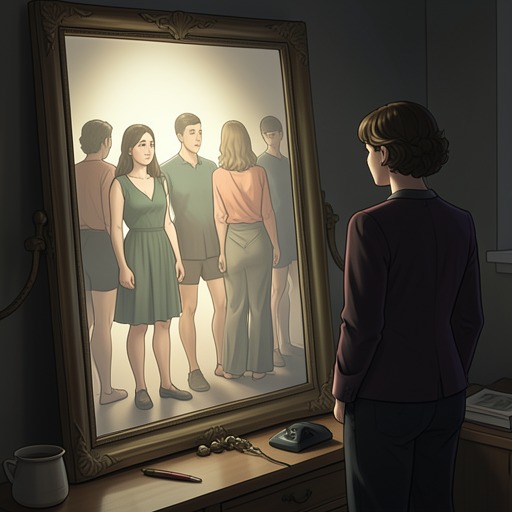
That instability surfaces during pageant preparation. Millie Michalchuk identifies confidence as Willowdean’s strength, but Willowdean cannot simply inhabit the compliment. If confidence is something she performs without feeling, it seems hollow; if her feelings shift from satisfaction in her body to distress about it, neither state cancels the other. The novel does not present self-acceptance as a settled achievement. It shows the work of holding pride and insecurity at once, without allowing insecurity to prove that the body deserves shame.
The Pageant and the Demand to Be Seen
The pageant makes appearance an explicit public measure. Willowdean explains that its components include evening dress, talent, interview, and swimsuits, while her own fears concentrate on becoming the fat contestant who falls or fumbles through a magic trick. She does not expect to win, and says that winning is not her aim. She wants to demonstrate that her body does not make participation improper or impossible. The distinction shifts the stakes: entering is not a claim that the pageant’s standards are fair, but a refusal to let those standards decide who may appear on its stage.
The criticism she receives shows how readily appearance is treated as a moral obligation. Callie tells Willowdean that taking better care of herself would make a difference, then insists that the pageant is not a feel-good project in which effort earns approval. Afterward, Willowdean wonders whether losing a hundred pounds would make her life fall into place. The exchange makes the pressure more than a matter of taste: it offers thinness as a solution to unrelated difficulties and frames participation by a fat girl as something that must be justified by exceptional effort.
That pressure also enters the fitting of Willowdean’s red pageant dress. Her mother admits that she expected Willowdean to slim down and refuses to approve the dress because it is too snug, calling it inappropriate. Willowdean answers that the dress makes her feel like someone she did not know she could be. Her objection is not merely that the garment fits imperfectly; it is that her mother’s response turns her body into a source of pity and makes weight loss a condition of taking the pageant seriously. In defending how she feels in the dress, Willowdean claims authority over her own appearance even as the conflict leaves her mother behind in a room marked by her former pageant identity, sash, crown, and sea-foam dress.
The Swimsuit as a Countermeasure
The swimsuit round brings the conflict into the open. Watching Ellen Dryver walk out in a green two-piece, Willowdean looks down at her own red suit stretched over her round belly and names her particular insecurity: her thighs. Her language moves through a string of disparaging comparisons before arriving at the physical discomfort of the skin rubbing together. This specificity matters. Refusing the idea that an entire body should be hated does not mean she has no painful, intimate judgments about any part of it.
When her turn comes, Willowdean remembers her mother’s encouragement to smile. She is uncomfortable, but refuses to be ashamed. She does not hurry off the stage as she once did at a pool; nobody boos, the audience does not go blind, and the world does not end. Her passage through the swimsuit round does not make the insecurity disappear. Instead, it separates discomfort from disqualification: a person can dislike part of her appearance and still show her body without apologizing for its presence.
The novel’s central counterstatement is practical rather than dependent on winning approval. Swimsuits are often treated as garments a person must earn the right to wear, but the stated criterion is simply having a body. That principle gathers the earlier conflicts into one gesture: clothing should fit people rather than serve as proof that their bodies are wrong, public visibility need not be reserved for a single ideal, and refusing shame can be meaningful even when self-doubt remains.