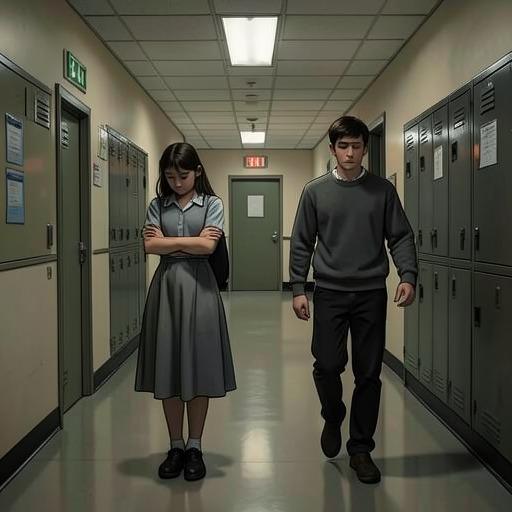
Clover City High School
Dumplin'Clover City High School is the setting where Willowdean Dickson’s everyday routines repeatedly collide with the town’s public ideals. Its classrooms, halls, and student gatherings are not merely backdrops: they make relationships visible, give social customs an audience, and bring the pressures of football and pageant culture into ordinary school life.
Setting and Social Order
Willowdean describes Clover City as a town whose lifeblood is football and the pageant. Football players attract attention and, sometimes, the interest of scouts; the pageant carries comparable importance. In her view, both can make the town feel larger than itself: the stadium lights and the moment a pageant curtain opens allow residents to see themselves at their best. Clover City High School sits within that shared culture, where athletic standing, pageant participation, and student reputation meet.
The school’s social order is visible in the way stories about successful football players circulate. A player’s reputation can become a subject of conversation even among students who are not part of the team. Patrick Thomas’s association with a well-regarded football player is enough to matter in such talk, while his own hostility makes him a source of anxiety for other students. School life thus links public prestige with the less celebratory business of navigating peer judgment.
Classrooms and Daily Routines
At the start of the semester, Willowdean waits outside second period for Ellen Dryver, the only class they share. Ellen arrives late, and the two remaining seats are separated: one beside Callie, Ellen’s coworker, and the other at the long table at the back beside Mitch Lewis. Willowdean takes the seat near Mitch. The teacher then announces that the seats will be assigned for the semester, turning an unplanned choice into a fixed arrangement. Ellen apologizes afterward; the seating rule means that even their one shared class will not place them together.
The assigned seat brings Willowdean and Mitch into closer proximity during class. They recall having shared a classroom in sixth grade with Mrs. Salisbury, a teacher they both remember. Willowdean remembers Mitch for asking questions that classmates treated as silly, while Mrs. Salisbury answered them seriously and made their value apparent. The recollection gives their new seating arrangement a history: the school is a place where old impressions can return, even as students meet one another again in changed circumstances.
The school day also intersects with family and work obligations. Willowdean’s mother drops her at the carport, where freshmen and other students without cars gather, then asks her to arrange a ride home because she has a pageant meeting. Later, Willowdean has to weigh time at school and with friends against a shift at Harpy’s Burgers & Dogs. The school’s routines therefore sit alongside the demands of work and the pageant season rather than replacing them.
Football, Pageants, and Public Courtship
The school sustains traditions that turn ordinary social choices into public performances. The Sadie Hawkins Dance is especially prominent. Girls are expected to ask boys, but the invitation has become a contest in elaboration as well as courage. Willowdean recalls that three years earlier Macy Palmer used the Twelve Days of Christmas, arranging a different gift or performance for each day. After that display, a simple plate of cookies or a shirt bearing a football number seemed inadequate by comparison. The custom makes asking someone to a dance both a personal risk and a spectacle for classmates.
This year, Willowdean is so absorbed in everything happening around her that she fails to notice the banners and signs announcing ticket sales. After hours of elaborate proposals, Bekah Cotter performs for a crowd with a baton and gymnastic movements. Glitter-painted letters on the pockets of her shorts identify Bo Larson as the boy she is asking. His classmates push him to the front; he accepts Bekah’s hand, and Willowdean sees the moment as the start of their public pairing. The scene turns the school’s performance culture into a painful personal encounter: the audience watches a dance invitation, while Willowdean registers what Bo’s choice means for her.
The pageant also appears in the school’s social atmosphere. Bekah’s talent is discussed as an advantage in the competition, and Willowdean watches her perform with the judgment of someone who knows that the school’s public displays and the town’s pageant standards are connected. Pageant season reaches into school conversations and relationships, while the dance provides another stage on which students can display confidence and claim attention.
Conflict and Visibility
Clover City High School is also where bullying becomes difficult to ignore. Patrick Thomas directs ridicule at students including Millie Michalchuk and Amanda Lumbard: he makes noises at Millie outside her car and mocks Amanda’s corrective shoes. Willowdean understands that students often avoid challenging him, and remembers that even Hannah Perez, who can be rough-edged herself, does not stand up to him. The school’s social environment allows his nicknames and insults to gain force because other students know how readily they can stick.
When Patrick uses Willowdean’s pet name as a taunt, she walks toward him rather than retreating. She is surprised by her own response and recognizes it as a physical act of self-defense, not the speech she had imagined delivering. The encounter makes the school a place where a name that might be affectionate at home can be turned into public humiliation—and where Willowdean’s refusal to accept that humiliation changes how she acts among her peers.
A Place Where Private Change Becomes Public
The school’s importance lies in how closely it brings different parts of Willowdean’s life together. A seating chart alters her daily contact with Ellen and Mitch; a transfer slip brings Bo into her World History class for the rest of the year; a dance proposal makes a change in her relationship with Bo visible before she can privately process it. Hallways, classrooms, and student gatherings repeatedly turn personal uncertainty into something witnessed by others.
That public quality is especially sharp because Clover City’s school culture offers both belonging and exposure. Football and pageants give the town shared rituals and a sense of collective pride, yet the same attention can intensify comparison, gossip, and ridicule. For Willowdean, Clover City High School is therefore a central arena of growing up: a place where she encounters old friendships, new affiliations, and the pressure to be seen on terms set by other people.