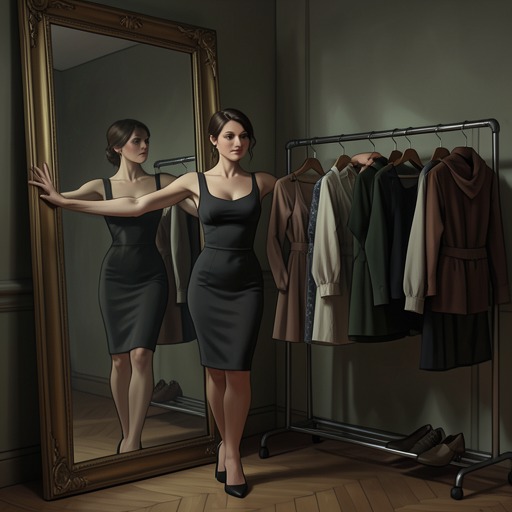
Conventional Beauty Standards and Exclusion
Dumplin'Conventional Beauty Standards and Exclusion operate in Clover City not only through pageant expectations but through everyday judgments about bodies, clothing, television, and romantic desirability. For Willowdean Dickson, the standard is both external and intimate: she recognizes that fatness is the first thing many people notice about her, yet refuses to treat it as an insult or as proof that she should disappear. Her eventual appearance in the pageant’s swimsuit round makes that refusal public, without pretending that confidence has made self-consciousness vanish.
A Standard Enforced Through Ordinary Life
The pressure to be thin appears in practical details before it becomes a formal contest. At work, Willowdean cannot fit into the available polyester pants because their elastic waistband will not stretch over her hips. She blames the garment rather than accepting that her body is a nuisance, and imagines her wide hips as an asset in a different historical economy. The joke gives her a moment of control over a situation in which clothing has been designed around a narrower body. It also reveals how standards become material: a supposedly ordinary uniform can mark whose body the available options accommodate and whose it does not.
Willowdean’s account of naming herself fat makes the conflict explicit. The word describes what people see, she observes, but it makes them uncomfortable in a way that descriptions of other bodily features do not. She uses the word herself to forestall that discomfort and rejects its automatic conversion into an insult. This is not a claim that other people have stopped judging her, or that she is unaffected by their judgments. Rather, it is an effort to separate a physical description from the shame conventionally attached to it.
Media and the Promise of Transformation
Television supplies a particularly stark version of the thinness ideal. Willowdean recognizes the pattern in a program that introduces Priscilla, a fat teenager, through a story of ridicule and dissatisfaction, then presents weight loss as the anticipated solution. The show’s title frames her body itself as the problem before viewers know what she wants. Willowdean objects to the limited roles available to fat girls on television: they are shown either as miserable about themselves or as cheerful supporting characters. She identifies herself with neither role, exposing how representation can confine a person even when it appears to make that person visible.
The program’s transformation narrative also affects Willowdean’s mother. Her mother’s eyes water during the moment that promises a participant will stop obstructing her own progress toward thinness; Willowdean knows this is her favorite part of weight-loss shows. That reaction connects the television spectacle to family history. Her mother had been large as a girl before losing weight ahead of ninth grade, while Lucy remained large. Willowdean does not know exactly why her mother stopped dieting when Willowdean reached middle school, but suspects that Lucy’s experience mattered. The contrast suggests that thinness is not simply a neutral health goal in the family’s story: it is bound up with different bodily outcomes and with the pressures attached to them.
Exclusion in Public and Private Relationships
Beauty norms also shape who is imagined as a plausible romantic partner. In conversation with Hannah, Willowdean acknowledges that she believes Bo Larson likes her, yet fears that other people will not understand what he sees in her. Hannah points to the way someone such as Patrick Thomas could turn their relationship into a spectacle. Her warning identifies exclusion as social enforcement: the anticipated judgment of others can make a relationship feel difficult to claim even when mutual affection is believed to be real.
Hannah does not respond with easy reassurance. She understands that people who stand outside accepted norms can face different forms of exposure, and argues that participation is necessary if those norms are to change. Fat girls, girls with limps, and girls with big teeth may not usually win beauty pageants, but absence from the contest leaves the usual outcome unchallenged. Willowdean initially answers from the experience of being immediately visible because of her size, while Hannah describes the prejudice attached to her own identity. Their exchange makes solidarity more complicated than assuming that every form of marginalization feels the same; it rests instead on recognizing exclusion and insisting that it should not determine who may take part.
The Pageant’s Gaze and the Body onstage
When Willowdean appears before the pageant judges, their reactions make her difference legible before she has answered them. One judge raises an eyebrow, while two others show similar surprise more discreetly. Willowdean realizes that she is the first of what she privately calls the unlikely suspects. The moment turns an unspoken beauty norm into a visible encounter: she is not merely worried about whether she belongs; the panel’s response gives her reason to see herself as an unexpected contestant.
The swimsuit round brings the standard closer to the body itself. As she watches Ellen Dryver walk out confidently in a green two-piece and espadrilles, Willowdean compares the scene with her own black sandals and red swimsuit. Her sharpest anxiety concerns her thighs, which she describes through several harsh comparisons and through the discomfort of chafing. Her self-acceptance is therefore not presented as complete or effortless. Even while she rejects the idea that her whole body deserves condemnation, she can fix on a particular part of herself with painful intensity.
Visibility Without Shame
At her turn, Willowdean breathes deeply and smiles, recalling her mother’s instruction to smile and not sigh. She remains uncomfortable, but refuses to be ashamed. Unlike the earlier occasion at a pool, she does not hurry offstage; the audience does not boo, and the world does not end. The contrast matters because her progress is measured not by becoming indifferent to scrutiny, but by remaining present while scrutiny is possible.
Willowdean’s principle for wearing a swimsuit is deliberately simple: a person needs a body, not permission earned by meeting a beauty standard. That assertion contests the idea that public display belongs only to those whose bodies already fit the ideal. The pageant cannot be treated as proof that Clover City’s standards have disappeared, and Willowdean’s self-consciousness remains part of the scene. Its significance is narrower and more concrete: she steps into a space organized around conventional beauty without accepting shame as the price of being seen.
Her view of her mother at the pageant offers a related image of imperfection. Rosie Dickson stands in a spotlight while hardware holds the back of her dress together; Willowdean sees her as beautiful and understands the small imperfections as part of the image rather than its negation. The dress that will not zip becomes a counterpoint to the demand for seamless perfection. Together, the swimsuit appearance and this glimpse of Rosie frame beauty less as flawless conformity than as something that can coexist with visible limits, discomfort, and repair.