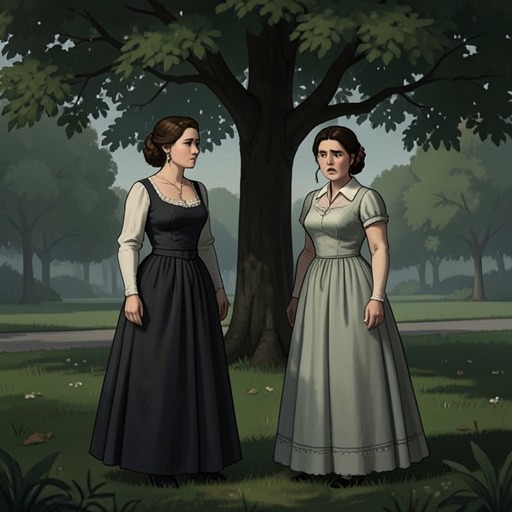
Ellen Dryver and Tim’s relationship
Dumplin'Ellen Dryver and Tim’s relationship is portrayed as a loving partnership that has required adjustment and persists despite other people’s attention. Ellen’s account joins affection to uncertainty: she loves Tim, but closeness did not immediately feel easy. When she explains this to Willowdean, their conversation makes room for the awkwardness of intimacy without treating it as proof that a relationship is wrong. Ellen’s defense of her own choice also helps Willowdean consider whether fear of ridicule should determine what happens with Bo.
Affection and the Learning Curve
Ellen states plainly that she loves Tim, while also acknowledging that becoming comfortable with intimacy has involved a learning curve. Her account does not present love as effortless certainty or physical closeness as something that must feel natural from the outset. Instead, affection and adjustment coexist: she can care deeply for Tim and still describe moments when his touch made her tense and unsure.
When Willowdean asks whether Ellen ever felt unsettled when Tim touched her, Ellen recognizes the experience immediately. She recalls clamming up when he touched her waist or a spot on her chin. The examples are ordinary, brief points of contact, but her reaction to them was strong enough that she remembers them as signs of how unfamiliar closeness could feel at first. The passage does not elaborate beyond that admission; its importance lies in Ellen’s willingness to acknowledge discomfort without using it to invalidate her relationship.
That recognition matters because Willowdean has just described a comparable response to Bo. She enjoyed being close to him, yet shut down when his touch drew attention to parts of her body about which she felt vulnerable. Ellen’s experience with Tim gives Willowdean a way to understand that intimacy can involve both desire and self-consciousness. Their experiences are not identical, and Ellen does not claim they are; she offers a point of recognition rather than a formula for what Willowdean should do.
Public Scrutiny and Private Choice
Ellen’s relationship with Tim is also shaped by the gap between the couple’s own feelings and the judgments of people around them. She points out that Tim is much shorter than she is and says that people laugh at them. The difference in their heights becomes an example of how observers turn a visible feature of a couple into an occasion for ridicule. Ellen does not pretend that other people are kind, but she refuses to make their reactions the measure of the relationship.
Her response is grounded in her own choice. Even if she could choose whom to love, Ellen says, she would choose Tim every time. The force of that statement comes from its repetition of personal decision: the couple’s relationship belongs to the two people in it, whereas the people who laugh remain spectators. Ellen’s distinction does not erase the social pressure Willowdean fears. It puts that pressure in perspective by separating the audience’s opinions from the choices the partners make with each other.
Ellen applies this distinction directly to Willowdean’s uncertainty about Bo. Willowdean fears that making the relationship official would expose them to ridicule at school. Ellen does not promise that such ridicule will stop; she instead argues that other people’s behavior should not be confused with the couple’s own feelings. In her view, loving someone and deciding whether to enter an exclusive relationship are related but distinct matters: affection can be clear even while the decision to define the relationship still belongs to the people involved. Her advice grows from her example with Tim, rather than from an abstract claim that social judgment is harmless.
Confidences and Context
The conversation also clarifies what Ellen’s visible distress means. Willowdean had worried that Ellen’s crying in the hallway signaled trouble between Ellen and Tim. Ellen explains that her parents have been fighting, that her father spent a night on her uncle’s couch, and that he has returned, though she is unsure whether the conflict may end the marriage. She had wanted to tell Willowdean but admits that she had been stubborn and had not done so.
That disclosure distinguishes strain in Ellen’s family from a breakup with Tim. The two subjects arise in the same candid conversation, but the evidence does not identify her parents’ conflict as a crisis in her relationship with Tim. Instead, Ellen and Willowdean each make room for what the other has kept private: Ellen offers insight into her relationship and her feelings about social approval, then explains the family worry behind her earlier tears. Her own experience becomes a source of support, while her disclosure restores context to a moment Willowdean had interpreted as possible romantic trouble.
Narrative Significance
Ellen and Tim’s relationship functions as a lived counterexample to the idea that a couple must satisfy outside expectations to be legitimate. The height difference that invites mockery is precisely the circumstance Ellen uses to show Willowdean that public judgment can accompany a relationship without deciding its value. Her confidence is not based on ignorance of ridicule: she acknowledges that people laugh and still says she would choose Tim.
The relationship’s other significance lies in Ellen’s frankness about adjustment. By admitting that Tim’s touch once made her clam up, she gives Willowdean recognition without minimizing the latter’s discomfort or insisting that affection settles every question. Together, these elements make Ellen’s partnership both an example and a limit: it shows that being judged need not dictate whom someone chooses, but leaves the choice of commitment to the individuals themselves. The passage therefore presents Ellen’s love for Tim not as a guarantee that relationships are easy, but as a commitment she can affirm while speaking honestly about vulnerability, social scrutiny, and the space each person needs to decide.