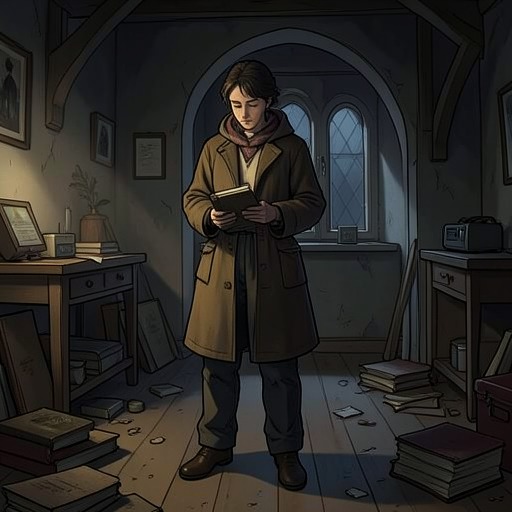
Grief, memory, and the compass motif
Dumplin'Grief, memory, and the compass motif traces how Willowdean’s loss of Lucy persists in ordinary objects, uncertain recollections, and encounters with people who remember her. Lucy had been a guide Willowdean did not know she depended on; after her death, the image of a compass changes meaning. It first names the steadiness Willowdean has lost, then becomes a way to imagine carrying Lucy’s influence forward without needing her to choose every direction.
The Inbox and the Unfinished Record
Late at night, Willowdean sits at her desk with Riot curled in her lap and finds an email from Lucy’s address among the junk mail. The message is only spam about interest rates, but for a moment its sender makes the loss feel newly immediate: Willowdean’s stomach tightens before relief arrives. The account can still produce a message, but it cannot make Lucy present. Willowdean recognizes that other people may also receive junk mail from the dead, a practical thought that helps her settle after the shock.
She logs out of her own account and tries several times before guessing Lucy’s password: DUMBBLONDE9, combining one of Lucy’s favorite Dolly songs with her favorite number. The password is a small, intimate piece of knowledge, evidence of how closely Willowdean knew her aunt even when she could not yet name the importance of their bond. Willowdean intends to shut down the account, but the unopened messages hold her attention. Their accumulated presence makes the inbox feel like a record of lives that continue to leave traces even as their owners are temporary. On the fifth page, she notices a message with the subject DOLLY PARTON NIGHT. The subject line connects Lucy’s account to a world of remembered interests, though the messages themselves do not erase the finality of her absence.
Lucy as a Compass
At the stage door, Dale identifies Willowdean as Lucy’s niece, and Lee immediately takes her hand to offer condolences. Lee remembers Lucy as warm and open-hearted and says that her loss was felt. The exchange matters because Lucy’s memory is not held by Willowdean alone: another person bears witness to the woman she misses. In response, Willowdean gives shape to a grief she has struggled to explain. Lucy had been like a compass she did not realize she possessed.
Lee does not dismiss that dependence or suggest that losing Lucy is a good thing. Instead, Lee gently changes the image: perhaps Lucy was not meant to be Willowdean’s compass forever, but was there long enough for Willowdean to learn how to become her own and find her way. The distinction preserves Lucy’s importance while giving Willowdean agency. A compass is no longer only something absent; it becomes a figure for a capacity that Lucy helped her discover. Lee seals the reassurance with a kiss on Willowdean’s forehead. Willowdean keeps the lipstick mark there, wanting it to remain as a blessing and as the last permission she needs to treat herself as her own role model.
Memory in Fragments
The compass image gives language to a relationship that resists easy labels. Later, while Willowdean is speaking with her mother about her disagreement with Ellen, her mother says that she and Lucy always managed to work things out. The remark places the sisters’ shared history beside Willowdean’s unsettled friendship, but it also sends her searching for a memory of her mother sitting at the foot of her bed. She cannot summon the last time she saw her there. The scene feels less like a recovered recollection than a memory she may have wanted to exist. Her uncertainty shows grief working not only through clear images of the dead, but also through gaps and doubts about what can still be remembered.
Willowdean asks her mother whether she misses Lucy, making the loss a question between them as well as a private sorrow. The question follows her mother’s recollection of the sisters’ ability to resolve their differences. Lucy’s absence therefore touches two relationships at once: Willowdean’s bond with her aunt and her effort to understand her mother’s bond with her sister. The account and the uncertain bedside memory are different kinds of remnants, but neither supplies a complete version of Lucy. They make the limits of memory visible without making the relationship less real.
A Bond Without a Simple Name
Willowdean’s difficulty naming Lucy’s place in her life returns when she talks with Mitch. After spending a day studying with him, she finds comfort in being able to feel simply like herself, rather than being defined as a daughter, a niece, or a token fat girl. That ease also makes her miss Ellen. In this moment, missing Lucy is part of a broader recognition that other people’s categories have often shaped how Willowdean experiences herself, and that she wants to find a sense of self she can inhabit on her own terms.
Willowdean explains her affection for Loraine through the difficulty of locating her in a familiar role: Loraine is not quite a friend or a mother, but something distinct. The comparison leads Willowdean to recognize that Lucy occupied a similarly irreducible place. There is no straightforward term for the relationship, and Willowdean thinks that the lack of one makes the pain of losing Lucy harder to reconcile. The grief is intensified not by a lack of love, but by the absence of a ready-made name that could contain it.
From Remembrance to Self-Direction
The motif gathers force because it does not present independence as forgetting. Willowdean wants Lucy to witness her at the stage, where an embrace from Lee makes the moment feel joyful and absurd; she wishes Lucy could see how she has connected pieces of Lucy’s fragmented life. That desire keeps remembrance active in the present. Lucy is not reduced to a lesson, even when Lee’s advice turns the compass into an image of self-direction.
Across the email, the remembered sisters, Lee’s condolence, and Willowdean’s search for a name for her aunt, grief appears as an ongoing effort to make a life with traces that cannot restore the person who left them. The account offers a password and a subject line, not a reply; memory offers fragments, not a complete portrait. Lee’s blessing supplies no substitute for Lucy. It offers instead a way for Willowdean to carry what Lucy gave her into a direction of her own, while continuing to miss the person who once helped her find it.