Hannah Perez
Dumplin'Hannah Perez is a quiet, stubborn student at Clover City High School whose conspicuous teeth and black clothing make her a target for ridicule. She first enters the Miss Teen Blue Bonnet Pageant intending to disrupt it, but her appearances onstage complicate that hostile pose: she sings with startling emotional conviction, then laughs her way through a fall and throws off her heels. Her story draws attention to the different pressures facing the girls around the pageant, including bullying, social isolation, and unequal access to dental care.
Identity and Background
Hannah is Dominican, a fact Willowdean recalls from an earlier school incident: in fifth grade, Hannah snapped at a teacher who kept calling her African American. An earlier memory reaches back to third-grade art class, when Hannah slapped away a marker Willowdean had taken without asking and insisted on being asked for permission. Even in these brief childhood recollections, she is not simply silent or passive; she defends her boundaries, though Willowdean remembers her as quiet and stubborn.
At school, Hannah’s overgrown bangs, black clothes, and large, crooked teeth are made into material for mockery. A phone image places her school photograph beside a horse with prominent teeth, under a caption that turns her name into a taunt. Students laugh at the comparison, call her hideous, and suggest she should get braces. Willowdean objects, recognizing that Hannah should not have to alter her appearance to make bullies stop. The scene also shows how humiliation travels through a crowd: a phone screen makes the insult easy to share, while the girl shown in it is not present to answer back.
The Pageant and Its Reversal
When Millie says she had tried to recruit Hannah, Millie reports that Hannah refused with an insult. Hannah nevertheless arrives at the registration session after it has begun, asks in a flat tone whether registration is too late, and fills out the form. Her entrance surprises the room, including Willowdean. The change is not presented as a sudden conversion to pageant culture. During a later discussion of possible talents, Hannah jokes about dressing as a horse and trotting across the stage, turning the very comparison used to shame her into a deliberately absurd performance idea.
At a group meeting, Hannah abruptly gets up and leaves. Willowdean calls after her to ask what changed her mind, since she had initially said no. The answer becomes clearer in a later conversation: Hannah says she entered because she wanted to sabotage the pageant from the inside. In her formulation, the contest could make her known not as the girl with buckteeth but as the girl who ruined it. Her plan recasts participation as an act of defiance rather than an attempt to win approval.
That purpose becomes less simple when Hannah’s mother discovers the welcome packet and is proud that her daughter entered. Hannah trails off as she describes her mother’s reaction and what followed. The account leaves her feelings unresolved, but it establishes a pressure beyond her own provocation: the pageant means something to her mother even when Hannah’s stated aim is to wreck it.
Public Performance
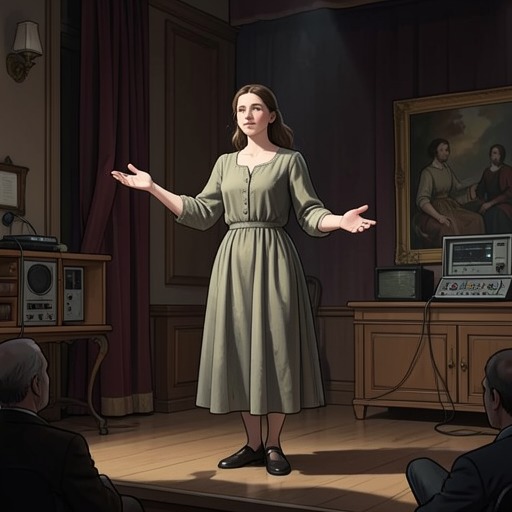
At the talent portion of the pageant, Hannah sings Send in the Clowns, a song Willowdean remembers from Lucy’s record player. Her voice is not described as technically extraordinary; what distinguishes the performance is the seriousness with which she inhabits it. As the music rises, Willowdean stops seeing the familiar sour expression, large teeth, and fading black clothes and instead hears a girl who understands the sadness of the song. When the music cuts off before its fade is complete, the auditorium falls briefly silent and then applauds.
Hannah’s later stage walk is almost the opposite kind of performance. She trips twice, then, halfway through the return walk, tears off her heels and throws them into the empty audience. Rather than hide the falls, she laughs throughout. Willowdean remarks that this is not a side of Hannah she has often seen. The moment does not erase the earlier ridicule or establish that Hannah has stopped feeling its effects; it shows her taking control of the visible mishap by refusing to treat it as a catastrophe.
Relationships, Isolation, and Conflict
Hannah’s defensiveness protects a person who feels she has little protection at school. Willowdean recalls her standing beside the sink in a school bathroom after Willowdean has been washing her hands repeatedly. Hannah turns off the faucet while watching her in the mirror. Willowdean worries that Hannah might reveal her secret involvement with Bo, but also believes that people would not listen to a girl like Hannah. The encounter leaves Willowdean feeling exposed, while its imbalance points to Hannah’s marginal position: the threat of disclosure is shadowed by the likelihood that her words would be dismissed.
Later, at Millie’s house, Hannah is sitting on a lavender beanbag dressed in black and initially does not look up. In a nighttime conversation, she asks about the boy who dropped Willowdean off and recognizes Bo as the boy she remembers from the bathroom. She describes him as attractive even though she says she does not like guys. Her blunt curiosity briefly creates a less hostile exchange between the two girls, without making them close friends or removing the guardedness that shapes their interactions.
When Willowdean asks why Hannah has never had her teeth fixed, Hannah immediately challenges the premise that she should have to. She explains that braces are expensive: her mother is a hairdresser, her father a mechanic, and the family does not have great insurance. Her response makes the social pressure concrete. A demand framed by other students as a simple solution depends on money and access, and would make Hannah bear the cost of their contempt. Willowdean agrees that Hannah should not have to change her teeth.
Hannah says she keeps her claws out because she has no friends like Willowdean’s and no one to walk down the hallway with her. Willowdean disputes the claim, but can picture Hannah at school in black from head to toe, her mouth stretched over her teeth, as if she hopes people might forget. The exchange connects Hannah’s abrasive manner to the isolation it helps conceal without treating that explanation as an apology for every sharp remark. Her humor, anger, and insistence on her own terms coexist with a plainly stated desire for companionship.
Narrative Significance
Hannah’s experiences resist reducing the pageant’s outsiders to one shared story. Her conflict centers not on body size but on her teeth, the expense of orthodontic care, and the public cruelty attached to a feature other students expect her to fix. Her Dominican identity is also present in Willowdean’s memories of how a teacher misidentified her. These details make visible how peer judgment and institutional assumptions can land differently, even among students who are all positioned outside the pageant’s ideal.
Her arc turns on a contrast between intention and experience. Hannah enters wanting to sabotage the contest, yet the audience applauds her singing, and her stage walk becomes an occasion for laughter she controls rather than ridicule others impose. The pageant does not resolve her isolation or supply a stated final transformation. Instead, its performances let Willowdean—and the reader—see more than the sour, sharp-tongued girl whom school gossip has made into a joke.