Lee Wei Trains the Girls for the Pageant
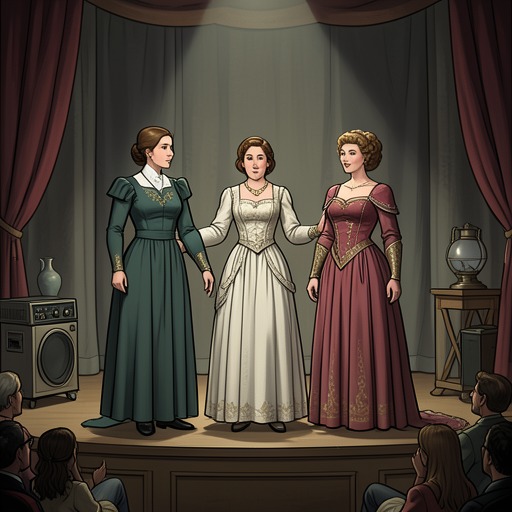
Dumplin'Lee Wei’s pageant training gives Willowdean Dickson and her friends both a practical lesson in stage presence and a model of what it means to pursue something they have been taught is out of reach. At The Hideaway, Lee teaches the girls how to walk in heels, while Dale supplies music and later drinks; the session moves from awkward practice toward a new sense of possibility. Lee’s guidance does not promise victory. It helps the girls imagine appearing before an audience on their own terms.
Why the Girls Ask for Help
The training follows Willowdean’s recognition that she and the other entrants do not know how to walk, pose, or present themselves. Her email to Lee and Dale is unusually candid: she explains that she found Lucy’s old registration form in a dresser, describes the girls she has drawn into the pageant, and admits that she fears making a fool of herself and bringing them down with her. She asks for help beyond what Clover City can offer. The request makes the lesson more than an extracurricular favor: Willowdean has begun to feel responsible for the other girls, even as she doubts her own ability to lead them.
The immediate stakes are specific. Willowdean does not expect to win, and says her aim is to demonstrate that there is no reason she cannot take part. She fears being reduced to a spectacle—the fat girl who falls and fumbles through magic tricks—rather than being seen as someone capable of performing. Her mother has already warned that approval for Willowdean’s talent was the only favor she would provide. Against that limited support, Lee and Dale agree to give up their Friday afternoon, offering instruction the girls cannot find in the pageant-centered town around them.
Lee’s Lesson in the Walk
Lee begins with the walk, explaining that a contestant’s movement makes her first impression before she speaks. She demonstrates by swinging her hips and then instructs the girls to place one foot in front of the other, follow an imagined straight line, and take a stride at least as long as a forearm rather than shuffling in tiny steps. The image of a sobriety test makes the exercise concrete; so does Lee’s advice to distribute weight across the foot instead of leaving the heel to bear it alone. Pageant presence, in her account, is not a mysterious quality but a sequence of movements that can be learned.
The demonstration also changes how Willowdean sees Lee. Moving across the stage in a silk robe and very high heels, Lee becomes, in Willowdean’s perception, a glamazon. The transformation is not presented as proof that appearance is effortless: Lee has made a performance out of gesture, balance, clothing, and motion. Her command of those elements lets the girls see stage identity as something constructed and practiced, rather than a quality reserved for people who already fit the pageant ideal.
Four Different Attempts
Willowdean volunteers first. Her toes pinch and the balls of her feet burn, but she follows Lee’s instruction, taking initially long, tentative steps and then turning at the far end of the stage. Walking toe to heel with one foot in front of the other sets her hips and body in motion. Dale’s whistle and Lee’s applause mark the change from trying to move correctly to walking with purpose. Willowdean imagines the room packed and every eye on her, facing the attention she fears instead of treating it as a reason to stay away.
Hannah Perez’s attempt takes a different course. She trips twice, then tears off her heels and throws them into the empty audience. She laughs throughout, a release Willowdean notes is unusual for her. The exercise does not make Hannah conform to the shoes; her refusal becomes part of the scene’s humor and self-possession. Millie Michalchuk is quieter, locking her knees and chewing her nails before and during the lesson. She walks carefully, sometimes lifting her hands for balance, and keeps trying as Lee reminds her to look toward the horizon rather than down at her feet. Amanda Lumbard, by contrast, is already comfortable in her shoes and needs little coaching. The same lesson accommodates hesitation, discomfort, and ease without making the four girls’ differences a reason to exclude any of them.
Beyond Technique
After the practice, the four girls sit at the bar while Dale makes virgin cocktails for them and a stronger drink for Lee. Lee continues with advice about stage makeup and clothes that make a statement, but the conversation turns from technique to the years when she was afraid to want a larger life. She says she wishes she had known girls like them in high school: friends willing to go after things they were not supposed to have. Lee remembers fearing that what she wanted would remain only a want. Her experience gives the afternoon an intergenerational dimension without making her a simple success story; she says that life improved and that she is now living her dream, in love, and happy, but also that she waited for those things to happen.
Lee contrasts her own waiting with the girls’ action. They are already going after what they want, and the distinction stirs something in Willowdean that she compares to using a forgotten muscle. The response is inward rather than a declaration of confidence: the session has not erased her fear of judgment, and it does not guarantee a pageant victory. It has given her a physical experience of taking the stage, along with a group in which awkwardness does not end participation. Willowdean also wants Lucy to see how she has connected the fragments of Lucy’s life; the training becomes part of that continuing effort to understand and remember her aunt.
Significance
Lee’s training makes pageant skill accessible by breaking it into repeatable actions—stride, balance, posture, and presentation—while showing that performance can be practiced rather than inherited. The heels expose the bodily difficulty behind the polished walk: Willowdean feels pain, Hannah falls, and Millie needs to steady herself. Yet the lesson does not treat those difficulties as evidence that the girls do not belong onstage. Their distinct attempts, and Amanda’s ease, make participation a collective undertaking rather than a test in which only one kind of body or temperament can succeed.
The afternoon also extends the pageant’s meaning beyond competition. Willowdean’s stated goal is not to win but to prove she can take part; Lee’s account of postponed desire gives that choice emotional weight. By agreeing to coach the girls, Lee and Dale provide help outside Clover City’s usual expectations, and Lee recognizes in them the courage she lacked when she was young. The scene’s central movement is therefore not simply from bad walking to better walking. It is from fearing that a desire must remain private to practicing, together, how to step into view.