Lucy Dickson’s death and funeral
Dumplin'Lucy Dickson’s death and funeral become a defining absence in Willowdean’s life, but the event also exposes a struggle over how Lucy will be remembered: as a body that drew judgment, or as a person whose private habits, enthusiasms, and love remain present in the lives of those who knew her.
Death and Its Circumstances
Lucy died at thirty-six, weighing 498 pounds, after suffering a massive heart attack while alone on the couch watching one of her shows. No one witnessed her death. Willowdean understands that absence as part of a larger invisibility: people outside the family had not really seen Lucy live, even as her body made her conspicuous to them. There are no photographs to counter that public image; Lucy disliked having her body reflected back at her in pictures.
Six months later, Willowdean still expects to find Lucy in familiar places, sitting on the couch or doing crossword puzzles in the kitchen. The ordinary details of that expectation sharpen the finality of her absence. Willowdean fears that without seeing or hearing Lucy, she will forget her, while also fearing that the memories available to the family will reduce her to the way she died.
The Funeral and the Town’s Gaze
The funeral is painful for reasons beyond the loss itself. Half of Clover City attends, and Willowdean suspects that some come because there is little else to do and expect to see Lucy’s body displayed as a cautionary spectacle. The family cannot afford the more expensive wide casket. Despite her mother’s distress at being unable to provide what she considers a proper funeral for her older sister, Lucy is cremated.
For Willowdean, the town’s attendance does not amount to genuine recognition. The funeral makes Lucy visible as an object of scrutiny while leaving the texture of her life unseen. Her mother, too, is caught in the circumstances of the death: Willowdean feels that when her mother thinks of Lucy, she remembers how Lucy died. The funeral therefore becomes a contested public memory, not simply a ceremony of farewell.
Objects That Keep Her Present
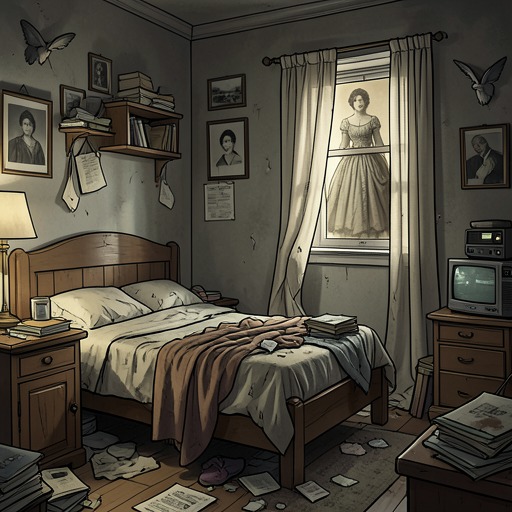
After Lucy’s death, her room holds the material traces that photographs do not. Willowdean finds newspaper clippings, Dolly Parton cassette tapes in a sock drawer, and papers that record small interests she never thought to ask Lucy about. Listening to a tape quietly on Lucy’s bed connects Willowdean to the enthusiasm Lucy shared with Ellen and Mrs. Dryver. Lucy had been vice president of a regional Dolly Parton fan club, and her friendship with Mrs. Dryver grew from that shared devotion.
Other keepsakes hold both affection and loss. In a red velvet box is a Dollywood Christmas ornament, a white iridescent globe marked with red lips and Dolly’s signature. Lucy had long wanted to visit Dollywood. When Mrs. Dryver offered her a ticket after winning airline tickets at work, the two planned the trip, looked into hotels and rental cars, and drove three hours to the nearest airport. Lucy learned she would have to buy an extra seat because she could not fit in one airplane seat; mortified, she chose to return home. Mrs. Dryver brought back the ornament instead. The souvenir preserves their shared plan while also embodying the way Lucy’s size restricted what she felt able to do.
A different discovery complicates Willowdean’s understanding of Lucy. Among clippings of Willowdean’s mother in her crown and pageant dress, she finds a blank pageant registration form dated 1994, three years before her mother won in 1997. Willowdean had thought Lucy regarded the pageant as a joke and cannot resolve why the form was there. Its unanswered questions make the keepsake less a revelation than a reminder of how much of Lucy’s life Willowdean never got to ask about.
Grief, Memory, and Family
Lucy’s room becomes the setting where grief changes shape. Willowdean’s mother begins sorting its contents, and Willowdean experiences the prospect of dismantling the room as a fresh injury: the objects are among the few remaining ways to encounter Lucy. Later, when her mother returns with boxes marked for donation, Willowdean reads the clearing-out as an effort to get rid of Lucy rather than simply reorganize the room. The conflict is intensified by the fact that both mother and daughter have been absorbed in their own concerns and have spent little time there.
Willowdean’s preferred memories resist the funeral’s reduction of Lucy to her death. She remembers Lucy taking her to dance class in third grade and sitting with her in the car when Willowdean was ashamed of her body and afraid to enter. Lucy urged her to give herself the chance to try, drawing on her own experience of missing out because she feared other people’s judgment. Willowdean stayed only through the fall, but Lucy’s support mattered beyond the length of the class. In the wake of Lucy’s death, that remembered kindness helps preserve a fuller account of her life: not an image of a body to be judged, but a person who understood fear and encouraged her niece to act despite it.
The aftermath remains unresolved rather than neatly consoling. Lucy’s belongings are sorted, saved, or threatened with removal; her family remembers her differently; and the missing photographs cannot be replaced. Yet the tapes, the ornament, the clippings, and Willowdean’s recollections keep her presence active in the household. The death and funeral thus establish the novel’s central tension between the body as something publicly interpreted and a life that can only be remembered through intimate, partial acts of attention.