Lucy’s Dolly Parton records and tapes
Dumplin'Lucy’s Dolly Parton records and tapes are more than remnants of a musical collection: they let Willowdean Dickson encounter Lucy through the music she loved, even as the family’s ways of remembering her diverge. First discovered among Lucy’s belongings and later threatened by the conversion of her room into a craft space, the recordings make memory both intimate and material. A tape can be taken from a drawer, set on a stereo, and heard; records can be carried away and played again. Their sound gives Willowdean a connection to Lucy that the family’s missing photographs cannot provide.
Collection and Discovery
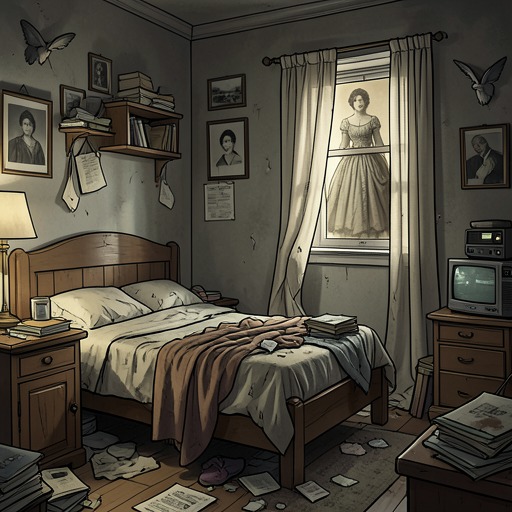
Willowdean’s first described discovery comes during a quiet search of Lucy’s room. After closing the restaurant where she works, she checks that her mother is asleep, slips down the upstairs hall without creaking the floorboards, and searches through the piles left in the room. The search also turns up stacks of newspaper clippings, including small details of Lucy’s interests that Willowdean wishes she had thought to ask about while Lucy was alive. The objects in the room therefore carry both a sense of closeness and the ache of all the conversations that can no longer happen.
In Lucy’s sock drawer, Willowdean finds a small box of cassette tapes, all by Dolly Parton. She chooses one at random, puts it in the stereo on the nightstand, and lies back on Lucy’s bed with the volume turned down until the music is scarcely louder than a murmur. The scene makes the collection usable rather than merely preserved: Willowdean can bring Lucy’s favorite music into the room and listen there, among Lucy’s things. The tapes are not a complete record of Lucy’s life, but they offer a sensory trace of something she loved and chose to keep close.
The records have a different presence in the room. Framed Dolly Parton records had lined its walls for as long as Willowdean can remember, making the collection part of the room’s familiar appearance. The tapes are tucked out of sight in a drawer; the framed records are visible, arranged as part of Lucy’s surroundings. Together, the two formats establish how thoroughly Dolly Parton’s music belonged to Lucy’s private space.
Music, Memory, and Shared Affection
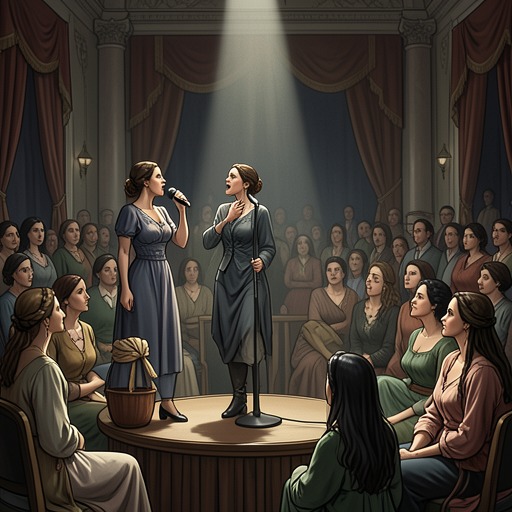
Lucy’s devotion was not an isolated habit. She had been vice president of a regional Dolly Parton fan club until a few years before, and her connection to the club brought her into contact with Mrs. Dryver, one of the best-known Dolly Parton impersonators in that part of Texas. Mrs. Dryver had the petite physique and voice to match the performer. Through their mothers’ shared enthusiasm, Willowdean sees a connection between her own lifelong friendship with Ellen and Lucy’s earlier musical world. The records and tapes thus point beyond Lucy’s room: they mark a shared cultural affection that links generations and friendships.
Willowdean understands that affection as extending beyond the music or Dolly Parton’s appearance. What draws her and Ellen is the attitude of someone who knows others may consider her ridiculous yet does not change what makes her feel good about herself. In this understanding, the collection stands for a form of self-possession that matters to Willowdean as she negotiates how other people see her. The tapes do not simply recall Lucy; listening to them also returns Willowdean to a source of confidence and to the bond that she associates with Ellen.
The contrast between music and photographs deepens the collection’s importance. Six months after Lucy’s death, Willowdean still expects to see her in familiar places, such as on the couch with Riot or doing crossword puzzles in the kitchen. Yet the family has no pictures of Lucy, because Lucy disliked seeing her body reflected in photographs. Willowdean fears that without being able to see or hear Lucy she will somehow forget her. She also knows that her mother’s memory is fixed on Lucy’s death: Lucy died alone on the couch, at thirty-six, after a massive heart attack. Against that painful account, the Dolly Parton recordings preserve a distinct part of Lucy’s life—not an image of her body, but the music she loved and the sound Willowdean can still call back into the room.
The Room and the Threat of Displacement
The records become a point of conflict when Willowdean returns home and finds her mother seated at a card table, with Lucy’s furniture pushed against the walls. Her mother is sewing and explains that she needs a craft room; her own bedroom no longer works for that purpose. The framed records have been taken down and stacked at the end of the dresser, and her iPod sits on Lucy’s pastel-pink record player. The changed arrangement makes visible a disagreement about what the room should be: a place kept as Lucy left it, or a room that can be put to new use.
Willowdean objects that the records have been removed and asks why her mother has changed everything. Her mother regards the records as old and points to the squares their frames left on the wallpaper, which she plans to remove. For her, the room’s transformation is a way to move forward rather than leave it like a tomb. For Willowdean, the removal of the records feels like an attempt to get rid of Lucy. The disagreement is not only about furnishings. It exposes the difference between a mother who believes the room must change and a daughter who fears that changing it will erase the person it recalls.
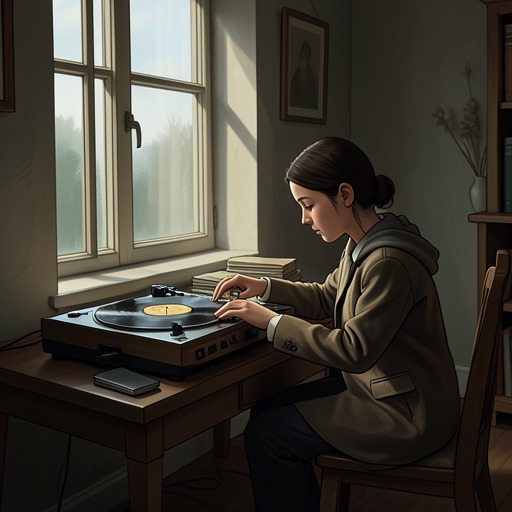
Willowdean responds physically: she gathers as many records as she can carry, takes them across the hall to her own bedroom, leaves them on her bed, and goes back for more. Their movement out of Lucy’s room does not end their use as keepsakes; it places them in Willowdean’s own space. The records become objects she can protect and, later, return to. When she sifts through them and puts one on the player, she watches the needle follow the grooves of Dolly Parton’s voice. The familiar music briefly restores a connection through listening, even though the room and the family’s practices around it have changed.
An Archive That Can Be Heard
Lucy’s room does not remain untouched. After her mother begins the craft-room transformation, the room is largely left alone for a time while both mother and daughter become occupied with other concerns. When Willowdean later finds her mother there with boxes marked for donation, she reads the cleaning as another attempt to remove Lucy’s presence. The changing room gives the records an unsettled status: they belong to Lucy’s collection, but their continued place in the household depends on what the living choose to keep, move, or give away.
That uncertainty makes the records especially significant as objects of remembrance. Willowdean cannot recover conversations she failed to have with Lucy, and the records cannot answer the questions raised by the clippings or explain every part of Lucy’s life. They can, however, be handled and played. Their persistence offers a form of memory that is neither a photograph nor a fixed family account of Lucy’s death. In the record player’s needle tracing the grooves, remembrance becomes an action in the present: Willowdean listens, and Lucy’s love of Dolly Parton remains audible.