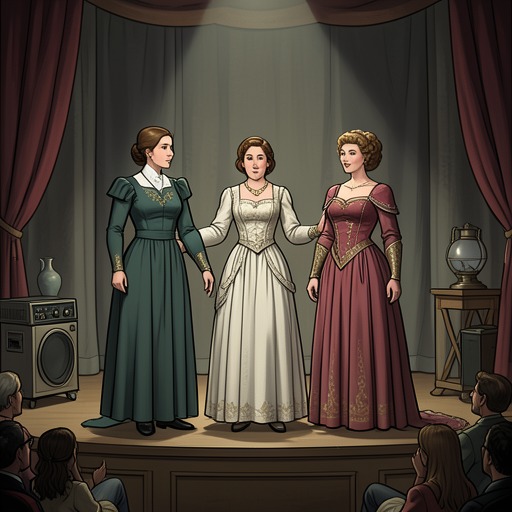
Millie Gets Her Parents' Permission to Compete
Dumplin'Millie Gets Her Parents' Permission to Compete is the confrontation in which Millie Michalchuk’s secret pageant entry becomes a direct appeal to her parents. After they discover she forged her mother’s signature, Millie admits the lie but insists that their wish to protect her cannot replace the support she needs. Willowdean Dickson intervenes when parental consent appears to bar Millie from competing, and Millie’s mother ultimately relents. The scene shifts the stakes from a forged form and a rule to whether Millie’s family will recognize her as capable of choosing this for herself.
The discovery during rehearsal
The confrontation breaks into the pageant’s preparations in the auditorium. Millie’s full name, Millie Ranea Michalchuk, is called from the back, and she freezes. Her parents are advancing down the aisle: her mother storms in first, with her father close behind. The interruption makes the deception public. Everyone is watching, including the technical crew, as Millie’s mother addresses her as Millicent and accuses her of lying to their faces.
Her mother explains the immediate cause of the conflict: the parents had decided not to sign the release form, but Millie went behind their backs. Tears gather at the edges of her mother’s eyes, and her makeup is visibly not waterproof. Millie’s father stands behind her with his arms crossed. The staging gives the dispute a public pressure that the original act of forging a signature had avoided: the family argument is now unfolding before the people involved in the pageant.
Willowdean’s mother is also onstage, holding a clipboard, and asks whether the accusation is true. Millie does not deny it. With her fists curled at her sides, she tells the adults that she forged her mother’s signature. Her face crumples briefly as if she might cry, but she turns back to her parents and explains the distinction she wants them to understand: she knows they want to protect her, yet she needs them to support her. Her admission accepts responsibility for the forgery without conceding that her parents were right to keep her out.
The appeal for permission
Willowdean’s mother proposes moving the discussion to the foyer. Millie walks up the aisle with her, while Willowdean climbs past Ellen Dryver’s long legs and follows, saying that she has to help. At the door, Willowdean hears her mother state the obstacle plainly: Millie cannot compete without parental consent. The rule makes the parents’ decision decisive, regardless of how much work Millie has put into preparing.
Willowdean answers the parents directly. She argues that Millie has worked hard and is not fragile, describing her as tougher than people might expect. Her appeal widens beyond Millie: she names the girls who know what it is to be teased, including herself, Amanda Lumbard, Hannah Perez, and Ellen Dryver, and acknowledges that even Willowdean’s mother knows that experience. Her point is not that teasing makes the pageant easy, but that fear of it cannot be allowed to govern what they do. The defense treats Millie as someone able to face judgment, rather than someone whose parents must decide on her behalf because she might be hurt.
Millie takes Willowdean’s hand and squeezes it tightly, then speaks for herself. She says that she has dreamed of entering the pageant for as long as she can remember. She also challenges the exclusion she sees beneath the dispute, noting that the rules do not say that fat girls are ineligible. Her mother flinches at the word and discreetly wipes away a tear. Millie ends her appeal by locating the remaining barrier in the room: her mother is the only person keeping her from competing. The exchange makes the conflict both practical—the missing consent—and personal, as Millie asks her mother to trust her expressed ambition.
Consent and collective support
Millie’s mother looks from the large pageant banner above the auditorium doors to Willowdean’s mother, who offers a faint grin. Millie’s father takes his wife’s hand, and she turns back to Millie and nods. The sequence resolves the standoff without erasing its emotional cost: Millie has confessed to a serious breach of trust, and her parents have had to reconsider the decision that prompted it. Her mother’s nod permits the possibility Millie has been pleading for, allowing her to return to the auditorium as a contestant rather than leave over the forged form.
Millie and Willowdean walk back in side by side. The other contestants have plainly been listening; a few smile encouragement as the girls take their seats. Ellen takes Willowdean’s hand, then Millie’s, and Millie links fingers with Amanda. Willowdean turns toward Hannah with her palm open, and Hannah takes her hand after a deep breath. The five girls’ joined hands convert a private appeal into visible solidarity. Their bond matters more to Willowdean in that moment than winning a crown, and the scene marks a shift in her sense of where the group’s strength lies.
The aftermath in the auditorium
Permission does not make the rehearsal smooth. When the girls finally begin, none performs her talent because there is not enough time. Callie slips on the ramp during the opening number, cues go wrong, and the rehearsal accumulates spills, tears, and even blood. The disorder contrasts with the emotional clarity of the consent scene: the contestants cannot control every mishap in the production, but Millie has secured the chance to take part in it. Her parents’ decision changes what she is allowed to do, not the difficult, chaotic circumstances of the pageant itself.