Miss Teen Blue Bonnet Pageant eligibility requirements
Dumplin'The Miss Teen Blue Bonnet Pageant eligibility requirements are limited, as Willowdean Dickson discovers, to being between fifteen and eighteen and having parental consent. Their significance lies in the contrast between those few formal conditions and the pageant’s elaborate aura: the application asks about traits such as height and weight, while the stated rules do not make those traits barriers to competing.
The Written Requirements
The distinction emerges when Willowdean finds a blank pageant registration form dated 1994 among Lucy’s belongings. It predates Rosie Dickson’s 1997 win by three years; Rosie would have been too young to enter when the form was issued. The application asks for a contestant’s name, date of birth, and address, but also requests height, weight, hair and eye color, career ambition, and talent. Those questions make the form feel like a measure of the applicant, even though Willowdean later recognizes that the actual entry requirements are only an age range and a parent’s permission.
Studying the form changes Willowdean’s sense of how exclusive the competition is. She has imagined many requirements that are not in the rules, and is surprised by how many girls are eligible. The form does not explain every practical step of registering, but it gives her a concrete basis for separating formal eligibility from assumptions she has attached to the pageant.
Consent and Registration
Parental consent is not a minor detail: at registration, Willowdean has not obtained her mother’s signature and fears being refused in front of the other people present. Registration takes place at the Clover City Community Center, where the fee is two hundred dollars. The fee is a practical cost of entering, distinct from the two stated eligibility conditions. Rosie Dickson ultimately signs Willowdean’s form, making her consent possible and allowing Willowdean to proceed.
Millie Michalchuk’s experience later shows the same condition operating as a family decision. Millie tells her mother that she wants to compete and that the rules do not exclude contestants for being fat; she identifies her mother’s approval as the remaining obstacle. Her mother eventually nods, and the two return to the auditorium together. The scene makes clear that the age rule may define who can apply, but permission determines whether an eligible teenager can actually take part.
Formal Access and Pageant Culture
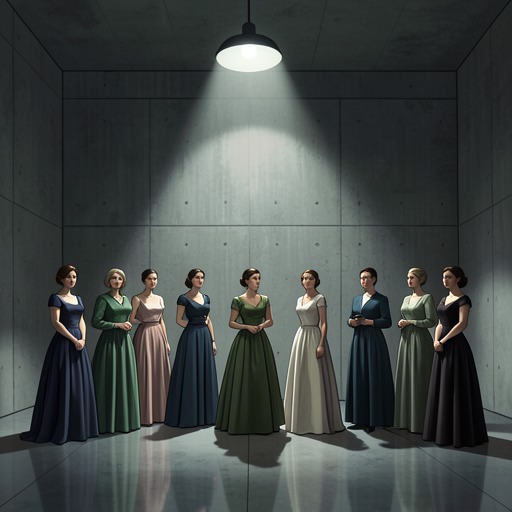
The requirements appear broad beside the pageant’s social rituals. At the information session, girls gather in distinct groups: contestants from pageant families, athletes, cheer participants, and theater and choir students. They wear dresses and cardigans, while Willowdean and her friends arrive in jeans and T-shirts. The contrast suggests how an event with few stated eligibility restrictions can still feel governed by inherited familiarity and expectations about how a contestant should present herself.
The pageant also trains contestants in a specific public performance. Lee Wei teaches the girls to walk with one foot in front of the other, turning posture and movement into part of the impression they make onstage. That instruction belongs to preparation rather than the formal age-and-consent rule, but it helps explain why the application’s questions about appearance can feel consequential even without a stated height, weight, or hair-color threshold.
Meaning and Consequences
The rules’ simplicity unsettles Willowdean’s assumption that entry is reserved for a narrow kind of girl. Millie’s appeal makes that contrast explicit: body size is not listed as a disqualification, even as the contestant’s mother visibly reacts to Millie’s choice of words. At the pageant, the girls’ support for one another becomes tangible when Ellen Dryver, Millie, Amanda Lumbard, and Hannah Perez join hands with Willowdean after Millie’s family conversation. Their solidarity does not erase the pageant’s expectations, but it gives the formally eligible contestants a shared presence within them.
The requirements therefore work on two levels. On paper, age and parental consent define entry; in practice, family approval, the registration fee, social confidence, and preparation shape the path to participation. The gap between a short rule and the pageant’s imposing culture is what Willowdean’s discovery exposes: a process that seems exclusive can admit more girls than she had believed, while still asking them to navigate barriers the eligibility rules do not name.