Miss Teen Blue Bonnet approved-talent rule
Dumplin'The Miss Teen Blue Bonnet approved-talent rule makes prior approval a condition of performing in the talent portion of the pageant, rather than leaving contestants free to substitute an act onstage. Its importance becomes unmistakable when Willowdean Dickson abandons her planned magic routine for Jolene: the performance wins an enthusiastic response, but her mother disqualifies her before she can finish the competition. The rule turns a personal artistic choice into a formal breach, and places Willowdean’s mother in the difficult position of enforcing the pageant’s standard against her own daughter.
The Rule Within the Pageant
The rule operates within a competition that is carefully organized well before the contestants reach the stage. At registration, Willowdean notes that entry costs two hundred dollars. The community center is crowded with girls seated in distinct groups: contestants with family pageant histories, athletes, cheerleaders, and theater and choir students. They arrive in dresses and cardigans, while Willowdean and her friends are in jeans and T-shirts. The scene establishes how the pageant gathers different kinds of ambition under one institution, though it does not spell out the approved-talent requirement during registration.
Preparation continues through interviews and rehearsals. Contestants are given the Friday before the pageant off from school, and the day is filled with interviews and demanding dress rehearsals. Willowdean’s mother has her wardrobe approved at the community theater. This sequence gives the talent requirement a context: the pageant’s performances are part of a managed program, not simply an open invitation to do whatever a contestant chooses when she reaches the stage.
Willowdean’s Planned Act and the Change of Plan
Willowdean initially prepares a magic act. For its costume, she finds the flapper headband she wore on Halloween, pairs it with the black dress she wore to Lucy’s funeral, and borrows her mother’s black satin gloves. The costume pieces show how much of her presentation is assembled from what she already owns or can borrow, and establish that the magic routine is a real plan rather than an act invented at the last moment.
On the day of the pageant, Ellen Dryver questions whether Willowdean is really going to perform the tricks, which Ellen considers unconvincing. She also points out that Willowdean need not accept disqualification if she cares about avoiding it. Until then, Willowdean has not considered doing something else and says she has no alternative ready. Ellen then whispers an idea; the specific words are not given, but the suggestion changes Willowdean’s course. At the later performance, she sings Jolene instead of presenting the magic tricks. The contrast is sharp: the pageant has a planned act associated with a costume and preparation, while her eventual performance is a departure from that approved plan.
Performance and Enforcement
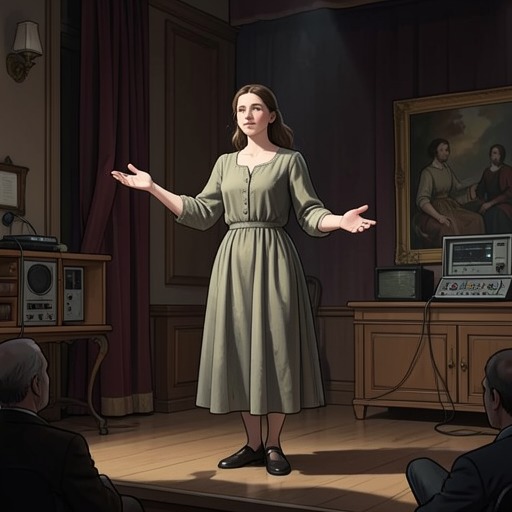
The substitution is public. Willowdean’s mother introduces her as the next contestant performing magic tricks, so the audience and pageant staff are expecting the approved act when Willowdean walks onstage. Instead, Willowdean sings Jolene. She thinks she hears audience members singing along, and the song ends in applause; a possible taunt is soon drowned out by cheers. The response gives the performance a success of its own, but audience approval does not erase the rule violation.
The consequences begin as soon as Willowdean leaves the stage. Her mother pulls her aside and asks what happened, then returns to announce the next contestant. Callie warns Willowdean that failing to perform the approved talent will get her disqualified. Willowdean does not stop to argue; she considers the choice worth making. The rule is therefore legible to the contestants as more than a technicality, even before the formal decision is delivered.
Disqualification and the Rule’s Reach
In her mother’s dressing room, Willowdean learns that she is disqualified and cannot finish the pageant. Her mother explains that Willowdean broke the rules and that the same standard would apply to anyone. She says it would not be fair to let Willowdean continue. The decision is particularly consequential because her mother is both personally involved and responsible for announcing the contestants. She does not allow the family relationship to exempt Willowdean from the standard, and then turns back to the immediate pageant preparations, asking Willowdean to zip her dress.
Disqualification does not erase Willowdean’s place in the rest of the pageant evening. She later escorts Ellen in the formal-wear portion, looping Ellen’s arm through hers and walking her across the stage. Willowdean uses the one-foot-in-front walk Lee Wei taught the contestants, and she joins the other girls as they take their turns. This is not a reversal of the disqualification: Willowdean appears as an escort, not as a contestant completing her own competition. The distinction shows the rule’s specific reach. It bars her from continuing as a competitor after the unauthorized substitution, while leaving room for her to participate in a different role.
The episode makes the approved-talent rule consequential through the gap between performance and eligibility. Jolene is warmly received, and Willowdean stands by her decision, but the pageant’s approval process governs whether she may continue, not whether the audience likes what she does. Her removal establishes the limit imposed by the rule; her later escort role shows that the pageant evening continues around that loss.