Rosie Turns Lucy's Room into a Craft Room
Dumplin'Rosie’s conversion of Lucy’s bedroom into a craft room turns a household reorganization into a conflict over grief, memory, and what it means to move forward. Rosie needs a place to sew costumes and make pageant set pieces; Willowdean sees Lucy’s room not as unused space but as a surviving part of her aunt’s life. As sewing begins and Lucy’s records are displaced, their competing purposes for the room become impossible to keep separate.
Background and Practical Purpose
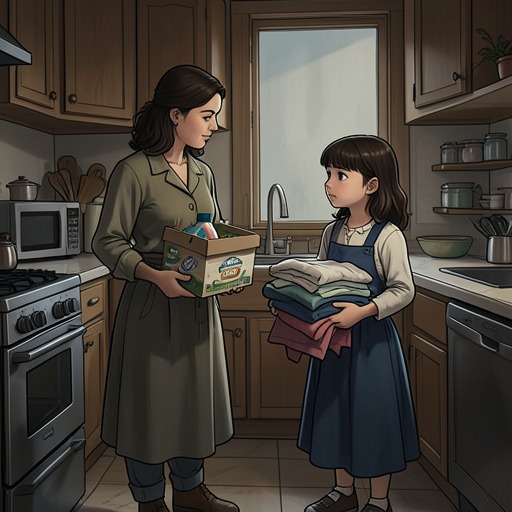
The change begins on Willowdean’s last day of school. She finds Rosie upstairs in Lucy’s room after the funeral home has finally obtained the urn the family ordered. Rosie has taken a half day and explains that she wants to get a head start on sorting the room. Willowdean’s immediate question—“A head start on what?”—registers how little the two of them share an understanding of what the work means.
Rosie’s explanation is practical and tied to the coming pageant season. She says the room has been collecting dust and that she will be working all summer; having a dedicated place to sew costumes and create set pieces would keep the rest of the house from being overrun. The plan is not simply an idea: Rosie starts sorting papers into keep, toss, and maybe piles. To her, the room’s contents can be assessed and redistributed. To Willowdean, watching those piles form makes the sorting feel personal; she wonders which pile she herself would belong in.
The Room’s Competing Meanings
Willowdean’s objection is direct: “This is her room.” She hears Rosie’s practical case as a proposal to replace a space that still belongs to Lucy with one organized around Rosie’s own work. When Rosie spells out the intended use, Willowdean repeats “A craft room?” with bitterness. The words name the gulf between them: what Rosie describes as useful space, Willowdean experiences as a change to Lucy’s place in the home.
The tension sharpens when Willowdean later returns to the house and sees Lucy’s room glowing. Olivia Newton-John’s music is playing upstairs. Inside, framed Dolly Parton records that had lined the walls are stacked at the end of the dresser, while Rosie’s iPod sits on Lucy’s pastel-pink record player. The familiar collection has not simply vanished, but it has been taken down and displaced. The contrast between the old records and the new equipment makes the room’s change visible in particular objects, while the music and sewing work show that Rosie is already using the space differently.
Rosie says they have discussed the plan before and that her own bedroom no longer works for her sewing. She acknowledges that Willowdean is upset, but argues that the room cannot remain “like a tomb” and that the family has to move forward. Her claim that Lucy would understand is meant to reconcile the practical change with affection for Lucy. Willowdean cannot accept that reassurance: for her, changing the room feels less like making space for work than letting Lucy disappear.
The Confrontation and Its Escalation
Willowdean begins carrying as many records as she can hold across the hall to her own bedroom. The action is protective and immediate: rather than negotiate over whether the room should change, she removes the pieces of Lucy’s collection she can reach. She tells Rosie, “It’s like you’re trying to get rid of her.” Rosie answers that this is not true, speaking with a needle between her teeth as she works. The sewing continues alongside their argument, so the practical task itself becomes part of what Willowdean is resisting.
The dispute escalates when Willowdean pulls the dresser’s top drawer free and fills it with records. Rosie warns her not to ruin the drawer’s track. That concern about damage to the furniture meets Willowdean’s much larger accusation: “It’s like her being dead isn’t good enough!” She says Rosie will not be satisfied until every bit of Lucy is gone and the room is filled with what Lucy was not. The accusation turns a disagreement over household use into a charge about the family’s response to death. Rosie stops the sewing machine and stands, but says nothing; Willowdean carries the loaded drawer away and slams her bedroom door.
Consequences and Significance
The scene leaves the room’s conversion in progress rather than resolving the disagreement. Rosie has a sewing machine at work and is making the space serve her pageant preparations, while Willowdean has moved records into her own room and taken a drawer with her. The surviving objects therefore become contested: records that had been displayed as part of Lucy’s room are now being gathered and relocated, and the furniture itself is caught up in the struggle over how much should be preserved.
The conflict gives the room two incompatible meanings without making either character’s position reducible to simple indifference or obstruction. Rosie presents the change as a way to use an idle room and keep her work from overtaking the house; she also insists that remembering Lucy need not mean leaving the room untouched. Willowdean experiences that reasoning through the loss of her aunt and the visible removal of the things that marked Lucy’s presence. Her anger makes clear that, for her, preservation is not an abstract preference: the records and the room are tangible links to someone who has died. The conversion thus makes the family’s unresolved grief material, turning a sewing space into the setting where the question of how to remember Lucy becomes an open confrontation.