Self-invention and performed identity
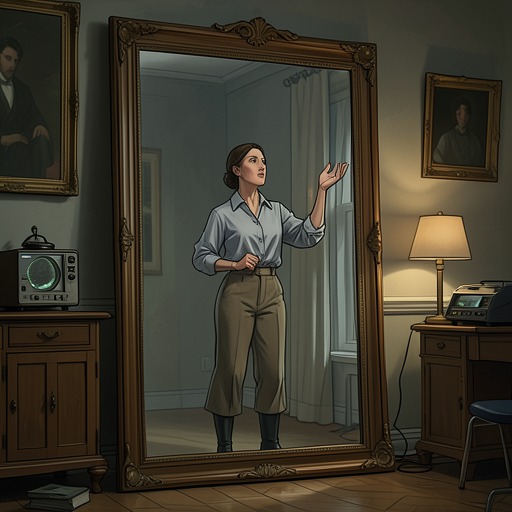
Dumplin'Self-invention and performed identity describe the gap between who a person feels they are and who they are trying to become. The novel treats that gap neither as simple hypocrisy nor as an easy route to confidence: acting differently can loosen fear, but a performance can also conceal feelings that have not changed. Willowdean Dickson’s reflections on confidence, her exchange with Mitch after Halloween, and her tentative pageant walk give the idea its central tension.
Confidence Seen from the Outside
At the pageant orientation, Millie Michalchuk tells Hannah that she looks good in a swimsuit, then identifies Willowdean’s strength as confidence. Willowdean asks what her own strength is, but the answer unsettles her rather than reassuring her. She cannot feel the quality that Millie sees. The exchange establishes a distinction between an identity legible to other people and an inner state the person herself recognizes: confidence may appear as a public characteristic before it becomes a private conviction.
Willowdean does not dismiss Millie’s judgment, but neither can she simply adopt it. She wonders what confidence means if it is only an act, and whether another person’s affection should make self-acceptance easier. Her thoughts turn specifically to Bo Larson: being liked by him has made her more conscious of her body, not less. The episode resists the comforting idea that approval from someone else automatically repairs insecurity. The gap between the confident girl Millie perceives and Willowdean’s fluctuating self-image remains real, even as the compliment gives that unseen possibility a name.
Her account of her body makes the contradiction explicit. She knows that fatness and stretch marks matter to her, despite telling herself they should not; at other times, she is entirely satisfied with her body. These states coexist rather than resolving into a single, stable self-description. In this context, performed confidence is not proof that insecurity has vanished. It is one position Willowdean can sometimes inhabit, alongside vulnerability that remains present.
Pretending as Practice
After Halloween, Mitch recalls how a child saw him as Indiana Jones rather than as someone who had played badly in a game or spent the day playing video games. The costume-mediated encounter gave him, for a moment, another identity in someone else’s eyes. Willowdean asks whether that kind of transformation amounts to hiding from oneself. Her question exposes the risk in performance: becoming someone else may offer relief from a disappointing self-image, but it may also seem like evasion.
Mitch answers by treating performance as rehearsal. His view is that a person can act like the person they want to become until the behavior feels more natural. He applies that idea to his own fear of Willowdean: he says that acting as though she did not frighten him made the fear diminish, even though it had not disappeared at once. The logic is incremental rather than magical. Repeated action does not instantly make a person fearless; it can alter the force that fear has over time.
Willowdean recognizes something unsettled in this account. She thinks she has been pretending for much of her life, acting as the person she decided she wanted to be, but now feels that the act is fading. She does not know whether she likes the person underneath it. The reversal matters: performance may help someone approach a chosen self, yet the loss of a familiar performance can expose uncertainty instead of revealing a ready-made authentic identity. Her response therefore complicates Mitch’s encouragement without simply disproving it.
The Test of Feeling
The exchange becomes personal when Mitch draws Willowdean’s hands away from her face and says that good things are supposed to be a little frightening. He kisses her, and she remains still as he puts an arm around her waist. The scene contains the trembling touch and exhilaration associated with a frightening new experience, but Willowdean recognizes that she is not frightened. That absence tells her that the moment is a lie: she knows what she thinks she ought to feel, and the feeling is not there.
The kiss gives the idea of performed identity a consequence. Mitch’s account of practicing courage may describe a genuine change in his relation to fear, but Willowdean cannot make herself feel an attraction simply by entering the expected scene. Her awareness of what she is supposed to feel is itself a kind of script; her actual response interrupts it. The distinction is not between an entirely false public self and a perfectly transparent private one. Rather, the scene shows that a role can be tested against feeling, and that the test may reveal a mismatch a person cannot overcome through effort alone.
Embodying a Chosen Self
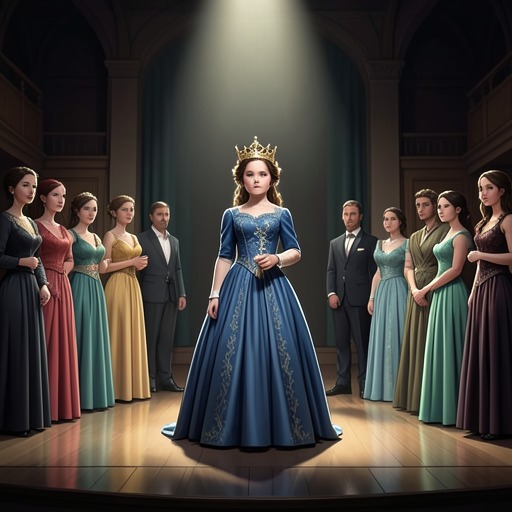
During Lee Wei’s pageant training, Willowdean walks across the stage in steps that are at first long but tentative. She follows the instruction to place one foot in front of the other, toe to heel, and notices how the movement sets her hips and body in motion. The walk becomes easier to continue once it has begun. This physical detail gives Mitch’s idea of practice a second form: confidence is not only a claim about the self but something enacted through posture, movement, and sustained action.
The rehearsal does not erase Willowdean’s awareness of her body. Her toes pinch, the balls of her feet burn, and she knows that a full room would have every eye on her. Still, she walks with purpose. The scene holds discomfort and agency together rather than making one cancel the other. Lee applauds and embraces her at the waist; Willowdean wants Lucy to see that she has connected the dots of Lucy’s fragmented life. The imagined witness links this public performance to memory and personal meaning, not merely to winning approval.
Hannah’s turn offers a contrasting kind of performance. She falls twice, removes her heels, throws them into the empty audience, and laughs throughout. Willowdean notes that she has rarely seen Hannah laugh so much. The rehearsal makes room for a display that does not follow the polished ideal of a flawless walk: a stumble can become part of a moment in which Hannah appears more openly joyful. Against the pressure to perform composure, her laughter suggests that being seen need not always mean successfully maintaining the expected pose.
A Self Still in Revision
Across these episodes, performed identity remains ambivalent. Millie can see confidence that Willowdean cannot feel; Mitch uses repeated behavior to make fear less controlling; Willowdean discovers that an anticipated romantic response cannot be summoned just because it seems due; and the pageant walk lets her act purposefully while still feeling physical discomfort and awareness of scrutiny. These are distinct outcomes, not a single formula for becoming oneself.
The concept’s significance lies in that unevenness. Performance can create room for change, as Mitch describes and Willowdean experiences in her deliberate walk, but it does not guarantee an inner transformation or settle identity once and for all. The novel allows confidence to be intermittent, visible before it is felt, and compatible with self-doubt. Its image of becoming is consequently neither pure self-invention nor the uncovering of a fixed self beneath every role: it is a continuing negotiation between chosen action, other people’s perceptions, and feelings that may or may not follow.