Sweet 16
Dumplin'Sweet 16 is a clothing store in Clover City where Ellen Dryver works and picks up her paycheck, but Willowdean Dickson experiences it less as a place to shop than as a display of who the town’s clothes and ideals are made to include. Its cramped racks and mirrors stage a daily contrast: Ellen can browse among the fashions, while Willowdean knows the store does not carry clothes that fit her. The location links ordinary shopping to the novel’s larger concerns with body size, friendship, and the beauty standards surrounding the pageant.
Store and Social Setting
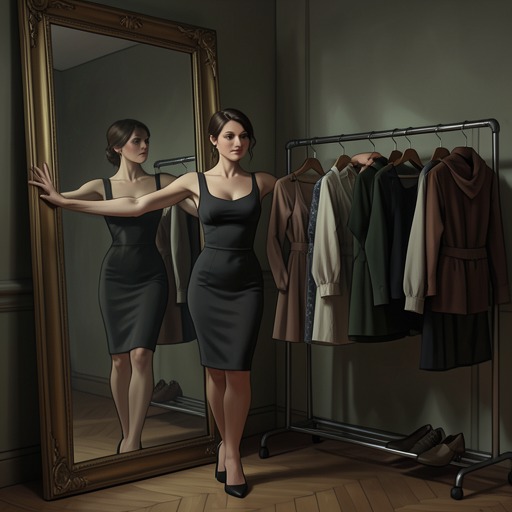
Sweet 16 is crowded with racks, mirrors, and mannequins whose jutting hipbones show off low-slung jeans and tiny slogan T-shirts. Willowdean follows Ellen through the aisles, careful not to knock things over with her hips. The store’s visual environment makes bodies part of the merchandise: the mannequins model a narrow silhouette, while Willowdean is acutely aware of how she occupies the limited space between the racks.
The exclusion is also practical, not only a matter of appearance. Sweet 16 does not carry sizes above twelve. Willowdean has pointed this out to Ellen, who seems to avoid acknowledging it. When Ellen asks why Willowdean took a job at Harpy's instead of working with her, Willowdean does not explain that she did not want to work in a store where she could not fit the clothes. Her silence leaves Ellen frustrated about their lost plan to work together, while the reader can see the material constraint behind Willowdean’s choice.
Ellen’s Workplace and Willowdean’s Visits
Willowdean comes to Sweet 16 with Ellen on Thursdays to collect Ellen’s paycheck. At first she makes a deliberate effort not to be difficult about the visits; over time, she forms a harsh opinion of the store and of the employees, whom she feels treat her as Ellen’s charity-case friend. That judgment reflects her experience of their treatment, but also the strain of repeatedly entering a shop whose clothes and sales culture exclude her.
Callie makes that strain explicit. She calls out to Ellen with a mocking nickname and refers to Willowdean by a distorted version of her name. She then hands Ellen a pristine white pay envelope and boasts that pageant boot camp has nearly given her a six-pack, while saying she does not want to become too muscular. Her comment turns the store’s ideal of femininity into casual conversation: fitness and thinness are celebrated, but visible muscle is treated as undesirable. Willowdean corrects Callie’s use of her name, though Callie does not hear; Ellen laughs at a later remark from the manager, which angers Willowdean. These encounters make the workplace a setting where the friends’ different positions are difficult to ignore.
When Ellen goes toward the back to look at merchandise, Willowdean follows, saying that the clothes probably will not fit her anyway. The manager, Morgan, stops her at the entrance and tells her that only employees may go farther in. Her apology is accompanied by a smile Willowdean reads as insincere. Ellen notices Willowdean’s reaction and checks whether she is all right; Willowdean says she is and urges Ellen to hurry. The brief exchange captures the social shape of the visit: Ellen belongs behind the counter and among the stock, while Willowdean is left waiting outside, trying not to make her exclusion the center of the afternoon.
Pageant Season and the Mall
Sweet 16 sits in a mall whose windows fill with formal dresses during homecoming and pageant season. Across from it, Frills advertises a glittering blue gown and promotes its dresses with a message that Clover City can have only one Miss Teen Blue Bonnet. The pageant’s competitive promise is therefore visible from Sweet 16, as a sales pitch and a town-wide ideal rather than a distant event. Willowdean feels that she despises the pageant, yet also senses how thoroughly it has spread through the town.
The mall setting also brings Willowdean and Bo Larson briefly into view of each other. Bo is there shopping with his stepmother and younger brother, who has been trying on basketball shoes. Willowdean wants to reach over and kiss him, but does not: they are in public, not hidden behind Harpy's or together in the cab of his truck, and neither has said aloud that their relationship is a secret. Sweet 16’s surroundings thus place private feeling beside public display. The same mall that showcases pageant dresses and narrow ideals becomes a place where Willowdean must keep her affection for Bo concealed.
Narrative Significance
Sweet 16 gives the book’s discussion of body image a concrete setting. Willowdean’s body is not merely a subject of other people’s opinions; it determines whether she can shop, where she can work, and how comfortable she feels accompanying her closest friend. Her attention to the store’s mirrors, mannequins, racks, and size limit makes exclusion part of the physical environment, not an abstract disagreement about beauty.
The store also sharpens the contrast between Ellen’s access and Willowdean’s. Ellen’s visits for her paycheck bring them together, but the clothing itself, the employees’ remarks, and the blocked entrance repeatedly mark the difference between their experiences. Alongside the pageant displays across the mall, Sweet 16 presents the standard Willowdean resists as something circulated through everyday commerce and conversation. Its importance lies in that ordinary pressure: a place meant for buying clothes becomes a measure of who is expected to fit.