The Hideaway
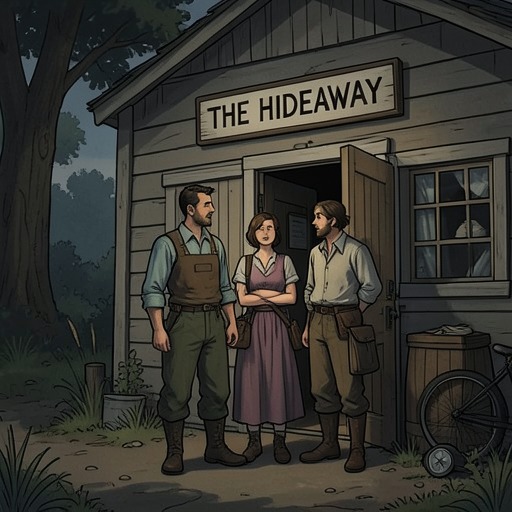
Dumplin'The Hideaway is an Odessa, Texas, bar that becomes a crucial point of connection for Willowdean Dickson and her friends. First, a Dolly Parton drag show gives them a night outside Clover City’s familiar expectations and brings Willowdean into contact with people who knew Lucy. Later, the same venue becomes a makeshift training space for the Miss Teen Blue Bonnet Pageant. Its significance lies in that double use: it is at once a rough-edged bar, a place of remembrance, and a source of practical help beyond the girls’ hometown.
Setting and First Arrival
The Hideaway is located at Palmer and Fourth in Odessa, Texas. Willowdean recognizes its hot-pink blinking sign from a photograph of Lucy that Mrs. Dryver gave her to keep. The recognition makes the trip more than a search for entertainment: the place is already connected, through the photograph, to someone Willowdean has lost. As the friends drive farther from town, they carry a crumpled advertisement for Dolly Parton Night, which promises a contest among Dolly impersonators and an unusually irreverent title for its winner. The poster’s exuberant language offers little indication of what the group will find once they arrive.
The venue also unsettles the group’s expectations. Millie Michalchuk wonders whether a pageant could really take place in a bar, and Willowdean admits that the event may not be a pageant in the sense her friends expect. Inside, they are seated at a small table beside the stage but well away from the bar. A waiter checks their wristbands and brings four waters. Those details establish the girls as visitors negotiating an unfamiliar adult venue, while the stage and the crowd place them close enough to watch the performance without making the bar itself their destination.
Dolly Parton Night
The show begins with the room going dark except for a few runner lights near the bar. A sultry announcement welcomes the crowd to Dolly Parton Night, and the cheering audience is introduced to the first performer. The Hideaway’s ordinary identity as a bar gives way to the particular ceremony of a live show: a stage, an emcee, a crowd, and a succession of acts presented for the room’s attention.
Willowdean and her friends watch drag queens of different shapes, sizes, and colors perform in elaborate sparkling costumes, high heels, and striking wigs. The performers do not present one uniform model of beauty; each has a distinct style and presence. One act pairs a woman dressed as Kenny Rogers with a performance of “Islands in the Stream.” The range onstage matters to Willowdean because she is accustomed to comparing herself against ideals that seem to reward being prettier, smarter, or thinner. Here, the performers’ individual forms of glamour are visible rather than erased in favor of a single standard.
Willowdean’s favorite is Lee Wei, a short Asian queen whose sequined baby-blue minidress blurs with movement. When Lee begins “Jolene,” a single note is enough to send the bar into an enthusiastic response. For Willowdean, the song carries more than its familiar melody: she connects its plea to the fear that another woman will be more beautiful and more worthy. She understands that fear as part of a relentless pursuit of perfection, an ideal that remains just out of reach. The Hideaway’s performance thus gives a personal association a public setting, linking the song she loves to the body-conscious anxieties that will accompany her own pageant participation.
Lucy’s Connections at the Bar
After the show, Dale, the bouncer and owner, calls Lee out from the back door. Lee is the performer who sang “Jolene”; away from the stage and without her high heels, she appears shorter and rounder to Willowdean. Dale asks whether Lee remembers Lucy, who used to come to the club with Mrs. Dryver. The exchange reveals that Lucy’s connection to the Hideaway was not merely a trace in a photograph: people there remember her as someone who visited and formed relationships.
When Dale explains that Willowdean is Lucy’s niece, Lee reaches for her hand without hesitation and offers her sympathy. She remembers Lucy as kind and open-hearted and says that the people at the club were sad to see her go. Willowdean tells Lee that she has felt lost without Lucy, comparing her aunt to a compass she had not realized she possessed. The image turns the meeting into an encounter with shared memory: Lee cannot replace Lucy, but her recollection confirms that Lucy’s life extended beyond the family and that others continue to feel her absence. Dale offers Willowdean the club’s email address if she ever needs anything, giving the welcome a continuing, practical form.
A Training Space Beyond Clover City
The Hideaway returns in daylight, stripped of the show’s colored lights and performance glamour. Willowdean describes peeling paint and sticky floors; Hannah Perez teeters in three-inch heels and objects to wearing them in the pageant. Lee has lined the girls up onstage in high heels, while Dale sits at the bar with a tall beer. The same space that hosted performers now serves as a place for the girls to begin learning how to present themselves onstage.
This return follows Willowdean’s email to Dale. She had told him about finding the old registration form in Lucy’s dresser and about Millie, Amanda Lumbard, and Hannah. She admitted that the group did not know how to walk, pose, or present themselves, and feared that she would make a fool of herself and pull her friends down with her. Her appeal for help beyond Clover City brings the girls back to the club with a clear need: they want instruction, not a promise that they will win. Willowdean says that she wants to prove she can take part, even if she does not expect to win. Lee’s lineup on the Hideaway stage makes the request concrete: the girls have entered a place where performance is practiced, and where someone with relevant experience can help them prepare.
Narrative Significance
The Hideaway links three kinds of recognition. Its sign first identifies a place Willowdean knows through Lucy’s photograph; the drag show then offers a stage on which many forms of beauty command attention; finally, Lee and Dale recognize Willowdean as Lucy’s niece and respond to the group’s request for help. These connections keep the location from serving as a mere backdrop. What happens there changes Willowdean’s sense of where support and possibility might be found.
The contrast between night and day sharpens that role. At night, costumes, wigs, heels, music, and applause transform the bar into a vivid performance space. By day, its peeling paint and sticky floors remain in view, but the stage is still available for practice. The Hideaway does not become a polished pageant venue; instead, it supplies access to performers and instruction outside Clover City. Its imperfect surroundings and generous welcome together offer an alternative to the town’s narrow measure of who belongs onstage.