The bullying climate at Clover City school
Dumplin'The bullying climate at Clover City school is defined by more than isolated insults: ridicule becomes a public routine, reinforced by spectators, shared images, and nicknames that follow their targets. Patrick Thomas is its most visible instigator, but the surrounding students help make mockery effective by watching, laughing, and passing it along. For Willowdean Dickson, encounters with Millie Michalchuk, Amanda Lumbard, and Hannah Perez gradually make clear that the cruelty she has endured is also directed at other students, and that silence can leave its targets isolated.
Nicknames and Public Humiliation
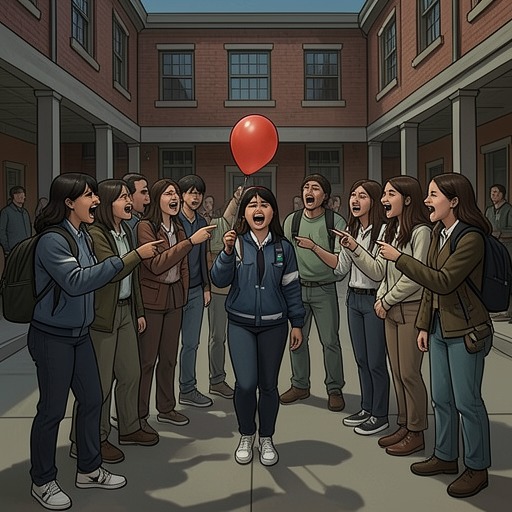
Patrick’s habit of assigning labels turns students’ bodies and differences into material for ridicule. When Millie approaches her parents’ minivan, Patrick and his friends gather by the driver’s-side door and make pig noises. Willowdean recognizes the setup before Millie reaches it and calls her over, giving her a reason to change course. She congratulates Millie on getting her driver’s license and listens as Millie talks about changing the radio presets and pumping gas for the first time. While Millie speaks, Patrick makes a mocking gesture behind her. His friends eventually leave, but the episode shows how humiliation is staged: a group occupies a public space, waits for its target, and expects her to face the ridicule alone.
Willowdean’s account also identifies the longer reach of Patrick’s nicknames. Hannah Perez has been singled out through a name tied to her teeth; Amanda Lumbard is mocked because she wears corrective shoes for her uneven legs. Willowdean recalls Amanda being stared at when she limped before getting those shoes, and notes the mismatch between Patrick’s comparison of her to a fictional monster and the actual character associated with that name. The details make clear that these insults do not describe the girls neutrally. They convert visible differences into invitations for group judgment.
Complicity and the Decision to Intervene
At lunch, the social circulation of bullying becomes explicit when students gather around their phones to look at a comparison between Hannah’s school photograph and a horse. Some laugh; others condemn her appearance or suggest that she should change it. Willowdean objects to the image and later thinks about the assumption behind the suggestion that Hannah should get braces. She recognizes that the audience treats a visible feature as a defect Hannah is responsible for correcting, without knowing whether braces are affordable or wanted. Her objection marks a change in attention: Patrick’s targets are no longer merely people Willowdean notices from a distance but classmates whose treatment she refuses to accept as harmless entertainment.
That recognition has particular force because Willowdean has previously managed bullying by trying not to give the bully a response. Her aunt Lucy had advised her that ignoring bullies could deprive them of attention, and Willowdean remembers that showing distress had once made the teasing worse. But she concludes that Patrick does not need a reason or an audience’s encouragement to continue. When he publicly uses a family nickname to humiliate her and links it to her size, Willowdean approaches him rather than disappearing from the encounter. She responds physically, and teachers intervene and take her away. The response is impulsive rather than a planned speech, but it exposes the limits of the strategy of invisibility: Patrick’s conduct persists even when targets try not to reward it with attention.
Body Scrutiny Beyond the Schoolyard
The novel connects school bullying to a wider culture that treats fatness as something to explain, correct, or hide. At work, Willowdean finds that the uniform’s polyester pants do not fit over her hips, while a customer makes an unwelcome comment about her appearance. The practical problem of clothing becomes part of the same public scrutiny she encounters at school: other people’s expectations are built into what is supposed to fit, and she is left to manage the discomfort. Yet her understanding of her body is not simply an extension of other people’s judgment. She uses the word fat for herself as an accurate description, rejecting the shame that others attach to it.
That conflict appears again when Willowdean watches a television weight-loss program with her mother. The program presents its fat teenage subject as unhappy and in need of transformation; Willowdean resents the narrow roles available to fat people on screen and does not recognize herself in either the miserable subject or the cheerful supporting friend. Her mother’s eyes water during the program’s appeal to abandon one’s current self for a thinner one, suggesting that its message resonates with her own history and hopes. Willowdean understands that her mother was once fat too, and connects the difference between her mother’s experience and Lucy’s to the family’s history of dieting. The scene places personal body-image pressure inside a larger pattern: images and family memories can teach people to regard thinness as the necessary end of a life story.
Even an affectionate family nickname becomes uncomfortable in public. When Willowdean’s mother calls her by the name she usually uses at home in front of students, several boys laugh. Willowdean asks her mother not to use it outside the house. The moment is not equivalent to Patrick’s sustained targeting, but it shows how an intimate term can acquire a different force under the school’s watching eyes. In that setting, Willowdean has to manage not only what others call her but also which parts of family affection she is willing to make public.
Resistance, Visibility, and Limits
The book contrasts these moments of exposure with Willowdean’s later appearance in the swimsuit round of the pageant. Her thighs remain a focus of self-consciousness, and she compares herself unfavorably with Ellen Dryver, who walks onstage in a green two-piece. Still, Willowdean takes her turn in a red swimsuit. She does not hurry away as she did after being noticed at the pool; no one boos, and the feared public catastrophe does not occur. Amanda waits at the far end and tells Willowdean she looked good. This moment does not erase the teasing or make insecurity disappear. Instead, it changes what visibility can mean: being seen in a body that attracts judgment does not require accepting the judgment as deserved.
The school’s bullying climate is therefore presented as both interpersonal and cultural. Patrick’s conduct supplies its most direct cruelty, while the crowd’s reactions, online sharing, appearance-based criticism, and everyday pressures around clothing and thinness help establish why such cruelty lands. Willowdean’s trajectory is not a simple passage from insecurity to confidence. She continues to notice and fear scrutiny, but increasingly distinguishes the existence of discomfort from the obligation to feel ashamed. Her interventions for Millie and Hannah, her refusal to treat fatness as an insult, and her decision to remain onstage each challenge a different condition of the climate: isolation, silence, and the demand that a body earn the right to be visible.