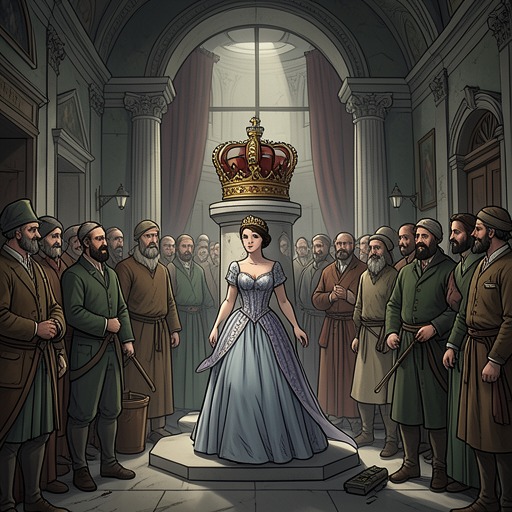
The original Miss Teen Blue Bonnet crown
Dumplin'The original Miss Teen Blue Bonnet crown is the pageant’s oldest and most distinctive crown, preserved among three crowns assigned to Clover City. Its cloudy rhinestones and tarnished metal set it apart from the newer, brighter versions, giving it a presence that exceeds its role as a prize. In a private fitting at All That Shines, the crown becomes more than an emblem of pageant victory: for Willowdean Dickson, wearing it offers a momentary connection to a tradition she has resisted and to the people she wishes could see her wear it.
Identity and Appearance
The crown is kept at All That Shines, a jewelry store nearly as old as Clover City and the sole distributor of Miss Blue Bonnet crowns for the entire state of Texas. Its custody is unusually careful: Willowdean describes the cubic-zirconia crowns as guarded more securely than the bank across the street. The original is not simply left out among the store’s merchandise. Donna locks the front door, leads Willowdean through a curtain and two offices, and unlocks a tiny closet lined with boxes.
The boxes are marked with towns from across the state, but three are labeled for Clover City. Donna explains that they hold three distinct crowns: the original, which sometimes goes on display at city hall; the crown given to the winner; and a reserve in case the winner’s crown goes missing. The original therefore belongs to the pageant’s history and public display, rather than serving as the ordinary award. The spare and the winner’s crown are almost identical, but the original is visibly different.
Its rhinestones have grown foggy and its metal tarnished with age. Willowdean finds it less shiny and less prissy than the newer crowns, yet still regal and commanding. That contrast makes age part of its character: where the newer crowns look like polished pageant prizes, this one bears the marks of time while retaining an authority that Willowdean recognizes. Donna shares her preference, catching Willowdean’s attention on the original and saying she likes it best, too.
The Private Fitting
Willowdean encounters the crown while making a downtown trip to fill a prescription for her mother before the pharmacy might close. With parking limited, she takes a spot in front of All That Shines, where a sign says that the space is for customers only. The errand places her at the store, and Donna’s invitation carries her past the ordinary shop and into the protected rooms where the city’s crowns are kept.
The original changes Willowdean’s view, briefly, of the pageant itself. She has despised the competition, but looking at the crown allows her to understand why her mother devotes so much of her life to it and why girls in Clover City dream of gowns and spotlights. That understanding does not erase her opposition; rather, it gives the institution a human meaning she had not been able to see. The crown becomes the point at which an abstract pageant tradition takes on the allure of a carefully preserved object.
Donna admits that she tries the crowns on once in a while and invites Willowdean to try the original. Willowdean hesitates, afraid she might break it, while Donna’s confidence makes clear that the offer is deliberate. She positions Willowdean before the mirror on the back of her door and places the crown on her head. The setting remains intimate and unofficial: this is not a stage appearance or an award ceremony, but a private encounter made possible by Donna’s access and trust.
Meaning for Willowdean
The crown’s physical weight becomes meaningful even though Willowdean knows it is costume jewelry and that the fitting is not an official pageant moment. On her head, it feels like a responsibility. She is wearing the crown over her red-and-white Harpy’s Burgers & Dogs uniform, an everyday work outfit that sharply contrasts with the ceremonial image of a pageant queen. The juxtaposition makes the moment less about transformation into a conventional contestant than about the unexpected coexistence of the ordinary Willowdean and the pageant’s prized object.
As she stands before the mirror, Willowdean wishes that Lucy, Ellen, or even her mother were there to see her. The unshared moment gathers together relationships that matter to her: Lucy is absent, her friendship with Ellen is part of what she longs to have present, and her mother is closely bound to the pageant that Willowdean has begun to understand differently. The crown does not repair those absences or settle Willowdean’s place in the pageant. Instead, its private presence brings those connections into the moment without turning it into a public victory.
Donna adds that she doubts Willowdean’s mother has ever tried on the original and tells Willowdean not to tell anyone. The secrecy distinguishes the fitting from the pageant’s public display and formal rules. Donna’s explanation for letting Willowdean wear it is that a person does not always have to win a pageant to wear a crown. The remark loosens the object from its usual logic of competition: the crown can be worn as an experience in its own right, not only as proof that a contestant has defeated the others.
Narrative Significance
The crown’s three-part arrangement—the original, the winner’s crown, and the backup—shows how the pageant’s symbols are both cherished and managed. The original is valuable enough to be guarded and sometimes displayed at city hall, while its carefully maintained distinction from the replacement crowns gives it a particular aura. Yet the moment that matters most to Willowdean takes place away from the official display, in front of a small mirror, with the crown resting on a work uniform.
That reversal gives the crown its significance in the scene. It is an emblem of a competition Willowdean dislikes, but its worn beauty enables her to glimpse why the pageant matters to her mother and to girls in Clover City. Donna’s invitation then makes the emblem available without requiring a win. The original crown thus holds two meanings together: it carries the authority of the pageant, and it briefly offers Willowdean a way to participate in that world on terms other than its usual measure of success.