Willowdean Decides to Enter the Miss Teen Blue Bonnet Pageant
Dumplin'Willowdean Decides to Enter the Miss Teen Blue Bonnet Pageant is the turning point at which Willowdean makes the pageant her own rather than treating it as part of her mother’s life. Her decision begins with a discovery among Lucy’s belongings and becomes a challenge to the self-denial that Willowdean recognizes in her aunt’s story. It also moves a private resolve into public action: Willowdean tells Ellen, prepares to enter, and faces the need for her mother’s consent.
Background: the pageant in Lucy’s room
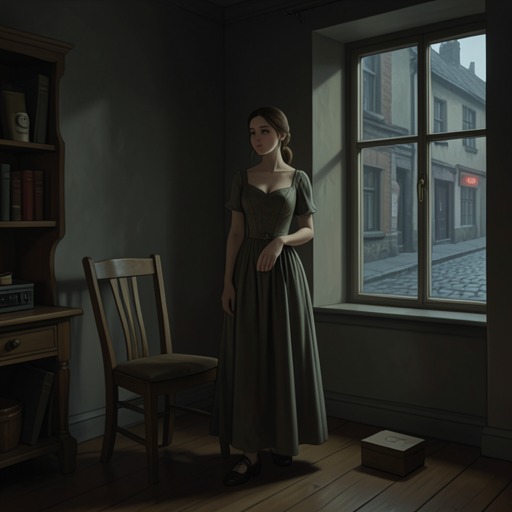
On a Saturday when Ellen is working and Willowdean is alone at home, boredom draws her into Lucy’s room. There she finds newspaper clippings of Willowdean’s mother, repeatedly pictured in her crown and the same dress beside successive Miss Teen Blue Bonnet winners. The pageant has been part of her mother’s life for years, but until now it has seemed like background noise to Willowdean: something her mother attended while Willowdean stayed with Lucy or visited Ellen. The clippings make the family connection visible, while an unexpected document changes what the pageant might mean to Willowdean herself.
Among Lucy’s papers is a blank registration form dated 1994, three years before Willowdean’s mother won. The date rules out her mother as a possible applicant then, and the form leaves Willowdean wondering why Lucy kept it. She knows Lucy was not timid, but cannot picture her entering the competition, which Lucy seemed to regard as a joke. The form offers no answer about Lucy’s intentions. Its importance lies instead in the possibility it opens: Willowdean imagines Lucy’s handwriting in the spaces for name, age, address, height, weight, hair and eye color, career ambition, and talent. The questions bring the pageant’s scrutiny of bodies and public identity into sharp focus even before Willowdean considers applying herself.
Another object in the drawer gives that possibility a painful context. A red velvet box holds an iridescent Dollywood ornament bearing Dolly Parton’s signature. Lucy had long wanted to visit Dollywood, and Mrs. Dryver once offered her a second airline ticket after winning tickets at work. Lucy and Mrs. Dryver made plans, looked into hotels and rental cars, and drove to the nearest airport. There Lucy learned that she would have to buy an extra seat because she would not fit in one plane seat. Mortified, she went home rather than take up two seats; Mrs. Dryver brought back the ornament. The keepsake preserves both the trip Lucy wanted and the physical and social barrier that stopped her from taking it.
From discovery to decision
Back in her room, Willowdean studies the form and discovers that the formal requirements are narrower than the obstacles she had imagined: a contestant must be between fifteen and eighteen, and her parents must consent. The contrast between the long list of personal measurements on the application and the short list of eligibility rules unsettles her assumptions about who can compete. It also makes entry seem possible, though not consequence-free. She puts the form away when the thought of entering first occurs to her, rather than announcing a decision on the spot.
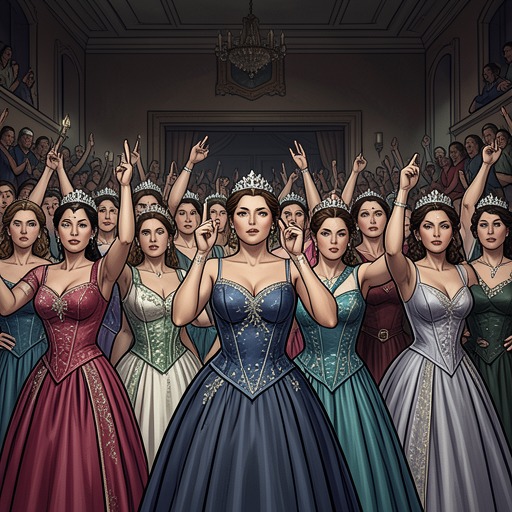
The following morning brings doubt. Willowdean has what she describes as an emotional hangover and tells herself that, since no one else knows what she decided the night before, she can back out without anyone noticing. She spends the day wavering. Later, instead of concentrating on required reading, she takes out the registration form again and pictures herself in a formal gown, moving across a stage as if she belonged there. The image seems absurd to her, but the return to the form shows that the idea has not gone away.
Lucy’s experience gives the choice its deeper urgency. Willowdean does not claim that Lucy wanted the pageant in particular, nor does she pretend that Lucy was healthy in her last years. What troubles her is the larger pattern: Lucy missed things she wanted not simply because she could not do them, but because she told herself she could not, and no one persuaded her otherwise. Willowdean sees that pattern as a reason not to pre-emptively deny herself an opportunity. Entering will not undo Lucy’s missed trip or establish what Lucy might have chosen, but it can interrupt the inheritance of assuming that desire must yield to anticipated judgment.
Telling Ellen and taking the first steps
When Willowdean calls Ellen, she could still retreat or turn the conversation toward Bo, whom she has not fully let go. Instead, she tells Ellen that she is entering the pageant. Ellen answers with immediate enthusiasm and proposes that they make a plan the next day. Her response turns Willowdean’s solitary, easily disowned intention into something shared. Willowdean worries that her mother will react badly and frames the entry partly as a way to give her mother a reason to be embarrassed. Ellen does not argue with that fear; she moves toward practical support, arranging to meet Willowdean while she is working.
The next concrete step is registration at the Clover City Community Center, downtown in the town square. Willowdean and Ellen sit on a bench as Willowdean counts out the two-hundred-dollar fee. She has not obtained her mother’s signature, and the requirement that a parent consent becomes the immediate obstacle. Her greatest fear is that her mother will refuse in front of the people gathered there. The gap between the form’s simple age requirement and the consent rule is therefore consequential: eligibility gives Willowdean a way in, but entering also makes her dependent on a parent whose relationship to the pageant is already charged with history.
Significance and wider stakes
The decision begins as an act of self-definition, but it does not make Willowdean suddenly free of self-doubt. Her imagined stage entrance still looks ludicrous to her, and the form’s questions still expose the kinds of bodily judgments the competition invites. The choice matters because she acts without waiting for certainty that she will feel at home there. Ellen’s support offers companionship, while the looming consent question and the two-hundred-dollar fee make clear that resolve alone cannot remove every practical barrier.
The pageant’s possible meaning also widens beyond Willowdean’s own body and family. Later, her attention to Hannah’s experiences brings other forms of exclusion into view: classmates ridicule Hannah’s teeth, and Hannah explains that dental treatment is expensive for her family. At the Hideaway, Willowdean recognizes how unfamiliar openly gay people are in her small-town world, recalling Lucy’s online friendships and her affection for Dolly Parton. These later encounters do not supply the cause of Willowdean’s original decision, which is rooted in the form and Lucy’s story. They show, however, how participation brings her into contact with other people who face distinct judgments and constraints. The choice to enter marks the beginning of that larger engagement: the pageant is no longer only her mother’s domain, but a public space Willowdean can enter while questioning who is presumed to belong there.