Willowdean Decides to Return to the Pageant
Dumplin'Willowdean Dickson decides to return to the Miss Teen Blue Bonnet Pageant after Hannah Perez reveals that Willowdean’s withdrawal has blocked Millie Michalchuk from competing. The decision turns Willowdean’s private crisis about belonging into a responsibility toward someone else: she does not suddenly become confident about the pageant, but recognizes that her absence has consequences for Millie and chooses not to let fear make that choice for her.
Crisis and self-doubt
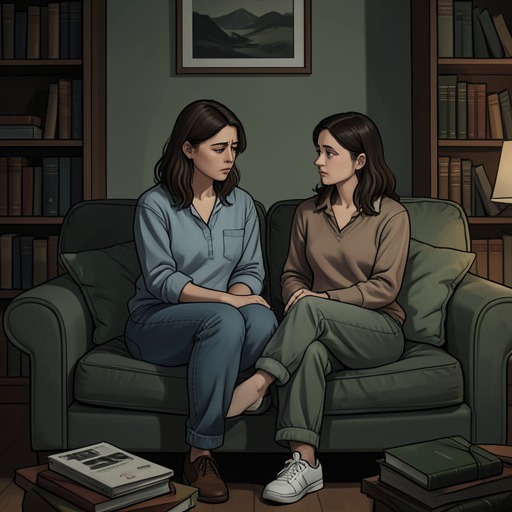
The conversation takes place upstairs in Willowdean’s bedroom. Hannah is spread across the bed, and the Magic 8 Ball from Willowdean’s nightstand supplies an absurdly blunt answer to whether Willowdean has lost her composure. Willowdean sits at the foot of the bed, then lies flat on her back, staring at the ceiling as if avoiding Hannah’s face might make the confession easier. The bedroom’s ordinary objects and deliberately evasive posture frame a moment she has trouble saying aloud.
Willowdean explains that two boys are part of what has unsettled her, but she cannot make sense of why she wanted to enter the pageant in the first place. Her uncertainty reaches beyond the competition: she wonders whether she deserves the same experiences as other girls, then counters that being different may mean she will not receive them. In her fearful logic, competing would not test whether the pageant could make room for her; it would prove that it could not. The possibility of being judged is therefore bound up with a more intimate fear that trying will turn exclusion into confirmation.
Hannah challenges the retreat
Hannah rejects Willowdean’s assumption that the answer is to avoid competing. She acknowledges that fat girls, girls with limps, and girls with big teeth may not usually win beauty pageants, but argues that the norm will not change if they are absent. Her point is not that participation guarantees victory. It is that expecting inclusion without demanding it leaves the existing standard untouched. The contest becomes, in Hannah’s framing, a place where presence itself can challenge what its contestants are expected to look like.
Hannah also presses Willowdean to stop treating the decision solely as a private test of courage. She names Amanda Lumbard and Millie as people for whom Willowdean should consider going through with it, then admits that she herself is included. Willowdean initially insists that her friends will be fine without her. Hannah answers that they will not, shifting the discussion from Willowdean’s abstract doubts about deserving a place to the practical effect of her withdrawal on the people around her.
Millie’s stake in the decision
Hannah explains that Millie’s parents learned about the pageant. Millie pleaded with them and told them that Willowdean’s mother ran it; her parents agreed that Millie could compete if Willowdean was competing too. That condition makes Willowdean’s withdrawal decisive. Millie has not simply been disappointed by a friend’s change of mind: the permission she worked to obtain depends on Willowdean’s continued participation, so Willowdean’s exit has closed the door for her as well.
Willowdean understands the importance of the opportunity through Millie’s long-held interest in the pageant. Millie has idolized and studied its contestants throughout her life, and competing would mean allowing herself to take a place among them. The distinction matters to Willowdean: for Millie, this is not a casual activity that can be replaced without loss. As the consequence settles in, Willowdean feels guilt and notices her own physical discomfort—chapped lips and the grime of a weekend without a shower. Her leg bounces while she weighs what she owes Millie; Hannah reaches over and stills it. The gesture accompanies a change in focus, from spiraling over Willowdean’s own fear to recognizing the cost of leaving Millie alone with it.
A reluctant return
Willowdean decides that she may not earn any good karma from returning, and she does not claim that the competition will stop being frightening or become fair. Instead, she arrives at a narrower obligation: if she cannot yet take hold of life as boldly as Millie is trying to, she can at least avoid standing in Millie’s way. Her return is therefore an act of solidarity rather than a declaration that her doubts have disappeared. It preserves Millie’s chance while requiring Willowdean to face the very exposure she had tried to escape.
She tells Hannah that the pageant is going to be a disaster. Hannah smiles and indicates that disaster is part of what she is counting on. Their exchange leaves the outcome open, but confirms the decision: Willowdean is going back, without any promise of winning or even of feeling ready. The next account turns to the pageant’s demanding preparation, including interviews and dress rehearsals that bring blisters, double-stick tape, and tears. That shift makes the return concrete: the decision moves Willowdean from the safety of a bedroom conversation into the work and public scrutiny of Clover City’s competition.