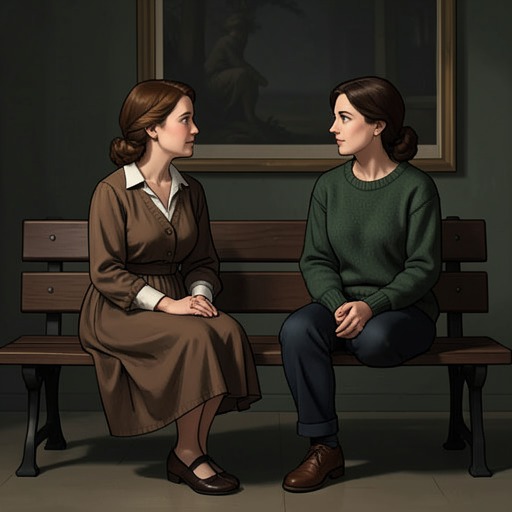
Willowdean Dickson and Hannah’s friendship
Dumplin'Willowdean Dickson and Hannah Perez form a friendship out of candor rather than easy reassurance. Their connection grows as they recognize one another’s guardedness and the different pressures each faces in Clover City. Hannah offers Willowdean a place to speak honestly about her body and her feelings for Bo Larson; Willowdean, in turn, names her affection for Hannah without making it a consolation prize. Their friendship becomes consequential when Hannah insists that Willowdean return to the pageant—not simply for herself, but for Millie Michalchuk and the other girls who need her presence.
First Impressions and Shared Marginality
Willowdean initially knows Hannah mostly through brief, forceful encounters. In third grade, Hannah had barely spoken during the year, but she slapped a marker from Willowdean’s hand and demanded that Willowdean ask permission before taking it. Later, in fifth grade, Hannah snapped at a teacher who repeatedly called her African American; Willowdean understood that Hannah was Dominican. These memories leave Willowdean with an impression of someone quiet but stubborn, ready to defend herself when others presume to define or disregard her.
At school, Willowdean notices the cruelty directed at Hannah’s teeth. The comments follow Hannah through the halls, including demands that she get braces. Willowdean thinks about the possibility that braces are unaffordable or frightening for Hannah, and rejects the idea that Hannah should have to alter her mouth to satisfy people who are tormenting her. That early sympathy is not yet a friendship, but it anticipates the trust between them: Willowdean can recognize a cruelty directed at someone else without pretending that their experiences are identical.
Their different positions become clearer during a visit to The Hideaway. Willowdean realizes how little she knows about openly gay people in Clover City, where they have been treated as rumors or cautionary tales, while remembering Lucy’s many gay friends online and her description of Dolly Parton as the patron saint of gay men. Hannah and Amanda Lumbard respond to the men outside the bar with casual curiosity, including Amanda’s admiration for their eyebrows. The scene places Willowdean’s sheltered perspective beside a social world she has not encountered, and opens a context in which Hannah can speak more plainly about herself.
A Friendship Built on Plain Speech
In a dark, private conversation, Willowdean tells Hannah that she and Bo work together and are friends. Hannah recognizes him as the attractive boy from study hall and recalls seeing them together in the girls’ bathroom. Willowdean admits that the friendship includes kissing. Hannah does not force a label onto what Willowdean has not resolved; her teasing gives way to a serious discussion of why Willowdean cannot answer Bo’s offer of a relationship.
Willowdean explains that she believes Bo likes her, but fears other people will not understand what he sees in her. She describes the ordinary humiliations that shape her sense of exposure: wondering whether an armchair will accommodate her, feeling watched when a floor creaks beneath her, and knowing that most mall clothes will not fit. Hannah does not offer a quick reassurance that Willowdean should simply do what makes her happy. Instead, she acknowledges how people such as Patrick Thomas could turn a public relationship into an occasion for ridicule. For Willowdean, that lack of forced comfort is a relief: Hannah listens without denying the social conditions that make the fear real.
Their conversation also turns toward labels. Hannah suggests that terms such as boyfriend and girlfriend may make relationships easier for other people to understand, while Willowdean admits that labels offer her a sense of safety, especially with Bo. They do not resolve the tension between naming a relationship and resisting other people’s expectations. The friendship matters partly because it allows the disagreement to remain open: Hannah can question the usefulness of labels without making Willowdean’s need for certainty seem foolish.
Willowdean then asks why Hannah has never had her teeth fixed, an intentionally awkward question. Hannah immediately asks why she should have to, then explains that braces are expensive: her mother is a hairdresser, her father a mechanic, and the family does not have strong insurance. Willowdean agrees that Hannah should not have to change her teeth. Hannah clarifies that she is not apologizing for being sharp; she says she keeps her defenses up because she has no friend to walk down the school hallway with. Willowdean tells her she likes her and likes talking with her, not out of pity but because she genuinely wants her friendship. Hannah answers quietly. Willowdean still misses Ellen Dryver, but recognizes relief in having another person with whom she can talk about more than the pageant, even if those conversations happen in the dark.
From Confidante to Ally
The friendship extends beyond their private talk. After Hannah has called repeatedly over a weekend, she comes to Willowdean’s home with a container of sancocho made by her mother. Hannah says her mother considers Willowdean a favorite because of the pageant. The gesture brings Willowdean into Hannah’s family’s concern, while Hannah’s blunt insistence that Willowdean cannot quit makes their friendship active rather than merely sympathetic.
When Willowdean explains that competing may only prove how different she is from the girls who usually win, Hannah rejects the idea that anyone must first deserve a pageant place by already fitting its standards. Girls who are fat, have limps, or have big teeth may not usually win, she argues, but changing that requires their presence; nobody is going to offer them inclusion without being asked to. Hannah speaks from her own position as a half-Dominican lesbian with buckteeth, and Willowdean’s response—that Hannah can conceal part of herself in a way Willowdean cannot conceal her size—lands as a low blow. Hannah does not let the hurt erase her point. She identifies Willowdean’s projection and asks her to consider Amanda and Millie as well as herself.
That appeal changes the stakes for Willowdean. Millie has studied pageant contestants for years and has finally allowed herself to compete; without Willowdean, Millie cannot enter. Hannah makes clear that Willowdean’s withdrawal would obstruct someone else’s long-awaited chance. Willowdean recognizes that this is not a joke to Millie and decides that, even if she cannot yet feel brave for herself, she should not stand in Millie’s way. Hannah reaches over and stills Willowdean’s bouncing leg as she makes the decision. The small gesture accompanies a difficult turn: Hannah does not simply comfort her friend but helps her move from self-protective withdrawal toward responsibility and action.
Trust, Difference, and Continuing Support
The friendship does not replace Willowdean’s bond with Ellen. When Willowdean and Ellen finally speak honestly, Willowdean calls Ellen her best friend and says that this has remained true even through the previous two months. That acknowledgment gives the relationships distinct places in Willowdean’s life: she misses Ellen and wants to repair their friendship, while Hannah has become someone she can confide in about the pageant, body image, and Bo. The book does not present one friend as a substitute for the other.
Hannah’s support also remains understated in public. During the pageant, after Willowdean performs, Hannah passes her on the way out and raises a hand for a high five without saying anything. The gesture echoes the friendship’s characteristic economy: their strongest exchanges have been direct, sometimes uncomfortable, and more useful than polished reassurance. Hannah has challenged Willowdean, shared parts of her own isolation, and stood beside her decision to return. In turn, Willowdean has treated Hannah’s teeth and identity as matters Hannah has the right to define, not defects she owes the town an explanation for. Their friendship makes solidarity practical: it means listening without flattening difference, telling a friend when she is wrong, and showing up when another girl’s opportunity depends on it.