Willowdean and Hannah's growing friendship
Dumplin'Willowdean and Hannah’s growing friendship begins in the uneasy quiet of a late-night conversation and becomes a source of mutual support when Willowdean considers abandoning the Miss Teen Blue Bonnet Pageant. Hannah’s candor about isolation and prejudice gives Willowdean someone to talk to beyond the pageant, while Willowdean’s willingness to listen and her eventual return help make Hannah’s advocacy for the other contestants part of a shared effort. Their bond is private at first, then visible in a chain of hands joined before the pageant rehearsal and in a wordless high five afterward.
A Friendship Spoken Into the Dark
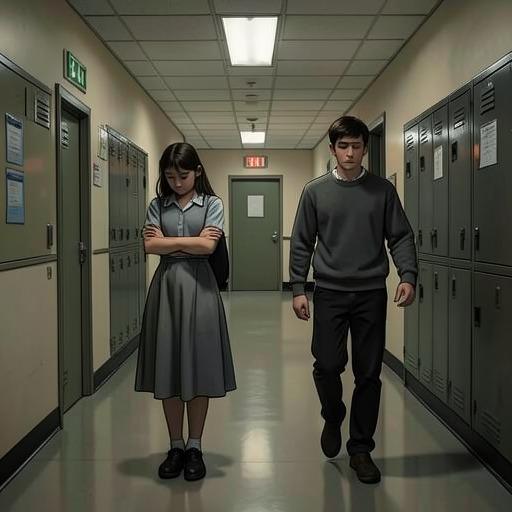
Hannah admits that she is tired of keeping her defenses raised. She says she has no friends who will walk down the school hallway with her, a confession that makes her earlier sharpness legible as more than simple hostility. Willowdean does not answer with a polished reassurance: she tells Hannah that she is her friend because she likes her and likes talking to her. The distinction matters. Her offer is not framed as pity or as a response Hannah has successfully elicited by describing her loneliness; it is an expression of personal affection and conversational ease.
The scene’s setting gives that affirmation its shape. Hannah is getting ready to leave, and Willowdean passes her two empty beer cans. For a moment, the room is so quiet that Willowdean cannot tell whether Hannah is still there. Hannah’s whispered answer is small, but the exchange changes what the silence means: it is no longer simply the space between two guarded people. Willowdean later recognizes the relief of having another friend with whom she can discuss more than the pageant, even if, at this stage, that friendship exists only in the dark.
That relief does not erase Willowdean’s grief over her estrangement from Ellen Dryver. She explicitly continues to miss Ellen, while also valuing the possibility of a different connection. The friendship with Hannah is therefore not presented as a replacement that makes the earlier loss disappear. It gives Willowdean another place for conversation while her closest old friendship remains painfully absent.
Hannah’s Isolation and Her Pageant Defiance
Hannah’s account connects her guardedness to both social exclusion and material circumstances. She explains that medical care is expensive and that her mother is a hairdresser while her father is a mechanic, so the family does not have especially good insurance. She also describes having no companion beside her in the school hallway. Her circumstances give context to her defensiveness without reducing her to it: she can laugh at the idea that she was apologizing, acknowledge how hard it is not to keep her claws out, and still speak plainly about what she lacks.
The pageant began for Hannah as an act of sabotage. She entered intending to ruin it from within, because she did not want to be defined as the girl with buckteeth; she wanted instead to be remembered as the girl who wrecked the event. Her mother’s discovery of the welcome packet unsettles that plan. Hannah’s mother is proud that she entered, leaving Hannah caught between her original intention and the significance her participation has acquired at home. The contest that was supposed to let her control how she was seen has become a commitment with consequences beyond her own defiance.
When Willowdean later doubts that she belongs in the competition, Hannah challenges the conclusion that difference makes participation futile. She argues that girls who are fat, have limps, or have big teeth will not change pageant norms by staying away; they have to be present and demand inclusion. This is not an easy exchange. Willowdean says that people notice her size as soon as she enters a room, then wrongly suggests Hannah can conceal the difference that marks her out. Hannah calls this a low blow and identifies herself as a half-Dominican lesbian with buckteeth in their town. Willowdean begins to apologize, and Hannah identifies the remark as projection. Their closeness does not mean they share identical experiences or avoid hurting each other; the scene makes room for disagreement and correction within the friendship.
Mutual Support and Willowdean’s Return
Hannah does not rely only on broad arguments about representation. When Willowdean says the other girls will manage without her, Hannah answers that they will not: Millie Michalchuk cannot compete unless Willowdean does. She asks Willowdean to consider Amanda Lumbard and Millie as well as herself, and finally adds herself to that appeal. The request makes their connection part of a wider set of dependencies. Willowdean’s choice affects friends who have their own reasons for entering, not just her private sense of whether she can withstand being judged.
Willowdean understands that Millie’s participation is not a joke or a casual wish. Millie has studied and idolized pageant contestants for years and is finally allowing herself to become one. Willowdean recognizes that she owes Millie at least the courtesy of not standing in her way. Hannah’s intervention does not make the decision effortless: Willowdean still expects a disaster. But she agrees to return, and Hannah meets the prediction with a smile that suggests she is prepared for the mess rather than demanding a smooth or triumphant performance. Her support is directed toward showing up, not promising that the pageant will be easy.
Hannah also appears as a friend in ordinary, practical gestures. After calling Willowdean repeatedly over the weekend, she comes to her home carrying a container of her mother’s sancocho. She explains that her mother wanted Willowdean to have it and has become fond of her because of the pageant. The visit brings Hannah’s family into the relationship without turning the meal into a grand declaration: the food is something delivered and put into Willowdean’s refrigerator, while Hannah settles naturally at the kitchen table. The scene shows the friendship extending beyond the secretive conversation that first named it.
A Shared Place Among the Contestants
Before a rehearsal, the support among the girls becomes physical and collective. Millie holds Willowdean’s hand while explaining how much the pageant means to her and confronting her mother about the obstacle to competing. After Millie’s mother agrees, Willowdean and Millie return to the auditorium together. Contestants who have been listening give Millie encouraging smiles. Ellen Dryver takes Willowdean’s hand, then Millie’s; Millie links fingers with Amanda; Willowdean turns toward Hannah with her palm raised, and Hannah takes her hand after a deep breath. Hannah’s acceptance completes a visible chain rather than a private exchange between just the two friends.
For Willowdean, the joined hands mark a shift in how she understands her position. She feels a bond among the five girls that is bigger than a crown and, for the first time since the pageant began, feels she has the upper hand. Her confidence comes here not from defeating the contestants or proving herself the most deserving individual, but from belonging to a group whose members acknowledge and support one another. Hannah’s friendship is one strand of that larger solidarity, and the scene situates it alongside Willowdean’s repaired connection with Ellen and the alliance formed around Millie’s chance to compete.
The rehearsal itself is chaotic: there is no time for the contestants to perform their talents, Callie slips on the ramp during the opening number, cues go wrong, and the proceedings include spills, tears, and blood. Hannah’s part in the aftermath is quieter. As she passes Willowdean on her way out, she raises her hand for a high five without saying anything. The gesture echoes the hand-taking before rehearsal, but now it acknowledges that Willowdean has followed through and that Hannah is there to recognize it. Across the friendship’s progression, support moves from a whispered acceptance in darkness to food at home, an argument that pushes Willowdean back toward action, joined hands in the auditorium, and a brief salute after a messy performance. Hannah and Willowdean do not need the friendship to be grand or effortless for it to change what either of them can face.