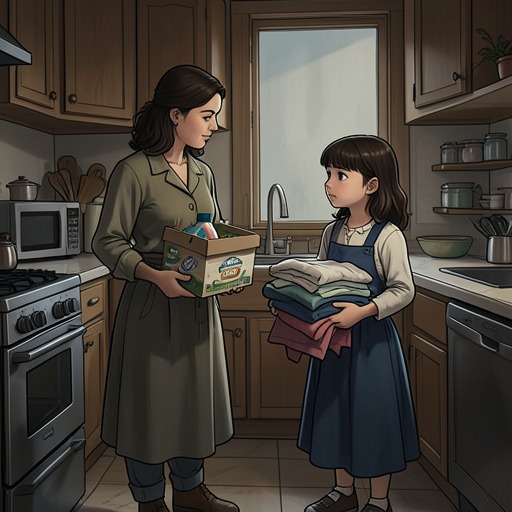
Willowdean and Her Mother Argue About Weight and Lucy
Dumplin'Willowdean Dickson and Her Mother Argue About Weight and Lucy is a confrontation in which a family’s grief becomes entangled with the demand that a fat body be changed. Willowdean challenges Rosie Dickson’s weight-focused concern as something more than worry about health or happiness: it carries the implication that Willowdean’s body is a problem and that Lucy’s life was diminished by hers. The argument ends not in agreement but in punishment, leaving the strain between mother and daughter unmistakable.
Causes and Background
Willowdean’s resistance grows out of ordinary, repeated encounters with standards that treat her body as a fault to correct. At work, the polyester pants offered as an alternative to a dress will not stretch far enough over her hips. She blames the garment rather than her body, and imagines her wide hips as an asset in a world that might value them differently. Her physical experience of clothing thus sharpens the conflict: the fit is presented as a problem with her, although the garment is what fails to accommodate her.
She is also deliberate about naming herself fat. Willowdean recognizes that people may describe other visible features without embarrassment, while the word that most accurately describes her body makes them uncomfortable. She uses the word herself rather than letting it function as an insult imposed by someone else. That distinction helps explain why Rosie’s repeated attention to weight feels to Willowdean like rejection, not neutral advice.
A television weight-loss program makes the competing views visible. The show follows Priscilla, a fat teenager, through ridicule, distress, exercise, and a trainer’s insistence that she pursue thinness. Willowdean objects to the familiar screen roles assigned to fat girls: unhappy with themselves or reduced to the jolly best friend. Rosie, meanwhile, is especially moved by the moment when the program urges Priscilla to stop obstructing her own path to thinness. Willowdean does not need to look at her mother to know that her eyes are watering. The scene gives context to her later accusation that weight-loss shows, fad-diet stories, and inspections of the pantry all communicate the same judgment about her body.
The Confrontation
The argument occurs while Willowdean is already under pressure following her school suspension. She objects that Rosie is punishing her for answering back after a boy used a degrading nickname—the same kind of nickname Rosie has used for years. Rosie calls Willowdean too sensitive. Willowdean insists the hurt is not confined to one name: she believes her mother cannot stand that her daughter looks the way she does.
She points to a pattern rather than a single remark. When Rosie watches weight-loss television, talks about a friend who lost a great deal of weight through a fad diet, or checks the pantry as though Willowdean might have eaten everything in it, Willowdean hears a judgment about her body. Rosie replies that she wants her daughter to be happy. Willowdean answers that she is happy, though she recognizes privately that she cannot make the claim with complete certainty. She also rejects the promise implicit in Rosie’s concern: losing fifteen or fifty pounds would not resolve her grief for Lucy, her confusion about Bo Larson, or the growing distance between her and Ellen Dryver.
Rosie connects thinness to the possibility of dating, arguing that Willowdean is missing out on boys and relationships. Willowdean counters that she wants to date and deserves the chance, but a man will not cure her troubles. The exchange exposes a crucial difference between them: Rosie frames weight loss as a route to a fuller life, while Willowdean refuses the notion that romantic attention must be earned by changing her body.
Lucy and the Meaning of Weight
The argument becomes most painful when each woman invokes Lucy. Rosie says Willowdean is doing what Lucy used to do as a girl: turning her words into something else. Willowdean rejects that account, saying Lucy showed Rosie how ridiculous she sounded. For Willowdean, Lucy’s responses were not distortions but challenges to the assumptions Rosie now repeats.
Rosie then insists that the dispute has nothing to do with Lucy, but immediately says she wishes Willowdean would not idolize her. Her claim that Lucy would still be alive if she had lost weight makes the conflict’s deepest wound explicit. Rosie treats Lucy’s body as the condition that might have prevented her survival; Willowdean refuses to accept weight as an explanation that can reduce Lucy’s life to a failure to become thin. She remembers Lucy as someone whose body did not prevent her from being happy, while also recognizing that Lucy chose to remain inside the house. Love and disagreement coexist in Willowdean’s response: she will always love Lucy, but she does not turn her aunt into a simple symbol of bodily acceptance or claim that Lucy’s isolation was imposed by her size alone.
Consequences and Significance
Rosie ends the confrontation by grounding Willowdean: she is forbidden to work or go out until her school suspension is over. The sanction gives the disagreement an immediate practical consequence, extending the conflict beyond words and into Willowdean’s freedom. Willowdean goes upstairs, followed by Riot, and holds the Magic 8 Ball from her nightstand while her phone vibrates with messages she assumes are from Ellen. The unanswered questions represented by the toy sit beside the unresolved distance between mother and daughter and the uncertainty in her friendship.
The confrontation does not settle Willowdean’s body-image struggles. Later, during the pageant swimsuit round, she still fixates on her thighs and the discomfort of being seen; at the same time, she refuses to be ashamed and makes the principle at stake plain: having a body is enough reason to wear a swimsuit. That later moment does not erase the hurt of Rosie’s words or prove that the argument instantly changed Willowdean’s feelings. It does, however, place the confrontation within a continuing conflict over who gets to define a body’s worth. The argument’s force lies in how closely it binds weight to family love, grief, punishment, and the possibility of ordinary happiness—and in Willowdean’s refusal to accept thinness as the price of any of them.