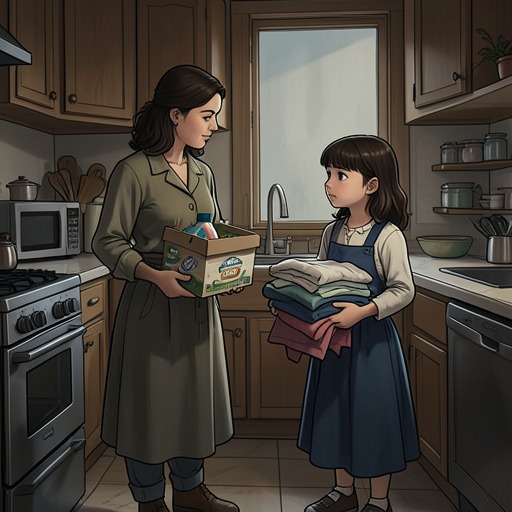
Willowdean and Her Mother Make a Cadillac Ranch Prop
Dumplin'Willowdean Dickson and her mother make a cardboard Cadillac Ranch prop for the Miss Teen Blue Bonnet Pageant’s opening number, transforming an improvised deadline into an act of collaboration. The prop is both a response to the pageant’s demand for spectacle and the product of a rare, unguarded evening between mother and daughter: they cut, paint, drink champagne, and laugh together until one in the morning. By the time Willowdean tries on the finished piece, its ridiculousness feels exactly right, and the night has opened a small space for possibility at home.
The Assignment and Its Meaning
The prop becomes urgent after a disastrous rehearsal. The girls have not practiced their individual talents, there is no time to do so, Callie slips on the ramp during the opening number, and the cues go wrong amid spills, tears, and even blood. Willowdean has to produce a prop for the number despite having given little thought to her assigned landmark, Cadillac Ranch, since dance rehearsal. The scene begins with the sense that the pageant’s preparations are already coming apart, and her project is one more task to complete in the wreckage.
At the kitchen table, the scale of the problem is literal: Willowdean has a huge cardboard box, a few bottles of craft paint, and scissors, but no clear idea how to make the landmark recognizable. She considers the assignment the sort of pageant fluff she would normally dismiss, then revises that judgment. Texas has famous landmarks, she reflects, but also less familiar places and oddities, including the Marfa lights, Jacob’s Well, Dinosaur Valley, and the Prada sculpture. Cadillac Ranch belongs to that less expected Texas: recognizable as a place, yet difficult to reduce to a familiar stereotype.
The landmark’s actual form sharpens the practical challenge. Cadillac Ranch is a public art installation in Amarillo, where old Cadillacs are buried nose-first in a row beside the highway. Their paint has faded, and visitors are encouraged to spray-paint them. Willowdean understands what makes the site distinctive, but that knowledge does not immediately tell her how to turn it into a wearable stage prop. The gap between recognizing the artwork and making a cardboard version of it gives the scene its modest, concrete problem to solve.
A Collaboration at the Kitchen Table
Willowdean’s mother arrives to get ice for her champagne and initially mistakes the box and supplies for a school project. When Willowdean admits that they are for her opening-number prop, her mother responds with concern about the late hour and the need for sleep. The exchange establishes that Willowdean has left the work until the last minute, but her mother does not stop at pointing this out. After sitting beside her and looking at the assignment, she decides they can do it together.
Her support quickly becomes practical. She pours Willowdean a few sips of champagne, asks whether Willowdean’s waist will fit inside the box, and sends her to the garage for wide elastic, a glue gun, and spray paints. When Willowdean returns, her mother has already begun cutting the cardboard with an X-ACTO knife. She assures Willowdean that the prop will be the best in the opening number. The work is no longer Willowdean’s solitary attempt to rescue an assignment; her mother has joined in with materials, tools, and confidence in what they can make.
The question about the box’s fit gives the construction a bodily, wearable dimension: this is not simply a model of Cadillac Ranch but a piece Willowdean will carry onstage around her waist. Willowdean answers that it will fit, and the two proceed. Her satisfaction as she takes another sip of champagne registers the pleasure of being helped without having to argue for the help first. In the scene, the prop’s physical construction and the mother-daughter exchange develop together, each requiring them to work with what is already at hand.
Work, Play, and a Change in Their Rapport
A few hours into the project, Willowdean thanks her mother for allowing Millie Michalchuk to compete, even though Millie lied. Her mother says Millie is a good girl, a sweet one, with a good smile. Willowdean expects the conversation to turn to Millie’s size and the disadvantages it might create, but her mother does not make that judgment. The exchange links the making of the prop to the pageant’s larger question of who is allowed to participate, while also showing Willowdean noticing the difference between the response she fears and the one her mother actually gives.
Their work continues with a white base coat. When paint splatters onto Willowdean’s cheek, she flicks it onto her mother’s nose. The interruption turns their careful task into a paint-throwing joke, and they laugh so hard that it hurts. Both have been drinking champagne, and Willowdean recognizes that she may be drunk, but the scene’s emphasis is on their shared pleasure. Their laughter is not a discussion of the tension between them; it is a moment in which they can be together without returning to an argument.
The hours leave visible traces around them. At one in the morning, the kitchen table is covered with randomly spray-painted newspaper pages and stray pieces of cardboard. Riot hops onto the table, sniffs the finished cardboard Cadillac, and sweeps its tail against it. This cluttered aftermath makes the project feel handmade rather than polished: the successful prop has emerged from scraps, paint, and a long stretch of shared labor. It also records the unusual duration of the collaboration, which has carried mother and daughter well past the hour when Willowdean’s mother first told her to get some sleep.
The Finished Prop and Its Afterimage
The finished cardboard Cadillac is suspended from Willowdean’s shoulders by elastic and hangs around her waist. When she tries it on, she sees how ridiculous it is, but does not treat that as a flaw; its absurdity is part of why it works for her. The judgment marks a change from the initial uncertainty about how to make a prop that clearly reads as Cadillac Ranch. She now has an answer in the form of a wearable object she can accept on its own terms, rather than an attempt to make the assignment respectable or elegant.
Before bed, Willowdean opens the front door and looks out at the quiet, dark street. From that familiar vantage point, the house seems new with possibilities. Her mother switches off the hallway light behind her; Willowdean closes the door and locks the dead bolt. The ending does not promise that their disagreements have disappeared or that the pageant will go smoothly. Instead, the completed prop and the changed feeling of home leave the scene on a smaller, earned shift: an evening that began with an overdue task and a chaotic rehearsal ends with shared laughter, a finished creation, and a glimpse of what might be possible between them.