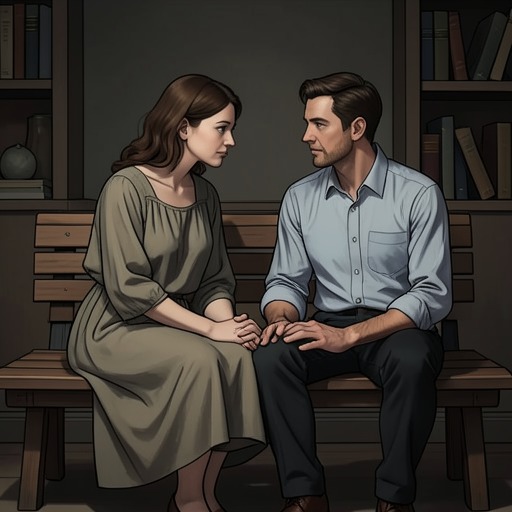
Willowdean and Mitch's Halloween Kiss
Dumplin'Willowdean and Mitch's Halloween Kiss turns an improvised trick-or-treating trip into a moment of intimacy—and then into a private recognition that intimacy is not the same as reciprocated desire. As Mitch and Willowdean move from comic adventure to conversation about the selves they perform, his kiss tests the meaning of their closeness. Willowdean’s stillness afterward makes the decisive turn: she knows the moment is false for her, however tender it appears from the outside.
The Encounter After the Party
The night begins with Willowdean leaving a gathering in the company of Bo and Marcus. Bo still wears a conductor’s hat, and she cannot look at him without smiling. Outside, Mitch is leaning against her car. His presence irritates her; she resents having him occupy the same emotional space as Bo, and thinks of the feeling as wanting separate foods to stay on separate sides of a plate. The contrast matters: while her attention remains fixed on Bo, she must turn to Mitch and greet him. Her choice to leave with Mitch does not erase that divided attention.
Mitch drives Willowdean to Stonebridge, a gated neighborhood built within the last decade and regarded as wealthy by Clover City standards, though its gates are usually open. He gives her a pillowcase for candy. The hour is late enough that Willowdean questions whether they can still go trick-or-treating, but Mitch presses on. The outing begins less as a planned date than as an act of play, with the two of them testing how far they can carry the Halloween ritual into the night.
The Neighborhood as a Series of Tests
At one house, a woman answers in a bathrobe, with wet hair wrapped in a towel. Mitch offers his pillowcase without hesitation. After checking the time, she returns with a bowl and empties half its candy into his bag. The encounter is awkward but generous: the late hour does not prevent the woman from joining the game once Mitch has made the request.
Another door opens onto danger rather than a treat. A man threatens the pair while holding a shotgun, and Mitch grabs Willowdean’s hand and tells her to run. They sprint down the driveway and around a corner; only after they are at a safe distance does Willowdean stop, bracing her hands on her knees and gasping. She recognizes that the threat could have killed them. The hand-grab is practical and urgent, but it also makes their closeness physical before either of them names it.
At a later house, Willowdean says they are fooling around and should head home. As they leave, a boy in a pirate costume runs after them with a plastic pumpkin and gives each of them candy. He compliments Mitch’s costume, and Mitch returns the compliment without speaking down to him. Willowdean notices the ease of Mitch’s regard: he treats the boy as someone in his own right, not merely as a child. After the danger at the previous house, this small exchange shifts the evening back toward kindness and play.
A Conversation About Pretending
The two sit on a curb with their candy at their feet. It is the first night of the year that feels as if autumn might be approaching, and the breeze cuts through Willowdean’s southern bones. She lies on the grass between the road and sidewalk, appreciating that it is lush, unlike the dry, brown grass she associates with Texas. The pause gives the night a different rhythm: the running stops, the candy is set aside, and the two can talk without having to respond to another door.
Mitch explains that, in the pirate boy’s eyes, he had been Indiana Jones rather than the basketball player who had botched plays in the previous night’s game or the person who spends his days playing video games. The costume gave the child another version of him to see. Willowdean asks whether that kind of transformation can also become a way of hiding from oneself. Her question opens onto her own unease: she has spent a long time acting like the person she once decided she wanted to be, but now feels that the performance is fading and is unsure about the self beneath it. The idea of simply pretending until she becomes that person no longer seems to bridge the distance.
Mitch answers that a person can act like the person they hope to become until that identity begins to feel real. He connects the thought to his own fear of Willowdean: when he first spoke to her, she frightened him, and she still does, but acting as though she did not has made the fear diminish. His account turns the evening’s costumes into more than disguise. Pretending can be a rehearsal for becoming, though Willowdean’s response shows that it does not automatically settle the question of who she is or what she feels.
The Kiss and Its Reversal
Willowdean smiles at the admission that she frightens Mitch. The idea makes her feel bad, but it is also pleasurable to imagine that she might be the person who unsettles someone else, rather than always being the one about to jump out of her skin. Mitch draws her hands away from her face. His palms are sweaty; close enough for Willowdean to see the pores on his nose, he tells her that good things are supposed to be a little scary. The exchange moves from a conversation about fear into a physical closeness neither has to explain.
Mitch’s lips brush Willowdean’s. He curls an arm around her waist, and they kiss with their mouths open but without using their tongues. His touch trembles, carrying both terror and exhilaration. From outside, the kiss could register as the culmination of the night: after the shared adventure, the hand held in a dangerous moment, and the talk about becoming someone new, the two finally move toward each other. But Willowdean remains still, and the expected feeling does not arrive. She is not terrified at all. She recognizes that this moment is a lie—not because the kiss has not happened, but because her body does not confirm the meaning she thinks she should attach to it.
Narrative Significance
The scene makes a sharp distinction between Mitch’s growing intimacy with Willowdean and Willowdean’s actual response to him. The evening supplies conventional signs of romantic momentum: a private outing, shared danger, a hand held in flight, a quiet conversation, and a kiss. Yet the story does not treat those signs as proof of desire. Willowdean’s realization interrupts the apparent romantic payoff and gives her bodily stillness more weight than the scene’s accumulating gestures.
The Halloween disguises also sharpen the difference between becoming and pretending. Mitch finds freedom in being seen as another person for a night, and he describes practiced confidence as a way to lessen fear. Willowdean, by contrast, is troubled by the gap between the person she has performed and the person she suspects lies beneath the act. The kiss becomes part of that same problem: an intimate moment can look like the role she is expected to play without feeling true to her. The next day, the narrative turns abruptly to a crisis at home when Willowdean’s mother tries on her pageant dress, leaving the kiss without an immediate romantic resolution.