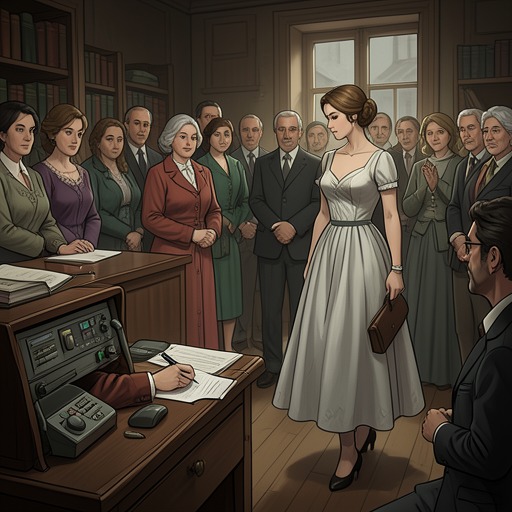
Willowdean registers for the Miss Teen Blue Bonnet pageant
Dumplin'Willowdean registers for the Miss Teen Blue Bonnet Pageant by insisting that her mother sign her application, making entry both a practical step and a direct challenge to the standards her family and Clover City attach to the contest. The scene moves from the crowded registration room, where she and her friends stand apart from the conventionally dressed contestants, to a private confrontation in which Willowdean names the rejection implicit in her mother’s hesitation. Rosie ultimately signs, and the registration meeting begins with Willowdean seated among Ellen Dryver, Millie Michalchuk, and Amanda Lumbard. Hannah Perez then arrives late and registers alone, adding another unexpected presence to the pageant field.
Background and Stakes
The registration meeting places the pageant’s social world on display before the formal proceedings begin. Girls sit in cliques at round tables covered with white tablecloths. Rosie had ironed those same cloths in the family living room the previous night, connecting the public event to the domestic labor surrounding it. Willowdean observes groups organized around different routes into pageant culture: contestants with mothers or sisters who had won titles, athletes hoping to strengthen college résumés, cheerleaders, and girls from theater and choir. Their Easter-style dresses and matching cardigans contrast sharply with the jeans and T-shirts Willowdean and her companions wear.
The contrast makes registration feel less like neutral paperwork than entry into an established hierarchy. Willowdean calls the fee a two-hundred-dollar registration for a revolution: the cost is concrete, but her phrasing casts participation as opposition to the assumptions governing who belongs. Millie remains in place after Amanda begins to walk away, silently asking for an appeal. Ellen squeezes Willowdean’s hand. Their gestures show that the decision is not hers alone in its consequences; her friends are also exposed to the room’s judgment, and their support helps sustain her resolve.
Willowdean Confronts Rosie
Rosie pulls Willowdean aside through a set of French doors while Amanda and Millie hand in their applications. Watching them from outside, Willowdean feels that she has abandoned her friends by stepping away. Ellen, still with the girls, gives Willowdean a thumbs-up. The division between the women at the registration table and the mother and daughter in private turns the signature into the scene’s immediate point of conflict: Willowdean wants to register, but Rosie’s consent is required.
Rosie challenges what Willowdean is doing and insists that the pageant is not a joke. Her objection also rests on the fear that Willowdean and the other girls will be ridiculed. She uses the nickname Dumplin’, which now cuts more deeply than it once did. Willowdean answers by making the meaning of a withheld signature explicit: without Rosie’s approval, she would hear that she was not good enough and that nearly every girl in the room was prettier and more deserving. Her appeal shifts the dispute from whether the pageant is suitable to what Rosie’s refusal would communicate about her daughter’s worth.
The silence that follows marks a change in the exchange. Willowdean recalls a summer before freshman year when she overheard Rosie suggest that Ellen consider entering the pageant at fifteen. Willowdean had waited in the hallway before returning to the kitchen, and remembers the moment as an early recognition that her mother’s beliefs did not work for her. The memory sharpens the present conflict: Rosie had once encouraged Ellen toward the pageant, while Willowdean has never received the same encouragement. After a long pause, Rosie agrees, but makes clear that she will offer no special treatment or allowances. She then walks to the registration table and signs Willowdean’s form. Consent is granted, but not as unqualified reassurance; Willowdean has to claim her place without asking the contest or her mother to soften its demands.
Registration Becomes Public
After Rosie signs, Willowdean takes her place at a table with Ellen, Millie, and Amanda. Rosie steps forward to address the room and begins the opening welcome. Her shift from opposing Willowdean’s entry in private to leading the gathering in public reveals another dimension of her relationship to the pageant. She stands straight, projects her voice, and commands the contestants’ attention. Willowdean sees her not simply as her mother but as Rosie Dickson, the former Miss Teen Blue Bonnet of 1997, occupying a role in which she appears entirely at home.
Rosie describes the pageant as a tradition with a long history and points to former titleholders who became business owners, physicians, and mothers and wives; she also notes that a mayor is among them. She recounts that the contest paused during World War II and again after Kennedy was assassinated. The historical account presents the pageant as an institution that has persisted through interruption, while the girls gathered in the room represent its present and future. Willowdean is surprised by how captivated the audience is, including the people at her own table. The woman who had just warned her against expecting allowances now speaks with authority in the very institution Willowdean has chosen to enter.
Hannah Perez’s Late Arrival
As Rosie begins her welcome, the heavy back door creaks and draws every head toward it. Hannah Perez asks whether registration is still open. Her arrival interrupts the opening address and surprises the room, Willowdean included. A younger staff member checks Hannah’s form and directs her to a seat; Hannah takes an empty table by herself.
Hannah’s solitary registration echoes Willowdean’s decision to stand apart from the pageant’s familiar groups, but the scene does not establish her reasons for entering or what she will do next. What it does establish is that Willowdean is not the only late or unexpected entrant. The event expands beyond the initial conflict between mother and daughter: with Hannah present, the registration room contains another girl willing to join a contest whose traditions and social expectations are already being carefully presented. Willowdean’s signed application thus marks the beginning of her participation, while the room’s changing composition hints that the pageant may gather contestants who do not fit its established patterns.