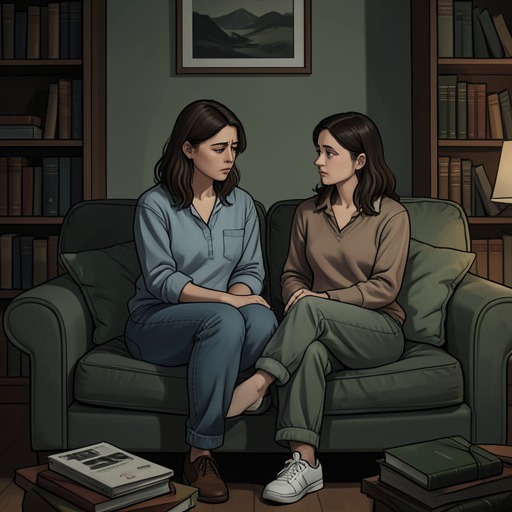
Willowdean’s grief over Lucy
Dumplin'Willowdean Dickson’s grief over Lucy is not confined to the fact of her aunt’s death; it keeps resurfacing in the ordinary spaces Lucy can no longer occupy. An email address, a conversation about pageant clothes, and a candle lit in silence all bring the loss into the present. Across these encounters, grief changes shape: Willowdean first experiences Lucy as a compass she has lost, then begins to consider how to find direction without expecting Lucy to return.
An email from Lucy
Before bed, Willowdean sits at her desk with Riot curled in her lap and finds a message from Lucy’s email address among the junk mail. Her stomach twists before she opens it. The message proves to be an advertisement about interest rates, not a message from Lucy. The brief false alarm makes the account feel momentarily active, but its contents insist on the difference between a surviving digital address and the person who once used it.
Willowdean lets out a breath and considers that other people may also be receiving junk mail from her dead aunt. She logs in to Lucy’s account after several guesses at the password, eventually entering DUMBBLONDE9, a combination of one of Lucy’s favorite Dolly songs and her favorite number. She intends to shut the account down, but pauses over its months of unopened messages. To Willowdean, this inbox is a reminder that people are temporary fixtures in a permanent world: Lucy’s correspondence remains available even though Lucy cannot answer it. The messages are not all explored; after clicking through several pages, Willowdean notices a subject line for Dolly Parton Night. The discovery links Lucy’s continuing digital presence to a world of attachments and memories that survives her, without suggesting that the account can restore her.
Lucy as a compass
Later, when Willowdean meets Lee Wei and Dale, Dale identifies her as Lucy’s niece. Lee reaches for Willowdean’s hand without hesitation and offers condolences, remembering Lucy as kind and openhearted and saying that the club was sad to see her go. Willowdean thanks her, then gives the loss a shape she can name: Lucy had been a compass she did not know she had. The image expresses more than affection. It conveys how much guidance Lucy supplied without Willowdean recognizing its importance until she was gone.
Lee answers not by minimizing the loss but by revising the compass image. She suggests that Lucy may have been there long enough for Willowdean to learn to become her own compass and find her way. She kisses Willowdean on the forehead, while Dale offers the club’s email address if she needs anything. Their gestures create a moment of witness and practical support: Willowdean’s grief is received by people who also knew Lucy, rather than treated as something she must explain away. Lee’s response does not make Lucy’s absence temporary or claim that Willowdean is already self-sufficient. Instead, it proposes a possibility for living with the loss—carrying forward the capacity for direction that Lucy helped provide.
The absence inside the family
Willowdean’s grief also becomes visible through what Lucy’s absence exposes in her relationship with Willowdean’s mother. When they discuss the pageant, Willowdean’s mother asks whether she has thought about her wardrobe. The dresses at Cindy’s are expensive and would have to be ordered, so she suggests that they might make something themselves. Her former Miss Teen Blue Bonnet identity briefly gives way to an effort to act as Willowdean’s mother, but Willowdean cannot experience that offer as enough to repair their distance.
The practical question of a dress opens onto the loss beneath it. Willowdean explains that she sometimes thinks she cannot miss Lucy more than she already does, only to be reminded by an occasion such as dress shopping that Lucy will not be there to see it. Willowdean’s mother says nothing for the first time in a long while. Willowdean recognizes that she had not understood how much their relationship lacked while Lucy was alive to fill some of its gaps. With Lucy gone, mother and daughter are left fumbling together in the dark. Grief here is therefore not only longing for Lucy; it alters the remaining family relationship by removing a person who had helped bridge its silences. The dress conversation makes an ordinary future milestone newly painful because Lucy’s absence is built into it.
Remembering without resolution
At a service with Bo, Willowdean follows him after the ceremony to a group gathered by the candles. He puts money in the lockbox and hands her a stick with which to light a candle from a larger one. They each light a candle, but neither says aloud who it is for. Their silence makes the remembrance shared without requiring either of them to identify the person being mourned. The scene echoes the earlier language of Lucy as a compass: grief is present, but it is held in a small, deliberate action rather than explained.
Willowdean imagines what it might be like to attend the service with Bo every Sunday. She is unsure whether she believes in everything involved, yet finds comfort in being part of something with him. That uncertainty matters: the ritual offers company and a form for remembrance without resolving her questions or supplying a substitute for Lucy. Taken together, the unopened messages, the family conversation about a dress, Lee Wei’s counsel, and the unspoken candles show grief returning through both objects and relationships. Lucy remains absent, and Willowdean continues to miss what Lucy cannot witness. The emerging change is not release from grief, but the possibility of carrying Lucy’s influence while beginning to find her own way.