Dolly Parton Night at the Hideaway Bar
Dumplin'Dolly Parton Night at the Hideaway Bar is a West Texas drag show that becomes a turning point in Willowdean Dickson’s experience of beauty, performance, and grief. Away from the pageant’s carefully sorted tables and familiar small-town expectations, Willowdean sees performers of many shapes, sizes, and colors command a stage on their own terms. The night also gives her a living connection to Lucy: the club recognizes her aunt’s name, and Lee Wei offers Willowdean a way to think about loss without treating remembrance as a permanent substitute for finding her own direction.
Background and arrival
The outing takes shape while Willowdean and her friends are trying to find their place in the Miss Teen Blue Bonnet Pageant. At registration, girls cluster at tables by social identity: legacy contestants, athletes, cheerleaders, theater students, and choir members. Most wear Easter-style dresses and cardigans; Willowdean, Amanda Lumbard, and Millie Michalchuk arrive in jeans and T-shirts. The gap between their clothes and the other contestants’ polished presentation makes Willowdean feel exposed before the competition has even begun. Her mother, who has ironed the registration tablecloths, signs Willowdean’s form, but the room’s pageant rituals offer little reassurance about where she and her friends fit.
The journey to the show is practical as well as social. Willowdean needs a ride, contributes money for Amanda’s mother’s van, and travels with Amanda, Millie, and Hannah Perez. In the back seat she holds a crumpled flyer advertising a contest for the best Dolly Parton impersonator. The prize is bragging rights and a year’s supply of Avon lipstick from Kiwi Lavender; the listing gives the venue as The Hideaway on Palmer and Fourth in Odessa, Texas, with doors opening at eight and the show beginning at nine. When the group reaches the parking lot, Millie questions whether the address can be right because the destination looks like a bar. Willowdean recognizes the hot-pink Hideaway sign from a photograph of Lucy that Mrs. Dryver had given her.
At the entrance, the man checking the flyer notices that the email address on it belongs to Lucy, not Willowdean. Willowdean explains that Lucy was her aunt. He folds the paper, gives the four friends fluorescent orange wristbands, and warns them not to look toward the bar. His recognition of Lucy, summed up in his assurance that she was good people, changes the meaning of their arrival: the flyer is not just a way into a show but evidence that Lucy had a life and friendships beyond the family’s memories of her.
The show and its performances
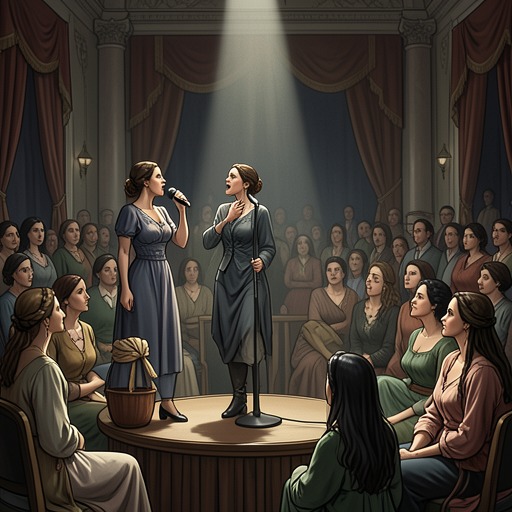
Inside, a low, sultry voice welcomes the crowd, and the audience cheers as performers are introduced. Willowdean and her friends have entered a drag show. The performers bring elaborate, sparkling costumes, towering heels, and extravagant wigs to the stage; the variety of their bodies and appearances is part of the spectacle rather than a reason to keep them out of sight. One act pairs a woman performing as Kenny Rogers with another performer for Islands in the Stream. The dingy bar becomes a stage on which deliberate transformation and showmanship are visible, shared, and celebrated.
Willowdean’s favorite is Lee Wei, a short Asian queen in a baby-blue minidress covered with sequins. Under the spotlight, the dress blurs with her movement. When Lee begins Jolene, the room responds almost immediately. The song has long mattered to Willowdean because its plea turns on the fear that someone else will be more beautiful, intelligent, or thin. She understands its jealousy not as proof that perfection is attainable, but as a reminder that people can spend their lives chasing an impossible standard. She imagines that, if she could sing, Jolene would be the song she performed at the pageant. By the end of Lee’s number, Willowdean is crying without having noticed that the tears had begun.
That response marks a sharp change from the numbness and uncertainty Willowdean has felt since the summer’s painful events. The show does not make her a confident singer or resolve her doubts about her body. Instead, it makes life feel active again: the performers’ visible, varied forms of beauty offer a counterimage to the singular ideal that haunts both the pageant and the song. The friends leave with expressions of wonder, as if the performance had opened a door onto a world larger than the one they expected to find in a bar outside town.
Lucy, Lee, and the compass
After the show, someone calls to the group from the stage door. Dale identifies Willowdean as Lucy’s niece, and Lee reaches for her hand without hesitation. Lee says Lucy had a kind, open heart and that the people at the club were saddened by her death. For Willowdean, who has been lost without her aunt, hearing Lucy remembered with warmth by people who knew her makes grief suddenly communal rather than private. She describes Lucy as a compass she had not known she possessed.
Lee answers with an image that reshapes that confession: Lucy may not have been meant to serve as Willowdean’s compass forever; perhaps she had been there long enough for Willowdean to learn to be her own compass. Lee kisses Willowdean on the forehead, while Dale offers the club’s email address in case she ever needs anything. The gesture does not lessen the loss or claim that grief has a simple solution. It places Lucy’s influence in a continuing chain of care: her friends remember her, welcome her niece, and leave open the possibility of further contact. Willowdean then returns to the van, carrying not only the memory of a performance but new evidence of the person Lucy had been.
Afterlife in the pageant
The night’s meaning carries into the pageant preparations through Lee’s later coaching. She teaches the contestants that a walk shapes a queen’s first impression, demonstrating how to place one foot in front of the other and move the hips. Willowdean later uses that lesson onstage, including when she escorts Ellen Dryver in the evening-gown round; the contestants move down the ramp with their heels leading their hips from side to side. The drag show’s artistry thus supplies a practical performance skill for the pageant, even as its broader vision of beauty sits uneasily beside the pageant’s restrictive standards.
The friends’ later solidarity also contrasts with the cliques Willowdean first observed at registration. During the pageant, Ellen, Millie, Amanda, Hannah, and Willowdean join hands before returning to the auditorium, forming a bond they experience as more important than a crown. The show is not stated to be the cause of that later unity, but its memory belongs to the same expanding circle of relationships: Willowdean travels with friends, meets people who loved Lucy, and encounters forms of self-presentation beyond the pageant’s approved mold. Its decisive change is not a victory in competition. It is Willowdean’s movement from feeling stranded by Lucy’s absence toward recognizing both the community Lucy left behind and the possibility of finding her own way.