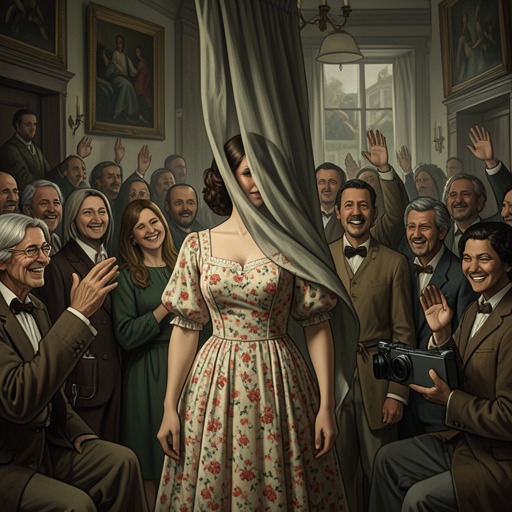
Magic for the Young and the Young at Heart
Dumplin'Magic for the Young and the Young at Heart is a how-to magic book that Mitch Lewis gives Willowdean Dickson when she needs a talent for the pageant. It turns a personal gesture into a practical possibility: Willowdean studies its tricks, practices one, and eventually presents it for approval. The attempt ends with the quarter on the floor, making the book significant not as a source of effortless transformation but as the instrument through which Willowdean tries, awkwardly and in public, to make a talent of her own.
A Gift with a Practical Purpose
At the end of the day, as Willowdean and Mitch walk to the parking lot, he takes her hand firmly and gives her a small hardback copy of Magic for the Young and the Young at Heart. He explains that he remembers her saying she needs a pageant talent. The gift is therefore both a response to a concrete problem and a personal act of attention: Mitch has listened, remembered, and found something he thinks might help. Willowdean thanks him and puts the book in her backpack, while Mitch asks her to read the note inside later.
The circumstances make the book more than a generic instruction manual. Willowdean has recently kissed Mitch, but their ordinary behavior the next day leaves the meaning of that kiss uncertain. His gesture at the parking lot—holding her hand and offering help with the pageant—suggests renewed closeness without defining what their relationship is. The book carries that mixture of care and ambiguity into her private space: it is a useful object, but also evidence that Mitch has paid attention to what she needs.
The Note and the First Attempt
At home, Willowdean empties her backpack onto her bed to look for homework and finds the book among her things. She pulls it to her chest and sinks to the floor. For several days she has nearly forgotten both her talent and the pageant, distracted by Bo Larson’s return to her life. The book brings the pageant back into view, though Willowdean recognizes that she does not want to be consumed by thoughts of Bo again.
Inside, she finds several tricks, but none initially catches her interest. The note explains that Mitch went through a childhood magician phase, wearing capes and top hats, and says he thought she might use some magic of her own. The message connects the gift to a specific piece of Mitch’s past while presenting magic as a possibility he is offering, not a talent Willowdean already possesses. She slides the note back between the pages and doubts that silly tricks suit her. Unlike Bekah Cotter, she does not believe she has a self-defining talent to fall back on, nor does she feel she has persisted long enough at something to claim one.
Still, Willowdean begins practicing the motions of a hidden-coin illusion with the book in her lap. She thinks of the choice as settling for something and as a missed opportunity, but does not conclude that trying it is wrong. That distinction matters: the book does not suddenly give her confidence or make the pageant feel exciting. Instead, it gives her a small, actionable task at a moment when she is unsure what else she can present. The initial spark that led her to enter the pageant remains absent, and practice is a decision to proceed without it.
From Instructions to the Approval Session
The book’s advice becomes the basis of Willowdean’s sample performance when contestants must have their talents approved. She sits in the third row of the school auditorium beside Millie Michalchuk and Amanda Lumbard. The rules call for a sample, and Willowdean has learned only one trick from Mitch’s book. Her choice is thus shaped by the immediate requirement: she has a routine to demonstrate, even though it does not yet feel like an expression of a settled identity or ability.
The trick uses an empty water bottle and a quarter. Willowdean has cut a narrow opening in the bottle and must hold it so the audience cannot see the cut. After showing that the bottle appears ordinary, she is meant to slap the quarter through the hidden opening. During the audition, she taps the bottle, displays the quarter, and uncaps the bottle to show that the coin cannot go through its top. The demonstration depends on controlling what the audience can see: the trick is not simply a sequence of motions but a small performance built around concealment and timing.
The scene also puts the book’s lessons under scrutiny. Willowdean tries to sound like a magician, while the room remains quiet and her mother’s face does not change. The book can supply instructions, but it cannot guarantee poise, an approving audience, or a successful result. Willowdean performs the routine in that exposed silence, hoping that the presentation will hold together long enough to demonstrate what she has learned.
The Failed Trick and the Book’s Significance
At the trick’s climax, Willowdean says, "Voilà!" before checking that she has struck the correct side of the bottle. She shakes it, but the bottle is empty apart from a few drops left from that morning, and the quarter has not passed through the hidden opening as intended. Callie, seated in the third row beside Ellen, points out that the coin is on the floor. The failure is specific and visible: the trick does not collapse because magic is impossible within the scene, but because Willowdean misses the required side of an ordinary, prepared bottle.
That mistake gives the book’s practical promise a comic limit. Its instructions have enabled Willowdean to learn a trick and bring it before the approval group, but successful performance also depends on checking the setup and executing the motion correctly. The bottle, the concealed slit, and the fallen quarter make the material mechanics of the act impossible to ignore. What should have appeared mysterious becomes a visible object lesson in the gap between knowing a trick and making it work.
The book consequently occupies an important middle ground between intention and outcome. Mitch’s gift helps Willowdean move from having no apparent talent to practicing and presenting one; it does not secure approval or make her feel that she has found a defining gift. Its place in the sequence is measured by that attempt, including its flaw. Magic for the Young and the Young at Heart gives Willowdean a way to act before certainty arrives, while the dropped quarter preserves the difference between trying to perform confidence and having the performance go as planned.