Millie Michalchuk
Dumplin'Millie Michalchuk is a Clover City teenager whom Willowdean Dickson first sees through a judgmental lens: as someone whose body and appearance make her more vulnerable to ridicule than Willowdean herself. Yet Millie is not simply the object of other people’s assessments. She drives, asks for what she needs without making a spectacle of it, takes the pageant seriously, and ultimately risks her parents’ disapproval to enter it. Her story turns the pageant from an emblem of conventional beauty into a space where she can claim ambition and act beyond the role others have assigned her.
Identity and Introduction
Willowdean first notices Millie walking through a parking lot toward her parents’ minivan. Patrick Thomas and his friends are gathered by the driver’s-side door, making pig noises as they wait to torment her. Willowdean recognizes what is about to happen and calls Millie over before she reaches them. The scene establishes the routine cruelty Millie faces, but also introduces the practical detail that she has been driving for only a few weeks and already handles the minivan with confidence.
Willowdean’s initial description of Millie is revealing as much for its cruelty as for its details. She compares their bodies and privately regards Millie as proof that things could be worse, cataloguing the difficulty of finding clothes in her size, her features, and her puppy-and-kitten shirts. The comparison exposes how fat stigma can turn even a person who experiences it into a judge of someone else. It also means that Millie first enters the story partly through Willowdean’s self-protective, hierarchical way of looking at bodies, rather than through Millie’s own account of herself.
When Millie and Amanda Lumbard later arrive at Harpy’s Burgers & Dogs, Millie wears a light-yellow matching shirt-and-shorts set with heart-shaped gems at the collar. Her forehead is damp, but her smile remains steady as she greets Willowdean, whom she did not know worked there. The corrective shoes she wears are another immediately visible part of her presentation. Willowdean thinks Millie makes life harder for herself, but Millie’s unforced greeting and unflinching smile suggest a composure that Willowdean’s private appraisal fails to recognize.
Pageant Ambition and Strategic Thinking
Millie announces that she and Amanda are signing up for the Miss Teen Blue Bonnet Pageant. The announcement places her among the girls Willowdean has drawn into the competition, but Millie’s reasons are not merely borrowed from her friend. At a meal with Willowdean, Amanda, and Hannah Perez, she speaks earnestly about pageants as a matter of showmanship, pride, and the complete contestant, not just dresses and talent acts. She points to local women who have gone on to prominent work as examples of what pageant participation can lead to. Willowdean realizes that Millie believes in the institution; for her, competing is a serious undertaking, not a joke or an act of sabotage.
Millie approaches the competition by thinking about what each participant can do well. She judges herself strongest in the interview and recognizes Amanda’s soccer ability as a possible talent. This practical assessment contrasts with the pageant’s ideal of the polished, uniform contestant: Millie does not claim that the group fits that ideal, but argues that they can play to their strengths. Her attention to strategy helps make the group’s participation more than a collective gesture of defiance.
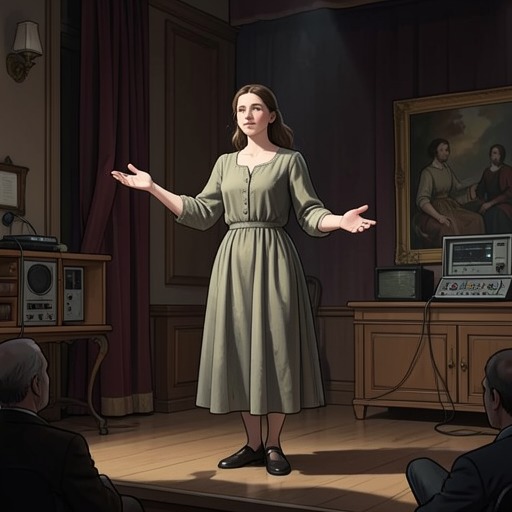
At a pageant practice, the contestants are asked to stretch beneath a Texas-themed banner. Millie is there with Amanda and Hannah, among other participants whose clothing and preparation vary widely. The setting places her inside the pageant’s organized culture, where a theme, rehearsal, and prescribed exercises turn aspiration into a public performance. The evidence shows Millie attending and engaging with that preparation, not treating her entry as a symbolic gesture that ends at registration.
Friendship and Solidarity
Millie’s friendship with Amanda is visible in the way they arrive and make decisions together. When Willowdean arranges a group outing to The Hideaway, she is concerned about transportation because her car is out of service. Millie confirms that she and Amanda are going and that Amanda can drive; Hannah Perez then agrees to join as well. Millie’s response helps make the group’s plan possible, and their shared participation extends the circle of friendship beyond pageant preparations.
At Frenchy’s, the group squeezes into a small booth, with Millie seated at the end in a chair. She acknowledges the tight space and asks for the accommodation she needs. The waitress’s frown does not stop her. Willowdean contrasts Millie’s reaction with what she imagines Lucy would have done: Millie does not seem sufficiently bothered to leave. That contrast does not mean the slight is harmless; rather, it shows Millie continuing with the meal despite a social cue that could make someone feel unwelcome. Her response is neither a grand speech nor a denial of the situation. She asks for a chair and stays with her friends.
Millie also joins Willowdean, Amanda, and Hannah in supporting one another’s attempts to find a place in the pageant. When Amanda demonstrates her soccer skills at the talent audition, Millie and Willowdean clap enthusiastically while the auditorium remains quiet. The committee takes longer than it has for the other performers to decide, and the approval is qualified rather than warmly given. Millie’s applause matters in that uneven reception: her idea of playing to a contestant’s strengths becomes an act of support when the official response is uncertain.
Risk, Family Conflict, and Self-Assertion
Millie’s entry carries a cost at home. When the parental-consent issue comes up, she admits that she forged her mother’s signature. She had first asked her parents for permission after learning that Willowdean was entering. They took several days to consider the request, then refused, fearing she would be mocked and believing that competing was not a Christlike way to spend her time. Their response casts the pageant as a danger from which they think they must protect her; Millie’s forged signature shows that protection has become a boundary she is prepared to cross.
The prospect of being publicly identified as a contestant sharpens the risk. Willowdean recognizes that once the local paper reports the entry, people such as Patrick Thomas will have fresh material for ridicule. Millie is uncertain and searches Willowdean’s face for reassurance. Willowdean tells her that it will be all right, while Amanda responds with admiration for the nerve it took. Millie’s decision is therefore not presented as fearlessness. She is anxious about exposure, but she has still acted, and the encouragement she receives helps turn that vulnerable disclosure into a moment of solidarity.
Hannah Perez’s account of her own isolation offers a related, though distinct, view of the group’s pressures. Hannah explains that dental work is expensive for her family and that she has no friend to walk the school hallway with her. Those circumstances belong to Hannah, not Millie, but their inclusion places Millie’s pageant circle among girls whose visible differences and access to resources shape how they are treated. Millie’s conflict at home is likewise specific: her parents’ refusal rests on anticipated ridicule and religious concern, while her own action insists that those fears need not determine whether she participates.
Narrative Significance
Millie’s arc depends on the distance between how Willowdean first sees her and what Millie demonstrates through action. The opening comparison treats Millie’s body as a measure of misfortune; the later scenes reveal a young woman with her own convictions about pageantry, a clear sense of her strengths, loyalty to her friends, and the resolve to challenge a parental decision. She is not transformed into someone untouched by other people’s judgments: her hesitation before the prospect of public exposure makes the danger legible. Instead, she moves forward while the danger remains.
Her importance to the pageant storyline is also practical. She signs up with Amanda, articulates a strategy for making the group’s individual abilities count, supports Amanda during an uncertain audition, and keeps participating despite disapproval at home. Through Millie, the competition becomes more than a contest over who best fits a beauty ideal. It becomes a test of whether a young woman can claim an ambition that her family considers risky, and whether friendship can help sustain that choice without pretending the risk is imaginary.