Miss Teen Blue Bonnet Pageant regulations
Dumplin'Miss Teen Blue Bonnet Pageant regulations set the practical terms of participation in Clover City’s long-running teen contest, from a signed application and advance approval of performances to interviews, scoring, and stage presentation. They define a process administered by former titleholders, but the events surrounding them show that the rules are not simply a test of polish: they can exclude or unsettle contestants, while also leaving space for unexpected forms of self-presentation.
Registration and Authority
Registration begins with an application and a fee of two hundred dollars. The rules also require a parent’s signature: when Willowdean Dickson submits her form, an official checks the information and asks for her mother’s approval. Willowdean’s mother, Rosie Dickson, confirms that Willowdean cannot enter without the signed release. Her hesitation is personal as well as procedural; she questions Willowdean’s reasons for entering and worries that the contest will expose her to embarrassment. She eventually signs the form, allowing Willowdean to register.
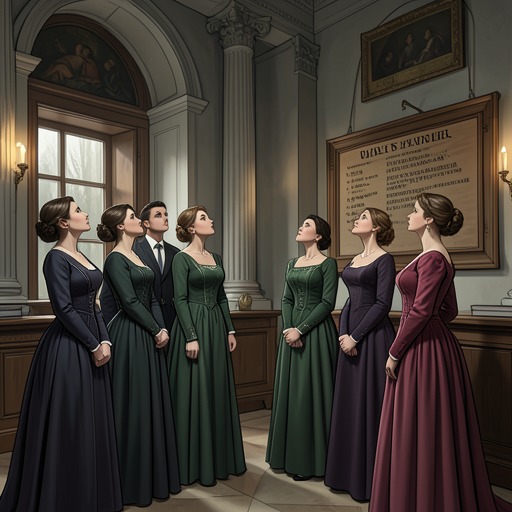
The registration meeting places the regulations inside a visible social hierarchy. At the community center, groups of contestants sit at separate tables: girls with pageant-winning relatives, athletes, cheerleaders, and theater and choir students. Many arrive in dresses and cardigans, while Willowdean, Millie Michalchuk, and Amanda Lumbard wear jeans and T-shirts. That contrast is not presented as a written clothing rule, but it makes the contest’s expectations legible before the formal briefing begins. The room’s established groups and pageant histories make newcomers’ uncertainty part of the entry process.
Rosie introduces the pageant as an institution with a long civic history, noting that it has paused during World War II and after Kennedy was assassinated. She presents Judith Clawson and Mallory Buckley as her fellow officials and makes their authority explicit: their approval counts as hers, and their refusal does too. The decision-making power therefore rests not only in the printed requirements but in a small group of women who administer them. The hot-pink folders distributed to contestants give the rules a tangible form, while the officials’ shared authority establishes how those rules will be applied.
Talent and Wardrobe Approval
Contestants must notify the organizers of their talents by the first week of November. The board must consider a proposed act appropriate, and the contestants’ formalwear, swimwear, and talent costumes must all be approved by the Wednesday before the pageant. Rosie cautions entrants to avoid sexualized material. These deadlines make approval a staged process: a contestant must first declare what she plans to do, then secure permission for the performance and the clothes in which it will be presented. The expectation that surprises belong to the audience further distinguishes the contestants’ advance disclosures from the eventual public show.
The talent auditions demonstrate that approval can require revision. Willowdean arrives at the school auditorium with only a magic trick learned from a book, hoping it will meet the requirement to prepare a sample. Another contestant, Karen Alvarez, performs a song from Chicago that the officials consider too sexy; she is given a week to choose something else and leaves visibly mortified. The contrast between a modest magic act and a rejected song shows how the board’s judgment operates in practice: a talent is not automatically acceptable merely because it has been prepared for the stage.
The rules also make clothing part of the approval process rather than leaving it entirely to the night of the contest. Formal, swimwear, and talent costumes all have to pass review, while the warning about sexual material applies to what contestants plan to perform. These requirements regulate both the acts and the images presented to the audience. At the same time, the evidence does not establish that every choice of style is prescribed in detail. Hannah Perez later appears in a black slip dress, combat boots, and no makeup without breaking a pageant rule, suggesting that a contestant can depart from conventional polish while remaining within the stated limits.
Interviews and Scoring
The contest includes a formalwear presentation, a talent portion, an interview, and a swimsuit component. The interview has two stages: a session on the Thursday before the pageant, whose score is combined with a live interview during the contest. Contestants do not know the questions in advance, and the live portion is expected to consist of one or two questions. Willowdean, who remembers the experience of being backstage as a child, explains that the questions can be designed to stump contestants.
The interview carries the highest point value. The contestants also learn that swimwear counts for more than talent, a weighting that surprises them as they compare the scoring breakdown. No exact point totals are supplied, but the relative values establish that a polished performance alone cannot determine the result. Contestants must prepare across several distinct categories, and the interview can outweigh the portion they may have regarded as the contest’s central display of skill.
Preparation extends beyond the written categories. Lee Wei teaches the contestants to walk with one foot in front of the other, moving their hips from side to side; she presents the walk as the basis of a queenly first impression. That instruction is coaching rather than a stated scoring rule, yet it shows how the pageant’s expectations are transmitted through repeated bodily practice as well as through application forms and approval deadlines. The contestants rehearse a shared style of movement before they take the stage.
Stage Procedure and Limits
The evening-gown round gives the regulations a public, sequential form. Contestants cross the stage with escorts, make a circle at its edge, and return backstage. Willowdean escorts Ellen Dryver, and the officials announce the pairing before the two walk across the stage. The other contestants follow in turn, including Amanda with her older brother and Millie with Malik. By the time they reach the ramp, the contestants use the one-foot-in-front-of-the-other walk Lee has taught them.
Hannah’s appearance makes the distinction between pageant expectations and explicit prohibitions particularly clear. She wears a black slip dress and combat boots, uses no makeup, and walks with Courtney Gans as her escort. The narration emphasizes that she violates no rule. The moment does not erase the contest’s conventional presentation or its systems of review; instead, it shows that those systems do not prescribe every detail of gendered appearance or require every contestant to perform the same version of femininity.
The regulations therefore work on two levels. They organize entry and competition through parental consent, approval deadlines, interviews, scoring, and stage procedure; at the same time, their administration and coaching teach contestants how to become legible within the pageant. Yet the rules’ boundaries are not identical to the room’s social expectations. Their formal requirements can be strict, as Karen’s rejected song makes plain, while Hannah’s permitted outfit demonstrates that the pageant’s public image is not completely closed to difference.