Rosie's Pageant Gown Crisis
Dumplin'Rosie’s Pageant Gown Crisis turns a practical failure backstage into a moment of repair between Rosie Dickson and Willowdean Dickson. When the gown Rosie has worn every year since winning the pageant no longer fits, Willowdean improvises a way to secure it. The rescue matters beyond the dress: coming immediately after Willowdean’s own disqualification, it shifts her attention from her disappointment to her mother, and leaves them able to express affection more openly than before.
The gown and the tradition
The crisis begins as Willowdean is still absorbing the news that she will not finish the competition. She knows she broke a rule and that the decision is consistent with the standard applied to other contestants, but she remains upset: she was less than an hour from completing the pageant and had hoped, against her own judgment, that someone might make an exception. Her disappointment supplies the immediate backdrop to the scene, but it does not prevent her from responding when Rosie asks for help.
Rosie turns so Willowdean can try to zip her into the gown. The zipper gets farther than it did on an earlier attempt, but stops with roughly four inches still open. Rosie says she tried the dress earlier that week and has been doing Pilates and spin classes. Her shock at the failure is tied to more than fit: she has worn the gown every year since she won, and sees appearing in it as a tradition people expect her to continue. The garment carries the public history of her pageant victory and the private pressure of trying to make that history fit the present.
An improvised repair
Willowdean first steadies the situation by telling Rosie they can make it work. She leaves the dressing room and runs to the theater woodshop, where she gathers tools that might help: saws, drills, nails, hammers, screws, stepladders, wrenches, and pliers. The frantic search is practical rather than elegant; she is trying to find a solution with whatever is at hand while Rosie grows close to hysterics.
Among the equipment, Willowdean chooses two large alligator clamps, the kind the technicians use to hold wires back or keep wood together while glue sets. She places one behind Rosie’s strapless bra and tucks the gown beneath it, then repeats the repair on the other side. The construction is makeshift, and Willowdean gives Rosie a condition for using it: she must stay in one place and not turn around onstage. The dress will not be zipped closed, but from the front, in the mirror, it looks secure enough. Rosie’s breathing eases when she sees the result.
A change in their relationship
The scene changes as much through what the women say to each other as through the repair. Rosie puts her crown back into her carefully styled hair, then asks whether Willowdean still hates being called Dumplin’. Willowdean acknowledges that she has begun to embrace the nickname. Her answer is part of a larger acceptance of the different names and qualities she holds together: Dumplin’, Will, and Willowdean; fat and happy, but also insecure and bold. The pageant scene does not make her uncertainty disappear; it lets her recognize that uncertainty and confidence can coexist.
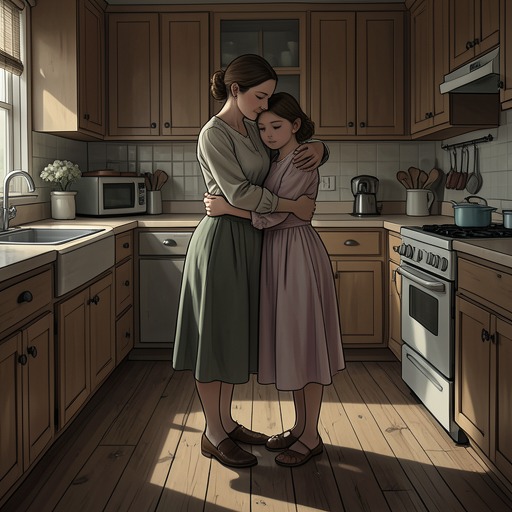
Before leaving, Rosie thanks Willowdean repeatedly, tells her she loves her, kisses her forehead, and calls her sweet Dumplin’. The gesture is especially resonant after Willowdean’s earlier distress over being judged and her own difficulty accepting her body. Here, the nickname is no longer only something she resists: she can receive it as part of an affectionate exchange with her mother. Rosie’s exit to announce the contestants makes the repaired gown’s public purpose immediate, while the tenderness backstage remains the scene’s emotional turning point.
After the rescue
Willowdean’s help does not undo her disqualification or return her to the competition on her own terms. Instead, the sequence places two outcomes side by side: she cannot finish the pageant, but she can help Rosie appear in the gown that has become part of Rosie’s annual ritual. The small technical workaround preserves the appearance Rosie needs without pretending the dress has suddenly become a perfect fit.
As soon as Rosie leaves, Willowdean retrieves the red gown her mother bought for her from a duffel bag beneath the counter, puts it on, and hurries toward Ellen Dryver’s place in line to serve as her escort. That next action carries the scene forward rather than closing the pageant’s story: even after her own exclusion, Willowdean remains involved in the evening and in the people she cares about. The alligator clamps, the crown, and the red gown mark different forms of participation—one improvised for Rosie, one worn by Rosie, and one Willowdean takes up as she returns to help Ellen.