Willowdean Dickson
Dumplin'Willowdean Dickson is a teenager who describes herself as fat and refuses to treat that word as an insult, even as intimacy and public scrutiny expose how much she still struggles with her body. Her decision to enter Clover City’s Miss Teen Blue Bonnet Pageant turns that contradiction into action: she does not need to feel secure every day to claim the right to appear onstage. Grief for Lucy, her lifelong friendship with Ellen Dryver, and her uncertain feelings for Bo Larson all shape the risks she is willing—and sometimes not yet willing—to take.
Identity and Early Bonds
Willowdean’s sense of herself is both blunt and unsettled. When she first meets Bo Larson as a new hire at work, she introduces herself as a cashier, a Dolly Parton enthusiast, and the resident fat girl. The label is offered as one part of a larger identity, not its entirety; she immediately starts to add that she is other things, too. Bo answers with his own name and takes her hand. In that brief contact, she imagines scenes of a future they have not lived: holding hands at a movie, walking down a street, or riding in a car. The fantasy arrives before a relationship does, but it establishes how quickly attraction can open a possibility she has not learned to trust.
Music also marks the beginning of Willowdean’s oldest friendship. During the summer before first grade, Lucy and Mrs. Dryver become friends through their shared devotion to Dolly Parton. Their daughters sit together watching cartoons without knowing what to make of one another until Dumb Blonde plays on Mrs. Dryver’s stereo. Ellen taps her foot; Willowdean hums; soon both girls are singing and spinning together. Their bond outlasts the song that sparked it. The story’s opening memory makes Dolly Parton more than a shared interest: music gives the girls a way to recognize one another before they have the words for friendship.
Grief and the Weight of Memory
Lucy’s death remains an active presence in Willowdean’s life six months later. She still expects to find her aunt on the couch with Riot in her lap or working crossword puzzles in the kitchen. Lucy died alone at thirty-six, weighing 498 pounds, from a massive heart attack while sitting on the couch and watching one of her shows. There are no photographs of her, because Lucy disliked seeing her body reflected back at her. Willowdean fears that, without being able to see or hear her aunt, she will forget her.
That fear makes Willowdean’s mother’s attempt to sort and dismantle Lucy’s room feel like more than household reorganization. Willowdean experiences the room as an echo of pain and worries that changing it will erase the life Lucy lived. Her mother sorts papers into piles to keep, toss, or perhaps decide about later; Willowdean wonders, in turn, which pile she herself would fall into. The scene links her grief to a larger fear of being judged and discarded. Remembering Lucy means resisting a version of her aunt reduced to the circumstances of her death, rather than the person Willowdean knew and still expects to find in familiar places.
Pageant as a Public Test
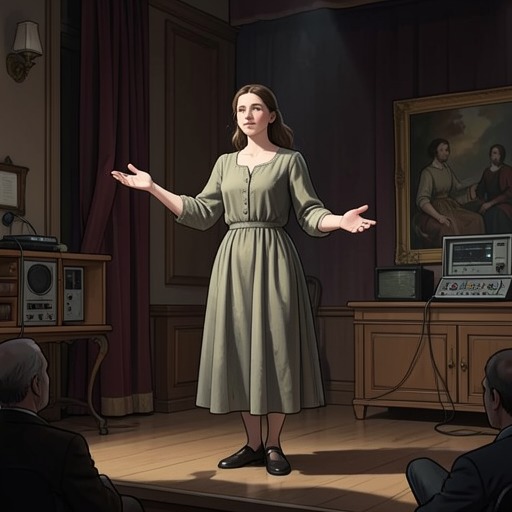
Willowdean announces that she is entering the pageant at a moment when she could instead have told her listener about Bo and the parts of herself that cannot let him go. The declaration is a choice to make a different private struggle public. At registration, the form prompts a request for her mother’s signature. Willowdean’s mother pulls her aside through French doors while Amanda Lumbard and Millie Michalchuk hand in their applications; Ellen, standing behind them, gives Willowdean a thumbs-up. When her mother challenges what she is doing, Willowdean stands straighter, plants her fists on her hips, and answers that she is registering as a contestant. Her response refuses to let the decision be dismissed as a joke.
The decision does not settle her body-image conflict. During a conversation about her strengths, another person identifies confidence as Willowdean’s, but she cannot feel the confidence being attributed to her. She had thought she did not care about the mirror; her feelings for Bo make her newly attentive to her body. She knows that his acceptance does not automatically quiet her own concerns about fat and stretch marks. On some days she is satisfied with her body and on others she is not, and she cannot make those states fit into a single, consistent self-image. The pageant therefore does not begin from a clean victory over insecurity. Its importance lies in Willowdean entering while the insecurity remains.
A drag show at The Hideaway gives her another image of what public performance can hold. Seeing performers of different shapes, sizes, and colors command the stage makes her feel, for the first time since a night watching a meteor shower in Bo’s truck, that her life is happening. Later, she writes to Lee Wei and Dale for help, explaining that she and the other girls do not know how to walk, pose, or present themselves. She worries about making a fool of herself and dragging the other contestants down with her; she also makes clear that winning is not her aim. She wants to demonstrate that there is no reason she cannot take part. The appeal for help turns that determination into practical preparation rather than a claim that she already knows how to succeed.
At the swimsuit round, Willowdean is uncomfortable but refuses to be ashamed. She does not flee the stage as she did at the pool. No one boos, and the audience does not go blind. Her survival of that moment does not make her suddenly free of self-consciousness; it gives her direct evidence against the imagined catastrophe that had made exposure feel impossible. Her conclusion is a principle of bodily inclusion: having a body is enough reason to put on a swimsuit. Onstage, the idea becomes an action she has taken in front of other people.
Friendship, Intimacy, and Fear of Being Seen
Willowdean’s attraction to Bo is real, but the prospect of being publicly recognized as his girlfriend frightens her. She believes he likes her, yet doubts that other people will understand what he sees in her. In talking with Hannah Perez, she acknowledges that she wants a version of the relationship in which she and Bo could be together without anyone else knowing. Hannah observes that relationship labels often make things easier for other people, while Willowdean admits that labels also offer her the safety of knowing where she stands. The exchange gives their friendship a particular intimacy: Hannah does not need to share every aspect of Willowdean’s experience to understand the pressure of other people’s judgment.
Willowdean connects that fear to Lucy’s inability to get on a plane to Dollywood. She had once thought Lucy was merely standing in her own way; now she recognizes how limited a choice can feel when the alternatives are private misery or public humiliation. The comparison helps explain why Willowdean cannot simply accept Bo’s feelings as a solution to her self-doubt. She knows she likes him, but imagines the stares and whispers their relationship might invite. When Bo tells her that she is beautiful and says that he can see and talk with her in a way he has not with anyone else, she kisses him again, then says she cannot proceed. Her refusal does not deny her affection. It marks the distance between being loved by Bo and being ready to face the world’s reaction to their relationship.
Her bond with Ellen also has to withstand what Willowdean has kept private. When they speak honestly, Willowdean admits that she wants Ellen to be happy and to make new friends, yet feels jealous and fears that their lives are moving at different speeds. She tells Ellen that she is still her best friend and that Ellen does not treat her differently as other people sometimes do. Then she reveals that she met Bo over the summer and that they kissed. Ellen is hurt that Willowdean did not tell her, but the disclosure gives their friendship a chance to address both the silence and the insecurity beneath it. Willowdean’s directness—her insistence that others can back her up or back away—coexists with the more vulnerable admission that she has been afraid to share an important part of her life.
Change and Narrative Significance
In the pageant interview, Willowdean faces judges whose reactions make her feel like the first of the unlikely contestants. Advice from Lucy does not come to mind, so she imagines what her mother would tell her if she were present simply as a parent rather than running the event: smile, and do not sigh. Willowdean follows that advice until her cheeks hurt. The moment brings her mother’s voice into a public setting where Willowdean might otherwise feel defined by the judges’ expectations. It also shows her drawing on a relationship that has been strained without pretending the strain has vanished.
By the pageant night, Willowdean can describe herself as a mosaic of experiences: Dumplin’, Will, and Willowdean; fat, happy, insecure, and bold. These identities do not cancel one another out. Her mother tells her she loves her, presses her red lips to Willowdean’s forehead, and calls her Dumplin’ before hurrying out to introduce the contestants and escorts. Their affectionate exchange does not erase Willowdean’s uncertainty, just as the swimsuit appearance does not make every fear disappear. Instead, she reaches a more capacious understanding of herself: insecurity can remain alongside happiness and boldness, and participation does not have to wait for perfect confidence. Her decisive change is not that she becomes untouched by judgment, but that she acts while knowing judgment is possible.