Willowdean Performs “Jolene” as Dolly Parton
Dumplin'Willowdean Dickson’s performance of Jolene as Dolly Parton is the decisive break between the pageant’s rules and the meaning she gives the stage. Instead of presenting her approved magic act, she lip-syncs to a song shared across her family’s memories and her own life. The audience’s cheers cannot prevent her disqualification, but they make the choice public: for a few minutes, the pageant’s carefully managed performance becomes an act of allegiance to the people and music that have shaped her.
Pageant Rules and Preparation
The performance takes place within a competition that sorts girls into familiar groups before they even reach the stage. At registration, Willowdean sees legacy contestants whose mothers and sisters have worn the crown, athletes adding pageant participation to college résumés, cheerleaders, and girls from theater and choir. Most arrive in dresses and cardigans; Willowdean, Amanda Lumbard, and Millie Michalchuk are in jeans and T-shirts. The crowded community center makes the event feel both socially intimidating and highly organized, a world with its own expectations about appearance and belonging.
Willowdean’s mother signs her form and addresses the contestants as she begins the registration welcome. Her role at the pageant is not only maternal: she is publicly associated with its proceedings, a fact that gives Willowdean’s later breach of the rules particular force. The event’s order is reinforced in training. Lee Wei teaches the contestants that a queen’s first impression comes from her walk, demonstrating a measured stride with one foot in front of the other. Willowdean later uses that instruction when she escorts Ellen Dryver across the stage, showing that she has learned the pageant’s choreography even as she rejects its control over her talent.
The relationships among the contestants also change the atmosphere surrounding the performance. After Millie tells her mother how much she wants to compete, the women return to the auditorium together. Ellen takes Willowdean’s hand, Millie takes Ellen’s and then Amanda’s, and Willowdean offers her hand to Hannah Perez. Hannah accepts. This chain of gestures makes the contestants’ support tangible before the pageant’s public spectacle begins. The solidarity does not erase the competition, but it gives Willowdean a community beyond the judges’ table and the crown.
The Unapproved Act
Backstage, Ellen helps Willowdean prepare in the one-stall bathroom. Ellen wears her old clogging costume, altered with an elastic band, while Willowdean struggles with a wig cap that feels too small. Ellen pins a blonde wig into place. When Willowdean looks up, she sees a fat teenage Dolly Parton. The transformation is playful, but it also makes the body the pageant would ordinarily assess part of the performance rather than something to conceal.
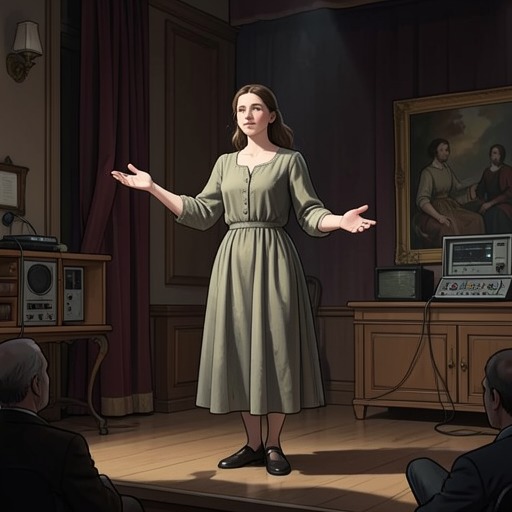
The sound technician has agreed to the change for twenty dollars, giving the act a small, practical foothold inside an event governed by advance approval. Ellen finishes her own clogging performance, then encourages Willowdean backstage. Her music has ended before she has completed the dance, and she finishes and curtsies anyway. Willowdean’s act follows under the official introduction of her approved magic tricks. Her mother, standing at the edge of the stage with a microphone, appears tense as Willowdean walks into the spotlight in boots and a suede-fringed, poncho-shaped outfit.
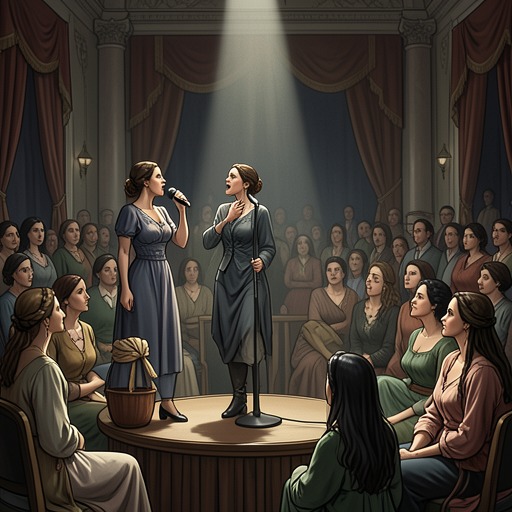
The opening chords are immediately recognizable. Willowdean turns toward her mother, raises a toy microphone, and mouths the words to Jolene. The song gathers the scenes in which it has already belonged to her life: driving with her mother, Lucy, and Gram with their hands in the wind; listening to the record in Lucy’s room; lying on the kitchen tiles while Ellen’s mother hums and makes spaghetti; Lucy’s funeral; Bo’s truck; and Lee Wei’s performance at the Hideaway. Onstage, the song is not simply an imitation of a country star. It carries a private history into the public contest, connecting family, grief, friendship, and the pageant’s wider audience through a tune Willowdean knows has traveled far beyond Clover City.
Applause and Disqualification
When the song ends, applause rises. Willowdean thinks she hears an oink, but cheers drown it out. The moment holds both the risk of being mocked for her body and the possibility of being received on her own terms. The performance does not make the pageant’s judgments disappear; rather, the contrast between the possible insult and the crowd’s response makes the act’s vulnerability visible.
Her mother pulls her aside as soon as she leaves the stage, but has to continue announcing the next contestant before Willowdean can answer. Callie warns her that the judges will disqualify her for failing to perform the approved talent. Willowdean accepts the risk without stopping to argue. In her mother’s dressing room, her mother confirms that she is disqualified: Willowdean broke the rules, and the same standard must apply to every contestant. The decision is presented as enforcement rather than a personal exception, even though mother and daughter are on opposite sides of it.
Willowdean is not surprised by the ruling; she knew the substituted act could disqualify her. Still, knowing the consequence does not make it painless. With less than an hour left in the pageant, she is upset that she will not finish after everything it has taken to reach that point. Her disappointment complicates any simple reading of the performance as carefree defiance: she wants to make the choice and still feels the loss imposed by it. Her mother turns to her and asks for help zipping her dress, returning them abruptly from the conflict to the practical demands of the competition.
What the Performance Changes
Disqualification ends Willowdean’s chance to complete the contest as a contestant, but it does not remove her from the pageant’s remaining rituals. When Ellen is called for the evening-gown round, Willowdean identifies herself as her escort and loops Ellen’s arm through hers. She walks her across the stage with one foot perfectly in front of the other, applying the lesson Lee taught. The return is significant: after breaking one of the pageant’s rules, Willowdean can still participate in a way that supports her friend, using the competition’s choreography for a relationship rather than a personal bid for its crown.
The event therefore holds two kinds of performance side by side. The approved walk depends on learning and repeating a prescribed movement; Willowdean performs it competently when accompanying Ellen. Her Dolly Parton act, by contrast, substitutes a song rooted in lived memory for the talent the pageant authorized. The first makes her part of the formal sequence; the second makes her difference and attachments visible, at the cost of being disqualified. Yet the contestants’ linked hands and the audience’s cheering keep the stage from belonging only to judges and rules. Willowdean cannot finish the pageant as a contestant, but her choice reshapes what participation means: she loses her place in the competition while remaining present as a performer, a friend, and part of the group.