Willowdean Replaces Her Magic Act with “Jolene”
Dumplin'Willowdean Dickson replaces her planned magic act with a performance of Dolly Parton’s “Jolene” during the Miss Teen Blue Bonnet Pageant. The choice turns a talent-round rule violation into a public declaration: rather than protect her chances by performing an act she considers weak, she takes the stage with a song bound to family, friendship, grief, and the life she has shared with the people she loves. The audience’s applause cannot undo the rule she breaks; she is disqualified before she can complete the pageant.
The decision to change acts
The decision begins when Ellen Dryver asks whether Willowdean is really going to perform the magic tricks. Ellen loves her, but thinks the tricks are unimpressive. Willowdean replies that she has little choice, then admits she has not considered doing something completely different and has no other act ready. Ellen’s question opens a possibility Willowdean had not allowed herself to consider: the approved routine is not her only imaginable choice, even if changing it could cost her the competition.
Ellen sits thinking, chewing her hair, then whispers an idea. The narration withholds the suggestion at first, preserving the suddenness of Willowdean’s response; she can picture the performance immediately. She believes she has no chance of winning and decides she might as well leave the pageant in a blaze of glory. The act is therefore not presented as a carefully prepared strategy for victory. It is an impulsive alternative to submitting to an outcome she already expects, and it makes the risk of disqualification part of the choice rather than an unforeseen accident.
A song made from shared memories
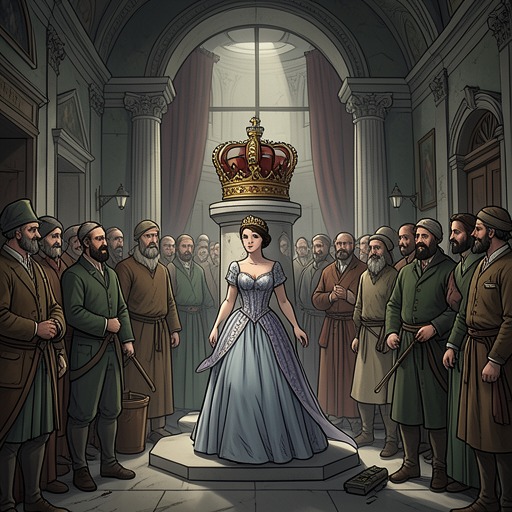
The pageant program still identifies Willowdean’s act as magic. Her mother introduces her as performing “a few magic tricks,” while Willowdean privately jokes that getting her wig cap over her head was already an impressive magic trick. She walks into the spotlight in boots and a suede-fringed, poncho-shaped outfit; her shadow stretches beyond the pool of light. The visual performance begins before the music, with a Dolly Parton-inspired appearance that makes the contrast between the announced act and what follows unmistakable.
The sound equipment has been arranged with the sound technician, who has been paid twenty dollars to cooperate. When the familiar opening chords begin, Willowdean sees the judges whispering at their table beneath their glowing desk lights. She turns toward her mother and holds a toy microphone to her lips, lip-syncing to Dolly Parton’s recording of “Jolene.” The choice of a toy microphone and a recorded voice makes the act a performance of a song rather than a conventional live vocal or the magic routine the judges have approved.
As the song plays, it gathers scenes from Willowdean’s life into one performance. She remembers driving with her mother, Lucy, and Gram, with the windows down and their hands moving through the wind; listening to “Jolene” in Lucy’s room as it came from the record player; and lying on the cool tiles of Ellen’s kitchen while Ellen’s mother hummed and made spaghetti. The song also recalls Lucy’s funeral, Bo Larson’s truck, and the Hideaway, where Lee Wei performed. These memories do not turn the talent round into a literal account of those earlier moments. Instead, the recurring song lets Willowdean carry them onto the stage, making the performance personal even as it is addressed to a room full of spectators.
Willowdean hears what may be a few people in the audience singing along. Her uncertainty matters: she cannot know how many voices join her, but she senses the song crossing the boundary between stage and audience. She describes “Jolene” as familiar beyond geography, language, and religion. When the song ends, the audience applauds. For a moment, she thinks she hears an oink, but cheers soon drown it out. The reaction is mixed rather than uniformly accepting, yet the applause gives her a response that the judges’ whispers alone could not provide.
Rule, consequence, and meaning
As soon as Willowdean leaves the stage, her mother grabs her arm and demands to know what the performance was. Before Willowdean can answer, her mother has to hurry back to announce the next contestant, publicly treating the unexpected act as a surprise. The quick return to pageant duties places the private confrontation inside the event’s fixed schedule: the show continues, and its host must keep it moving even while her daughter has disrupted the program.
On her way to the fitting room, Callie warns Willowdean that the judges will disqualify her for failing to perform the approved talent. Willowdean does not stop to argue. She says the choice was worth it. That answer does not erase the cost or show that she is indifferent to it; it marks her willingness to accept a known consequence rather than retract the act. In the dressing room, she sits beside Ellen while the remaining contestants complete their talents. Hannah passes and offers a silent high five, a small gesture of support amid the pause after Willowdean’s public risk.
The formal consequence arrives when Willowdean’s mother holds up Willowdean’s unzipped Miss Teen dress and tells her she is disqualified and cannot finish the pageant. Willowdean points out that she is unlikely to win and asks why she cannot at least continue walking. Her mother answers that Willowdean broke the rules and that the same standard would apply to anyone; the decision is framed as enforcement of a shared requirement, not an exception made specifically for her. Willowdean must therefore leave the competition without completing its remaining rounds.
The episode’s reversal is sharp: a performance that feels liberating to Willowdean is also a breach the pageant cannot simply overlook under its approved-talent rule. “Jolene” gives her a way to make the stage hold her own memories rather than only the act the organizers authorized, but that expressive freedom does not protect her from institutional consequences. Her disqualification makes the distinction between being heard and being allowed to remain in the competition concrete. The applause, the possible insult, the warning, and the ruling all coexist; the scene does not reduce the audience or the pageant to a single response. Willowdean’s act is consequential precisely because she chooses it knowing that success in the competition is not the only measure of whether it was worth doing.