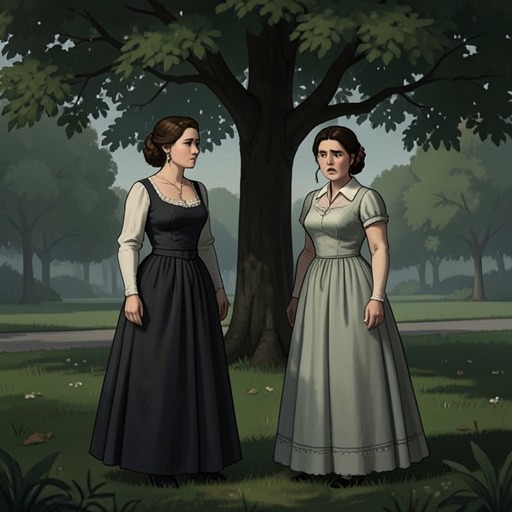
Willowdean and Ellen's estrangement and reconciliation
Dumplin'Willowdean and Ellen’s estrangement and reconciliation turn the pageant into a test of whether a long friendship can survive both conflict and change. After months of distance, the two girls confront the argument that divided them, admit to jealousy and withheld confidences, and choose to reconnect. Their reunion is not a return to an unchanged past: it makes room for separate lives, while leaving open the possibility that some hurts cannot be repaired forever.
Distance at the Pageant
The strain is visible before either girl manages to speak plainly. During the pageant interviews, the alphabetical seating puts Willowdean Dickson and Ellen Dryver beside each other. Whenever their shoulders touch, Ellen moves an exaggerated distance away. The gesture turns an ordinary accident of seating into a measure of their estrangement: physical proximity is unavoidable, but closeness is not yet welcome.
Later, after lunch and a keynote, the contestants are told to remain for newspaper photographs and return to their chairs in the same alphabetical order. Hannah Perez and Willowdean briefly check each other’s teeth before they separate for the seating arrangement. Willowdean waits for Ellen, deciding that she has to talk to her, but Ellen initially concentrates on rubbing a barbecue stain from her blazer. The stain supplies a small, concrete distraction while the harder conversation remains suspended between them.
As the contestants are called forward one by one, the pair move along the row of chairs. With two girls ahead, Willowdean says that she does not want them to be angry anymore. When Ellen does not immediately answer, Willowdean apologizes and admits that she was wrong; she says she cannot bear not speaking to her every day and asks her not to stay angry. The slow advance toward the photographer gives the exchange its shape: there is little privacy and no sudden resolution, only a few more moments together in which Willowdean keeps trying to make the first admission.
Ellen answers that reconciliation is not simple because they are becoming different people. Willowdean does not treat that difference as proof that their friendship must end. She tells Ellen that they can still be good for each other and admits her own stubbornness. The exchange establishes the central tension of their repair: they want to remain close, but neither can simply restore the childhood arrangement by denying that they are changing.
Repairing the Friendship
The photographers’ waiting area does not end the conversation. At the dressing-room mirrors, Willowdean finds her name label defaced with “DUMPLIN’,” written in black marker over her name. Ellen’s place is beside hers, as it was in the interview line. Without making a public scene, Ellen takes a pen, writes Willowdean’s name correctly on the back of the label, removes the tape, and replaces it. Her act directly counters the insult, but her explanation is more intimate: the word has no meaning unless Willowdean lets it, she says, and if it hurts Willowdean, it hurts her too. The gesture makes care visible before the two have finished explaining their conflict.
Willowdean’s chin trembles as they apologize to each other. Ellen notices, takes her hand, and leads her to a worn leather loveseat near the stage manager’s desk. There, with Ellen’s legs resting across Willowdean’s, Willowdean lays out the cycle that brought them here: she resented Ellen for entering the pageant; Ellen resented Willowdean’s reaction; each stayed angry at the other. Willowdean also recognizes that the quarrel did not arise in isolation. They had already been drifting apart.
Ellen says that the distance scares her and that she does not want to feel separated from Willowdean. At the same time, she wonders whether they may need space and whether they are meant to do everything together. Willowdean finds that difficult to accept, yet she can name what has complicated her response: she wants Ellen to be happy and make new friends, including friends like Callie, but she has felt jealous. She fears that their lives are moving at different speeds and that Ellen will outpace her. Naming the jealousy turns a concealed grievance into something they can discuss rather than act out through silence.
Ellen answers with a parallel admission. She loves Tim, but describes learning curves in their relationship; she also says that she sometimes envies Willowdean’s indifference to whether people like her. Ellen herself keeps count, mentally, of how many people approve of her, even when she does not think those people are especially impressive. The confession complicates their comparison of lives: Willowdean has feared being left behind, while Ellen has envied her friend’s apparent freedom from social approval.
Confidences and an Unfinished Reconciliation
Willowdean tells Ellen that she remains her best friend, even through the two months of estrangement, and that Ellen has never treated her differently in the way other people sometimes do. She knows how to stand by her identity, but has kept something important from Ellen: she met Bo Larson at work over the summer, kissed him, and continued seeing him. Ellen is surprised and chides her for not saying so. Willowdean acknowledges that she wanted to tell her but had been stubborn and foolish. The disclosure shows that the rift involved more than the pageant dispute; withholding a major part of her summer had also kept the friendship from the intimacy Willowdean says she missed.
Ellen responds that she, too, should have approached Willowdean when she saw her at the pageant. Her admission prevents the reconciliation from becoming a one-sided account of blame. Still, she warns that some things cannot be fixed forever. Willowdean physically sits up at the thought, and they remain together for a while, entwined like cats. The image offers tenderness without converting it into certainty: they can hold one another again, but the possibility of permanent loss has been spoken aloud.
Significance and Aftermath
The reconciliation depends on acknowledging difference rather than demanding that either girl return to an earlier version of herself. Willowdean accepts that Ellen may have other friends and concerns; Ellen recognizes that Willowdean’s feelings about the pageant and the changes in their friendship are real. Their apologies matter, but so do the practical gestures around them: a corrected name label, a hand taken, legs laid across a friend’s lap. Affection reappears through actions as well as explanations.
The moment remains deliberately qualified. Ellen’s warning that not everything can be repaired forever keeps the scene from promising that friendship is immune to change. Yet the two spend the rest of the afternoon together with Tim, and Ellen rides with Willowdean to her house. The movement from avoidance in the interview chairs to shared company afterward marks a meaningful return to one another, not a guarantee that they will never drift apart again.