Charlie
Earth AbidesCharlie’s brief place in the community becomes a turning point in its history: his arrival tests the customs Ish has helped establish, while his suspected role in a later epidemic makes the community’s response a matter of life and death. He is forceful and difficult to read, and the circumstances surrounding him leave the survivors with consequences they cannot undo.
Arrival and Character
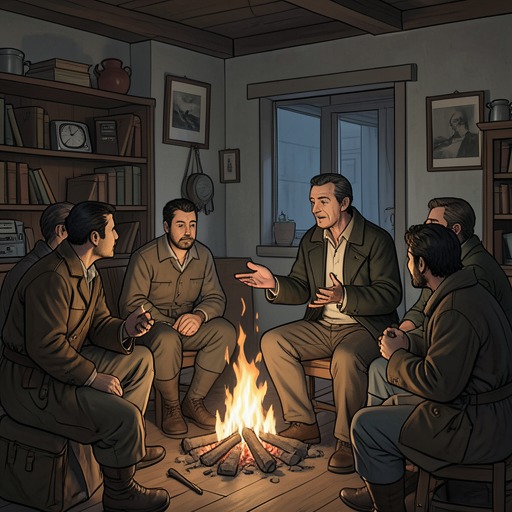
Charlie enters the story in connection with the return of the expedition party in a dirty, travel-worn jeep. The boys’ return alive brings Ish immediate relief, but the arrival also introduces a stranger whose presence unsettles the community. Charlie’s background is only partly known. Ezra later explains that he had drawn Charlie into talking about himself in order to learn more about him; even then, Charlie remains a figure known through observations and suspicions rather than a reliable account of his past.
Ezra’s assessment captures that uncertainty. He sees in Charlie a capacity for meanness, but cannot rule out the possibility that Charlie might become his friend. What Ezra feels sure of is Charlie’s determination: Charlie knows what he wants and generally gets it. This judgment is borne out in the confrontation over Evie, when Charlie does not retreat from the community’s disapproval but makes his attachment to her publicly unmistakable.
Defiance and the Hidden Pistol
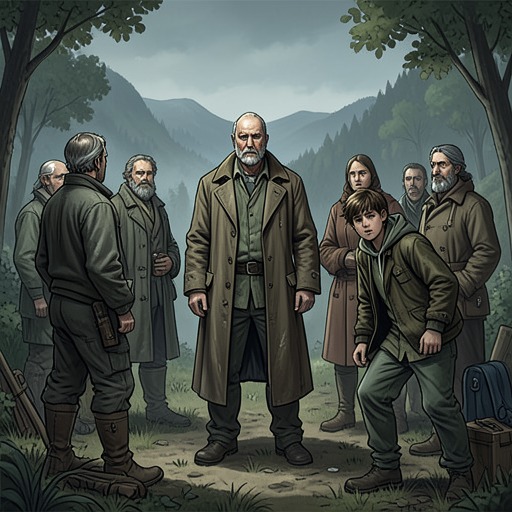
Charlie’s challenge to Ish takes shape around Evie. Ish recognizes that Charlie is pursuing her quickly and notices that she responds to him with laughter and apparent ease. When Charlie puts an arm around her and draws her close, the gesture makes the dispute public. The people watching look to Ish for a response, and he understands that the situation has become a test of his authority as well as a conflict between two men.
Ish approaches Charlie holding his hammer, but the familiar tool no longer feels like a sufficient answer to an immediate threat. His awareness that it is not a pistol sharpens the difference between the authority he has accumulated and the practical vulnerability of the moment. He forces himself to stay calm rather than let anger dictate what he does. Charlie’s open defiance thus exposes a weakness in the community’s reliance on Ish’s personal standing: his presence cannot by itself settle a conflict when someone chooses to resist him.
The danger is not only a matter of appearances. Ezra discovers that Charlie has enlarged a vest pocket to conceal a small pistol. To learn what Charlie was carrying, Ezra had tried to make him remove his vest; the test left him more certain that the object in the pocket was a weapon. Ish is relieved that the threat has a concrete form he can understand, though this discovery does not resolve the larger uncertainty about Charlie’s intentions or character.
Disease and the Community’s Decision
Ezra later reveals another disturbing part of what he learned from Charlie: Charlie claimed to have had numerous sexually transmitted diseases. The revelation alarms the adults, including George and Em, though the children do not understand what Ezra is discussing. This information does not establish what diseases Charlie actually had. It does, however, deepen the community’s fear that he could bring an infection from elsewhere, at a time when contact between isolated survivor groups carries risks the community is poorly equipped to judge.
That fear intensifies after the expedition. As the typhoid outbreak takes hold, Dick and then Ezra and five children fall ill. Ish considers the possibility that Charlie had carried typhoid from the area where he had lived, perhaps after an earlier or recent illness. The community cannot know whether that explanation is correct. What it does know is that Charlie, whose personal habits Ish regards as unclean, ate with the two boys for more than a week. The poorly constructed outhouses and flies provide additional routes by which infection might spread. Ish’s retrospective suspicion is therefore grounded in exposure and sanitation, but it remains suspicion, not proof that Charlie brought the disease.
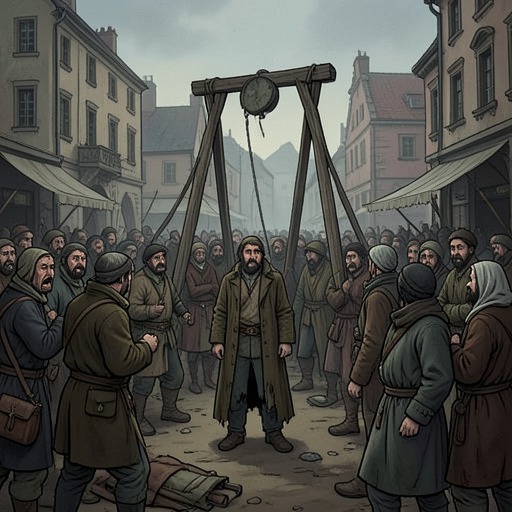
The outbreak changes the meaning of the earlier vote. When the ballots are handed in, all four read for Charlie’s death. His execution follows the community’s binding decision, but it does not protect the group from the epidemic or restore what is lost. In the aftermath, Ish sees the death of Joey and the shadow of Charlie’s execution together: the community has taken up the power to impose death, yet that power cannot control the disaster now unfolding.
Consequences and Narrative Significance
Charlie’s death becomes inseparable from the deaths and illness that follow. A week into the epidemic, the community is in the grip of what Ish believes to be typhoid fever. They boil drinking water, burn the old latrines, fill the pits, and spray the new latrines with DDT, but these precautions come too late to prevent exposure already incurred. The crisis exposes the limits of the community’s knowledge: Ish can reconstruct plausible paths of transmission, but cannot determine exactly when or where the infection entered their lives.
For Ish, the sequence leaves a lasting moral cost. He believes that the community’s response to Charlie, however necessary it seemed at the time, marked the loss of an innocence and trust he had not realized he still possessed. The death of Joey and the failure of Ish’s hope of restoring civilization deepen that loss. Charlie therefore matters not only as a disruptive newcomer or suspected carrier, but as the figure at the center of a decision that changes how the community understands law, protection, and the price of survival. The Tribe’s new authority can make a collective judgment; it cannot make that judgment harmless, nor can it shield the survivors from dangers they failed to anticipate.