Charlie and The Tribe
Earth AbidesCharlie’s relationship with the Tribe begins as the unexpected arrival of a stranger and becomes the crisis through which the community defines its right to protect itself. His welcome exposes competing hopes about contact with other survivors; his presence then divides the Tribe, and the decision to execute him marks a grim transition from an overgrown family to a community willing to impose a binding collective judgment.
Arrival and a Conditional Welcome
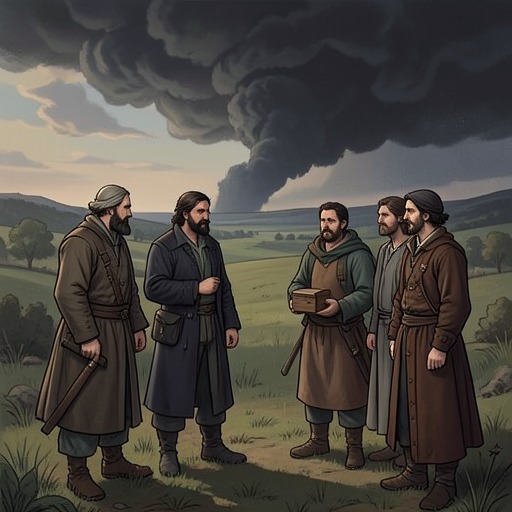
When Bob and Dick returned from their expedition in the Jeep, their survival brought the household rushing out to meet them. The boys were well, and Charlie arrived with them as a new acquaintance. Bob introduced him to the gathered group as a friend. After the family’s concern for the boys had been answered, the homecoming became a celebration, with the returned travelers at its center and the children marveling at the strangers they had encountered.
Charlie had been picked up near Los Angeles about ten days earlier. Bob said that people lived in and around the city, in both groups and isolation, and that Charlie had been alone. The boys found him likable and entertaining; Bob described him as a good man who told funny stories. Those impressions helped make the Tribe receptive. George welcomed the possibility of having another strong man among them, and the others joined in expressing the hope that Charlie would stay. At this point, the community treated his arrival as a possible addition to its small population, not as a threat.
The welcome also carried a larger significance. The expedition had made contact with people beyond the Tribe, including communities near Los Angeles and Albuquerque, although the travelers had met resistance from other survivors. For Ish, knowing that growing communities existed relieved some of the loneliness produced by isolation. Yet the contact was incomplete: the other groups’ resistance could reflect prejudice or an instinct for self-preservation. The Tribe’s celebration therefore held both promise and unease. Charlie was an individual newcomer, but his reception tested whether contact between scattered communities could become trust.
Ish’s Distrust and the Growing Division
Ish did not share the general enthusiasm. From the first meeting, he felt a strong dislike of Charlie and interpreted the newcomer’s appearance and manner as signs of something untrustworthy. Ish knew that his judgment might be unfair: he had little evidence beyond his impressions and the boys’ favorable opinion. Still, he could not bring himself to join the group’s welcome wholeheartedly. His suspicion placed him at odds with a community eager for novelty and strength.
That tension sharpened during the bonfire celebration. As the young people sang and played, Charlie joined a game of crack-the-whip, linked in the line between Dick and Evie. The children were pleased to have an adult stranger participate. Ish tried to recognize that the activity was harmless and to question his own resistance to accepting an outsider. But seeing Charlie among the young people made his dislike harder to set aside. He began to regard the immediate question of Charlie’s place in the Tribe as more urgent than the expedition’s discoveries about distant communities.
The difference between Ish and the others was not simply whether they liked Charlie. The expedition had returned with news that contact elsewhere could be difficult, while the Tribe itself had just offered Charlie an unusually warm reception. To Bob and the younger members, Charlie seemed capable of enriching life in a small, inward-looking community. Ish saw a risk that they were overlooking. Even Ezra, Ish’s closest support, remained uncertain: he could imagine Charlie becoming a close friend, yet also considered him a man who knew what he wanted and usually got it. The newcomer’s easy social connection and uncertain character made the Tribe’s welcome unstable.
Disclosure and Collective Judgment
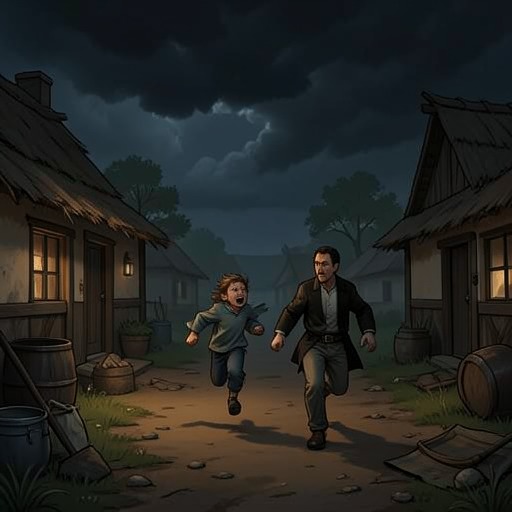
Ish’s confrontation with Charlie brought the private distrust into the open. Ish found Charlie among the young people and Evie, then asked the others to leave so he could speak with him alone. He sent Ezra to take Evie to Molly’s, sacrificing the support of his closest ally in order not to appear weak before Charlie and the others. The confrontation quickly became a community matter. When Ish raised the question of what should be done about Charlie and Evie, the discussion showed that most of the men did not share Ish’s certainty. They expected Charlie might bring useful new energy from outside, and some thought the immediate remedy should be an apology.
The balance changed when Ezra disclosed that Charlie had told him he carried several sexually transmitted infections. The information shocked the older adults, including George and Em, while the younger people did not understand its implications. Ezra’s disclosure transformed an argument about character and social boundaries into a question of collective health and protection. The adults could not be certain of every claim, but they believed the potential consequences for the Tribe were too serious to ignore.
Ish, Ezra, George, and Em agreed that the Tribe had a right and a duty to defend itself. They did not look to a surviving police force or legal institution; in their circumstances, communal self-defense was the governing principle. They also considered the practical limits of their power. A warning would not ensure safety, and the Tribe lacked the means to imprison Charlie and supervise him indefinitely. Banishment seemed feasible, but the adults feared that Charlie might return or gain the younger members’ protection. They therefore considered death as the alternative if he came back.
Em put the choice plainly: they could vote for banishment or death. Ish prepared four paper ballots, one for each adult, and initially wrote a mark for banishment on his own slip. After reconsidering his responsibility for the outcome, he collected the ballots. All four votes called for death. The unanimity did not make the decision easy; it made clear that the responsibility belonged to the group rather than to Ish alone.
Execution, Aftermath, and the Tribe’s New Order
The Tribe carried out the decision. In the aftermath, Ish walked back with the others from Charlie’s grave beneath an oak tree, where they had covered the grave with branches and stones to protect it from coyotes. He had carried his hammer, though it had no practical use in that moment; its weight had steadied him during the earlier confrontation, when he had spoken to Charlie with the boys’ rifles leveled nearby. George’s practical help had also been essential to carrying out the execution. Ish felt physically sick when he thought about what had happened and expected that he would never want to revisit it.
For Ish, the death closed the Tribe’s first twenty-one years, which he looked back on as a largely peaceful, family-like period despite its hardships and earlier losses. What followed would be something different: a state, with the capacity to act collectively and enforce a decision. He recognized the irony that this new political order began by taking a life, even though he had once understood a state as a force that should protect vulnerable people and make fuller lives possible. He reasoned that the community’s action had been necessary to protect its safety and future, but his justification did not erase his unease. The execution established both the Tribe’s power to defend itself and the moral burden attached to exercising that power.
A later typhoid epidemic complicated the memory of Charlie’s place in the crisis without resolving what had happened. About a week after the expedition returned, Dick fell ill, followed by Ezra and five children. Ish suspected typhoid. Charlie had eaten with the two travelers for more than a week, and the Tribe’s poorly maintained latrines and flies offered a route by which infection could spread. Ish came to suspect that Charlie might have carried typhoid, but the community could not establish whether Charlie had previously been sick or whether the disease had passed through his former surroundings. The Tribe began boiling drinking water, burning old latrines, filling old pits, and treating the new ones with DDT, but these measures came after exposure might already have occurred. The outbreak thus sharpened the community’s sense of vulnerability while leaving Charlie’s exact role uncertain.
Charlie’s relation to the Tribe consequently bears two connected meanings. His arrival reveals the community’s desire for contact and for people who might strengthen its life; the judgment against him reveals how quickly those hopes yield to perceived danger. The vote and its aftermath move authority away from Ish’s personal suspicion and toward a decision shared by the adults, while inaugurating a social order that can protect the Tribe only by accepting the weight of punishment. The later epidemic reinforces the limits of that power: collective judgment can be decisive, but it cannot make uncertain causes certain or undo the risks already present in communal life.