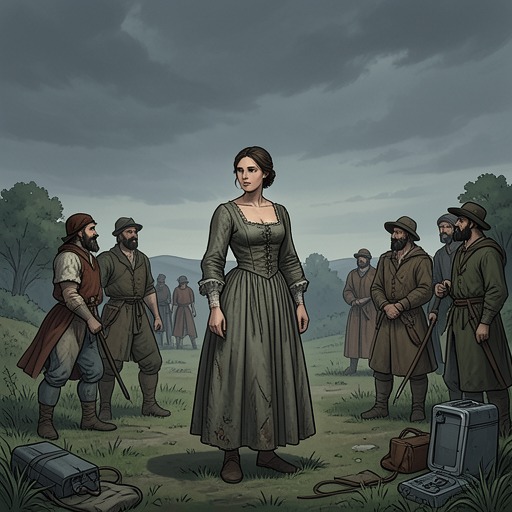
Charlie’s Death During the Epidemic
Earth AbidesCharlie’s death, carried out by The Tribe before a devastating typhoid outbreak, became a lasting source of doubt rather than a settled judgment. When the disease later spread through the community, its possible connection to Charlie gave the survivors’ grief a fearful moral dimension, even though the outbreak’s precise origin remained uncertain.
Background and the Decision
Charlie’s history of illness came into focus when Ezra, after a conversation with him, finally broke his usual reserve and disclosed that Charlie had multiple diseases. The news visibly unsettled George and Em, while the children did not understand its significance. The disclosure became part of the knowledge surrounding Charlie’s death, but it did not prove what would later happen or establish a definite cause for the epidemic.
The community had already acted against Charlie. In the later crisis, Ish would describe the group’s choice to Em as something they had done because they believed it was best. The evidence does not establish that the subsequent outbreak was a consequence of the decision; rather, the epidemic made the consequences of that earlier act newly painful to contemplate.
The Outbreak and the Uncertain Link
A week into the epidemic, Dick, Bob’s companion on an expedition, had fallen ill, as had Ezra and five children. Ish believed the disease was typhoid fever. Some adults had been inoculated in the Old Times, but he thought that protection had long since lapsed, and the children had no such safeguard. Once the disease had taken hold, the community had no effective remedy available to stop its course.
The conditions of daily life offered a plausible route of infection. Charlie had eaten with two boys for more than a week, and the Tribe’s poorly constructed outhouses and the flies around them could spread contamination. Ish later considered whether Charlie might have carried typhoid from an earlier illness, but the community could never know whether he had been sick years before, more recently, or whether the disease had arrived by another route. His potential role remained a disturbing possibility, not a confirmed explanation.
The epidemic followed other fears about disease. Ish had earlier worried that bubonic plague among rats could reach people through infected fleas moving from dead rats to the living. That danger was distinct from the later outbreak he identified as typhoid. The succession of threats sharpened the precariousness of life in a small community without functioning medical safeguards; it did not make the cause of this particular epidemic certain.
Fear, Grief, and Retribution
As the number of sick people grew, George, Maurine, and Molly turned to prayer, and some younger members joined them. They feared that God was exacting retribution for Charlie’s death. Ralph, whose family had not yet fallen ill, considered leaving. Ish persuaded him to stay for the time being, arguing that any of them might already be infected and that a small, isolated group would face greater danger alone.
Ish himself became feverish and, as the outbreak continued, voiced the possibility that the disease was punishment for Charlie’s killing. He connected the deaths, including Joey’s, to the fear that God had struck back. Em resisted that interpretation. She said that they had acted according to what they thought right and rejected the idea of a God who concealed the rules and then punished people for breaking them. Her answer did not undo the community’s decision or the losses that followed, but it helped Ish regain calm rather than let fear turn the epidemic into proof of divine vengeance.
Meaning and Aftermath
Charlie’s death thus returned in altered form: first as a decision made under the pressures facing The Tribe, then as a possible link in a chain of infection, and finally as the focus of a religious fear that the outbreak was retribution. The evidence sustains the community’s uncertainty, not a verdict that Charlie caused the epidemic or that the deaths were punishment. The distinction matters: the outbreak had plausible material routes through exposure and sanitation, while its moral meaning was imposed by frightened survivors searching for an explanation.
The event also exposed the cost of acting without secure knowledge. The Tribe could not determine whether Charlie had carried typhoid, and it could not reverse its earlier choice when illness spread. In Ish and Em’s exchange, the lasting consequence is not certainty but the struggle to live with that uncertainty without reviving a punitive faith built on fear.