Charlie’s Execution
Earth AbidesCharlie’s execution marks the moment The Tribe turns from an overgrown family into a community prepared to exercise collective power, and does so by killing one of its own. Faced with Ezra’s disclosure that Charlie had multiple sexually transmitted diseases, Ish, Ezra, George, and Em reason that neither warning nor imprisonment can protect the group. Their vote is unanimous: death. The burial beneath an oak tree follows, but the act does not settle easily into the past. Ish sees it as both an ending and a beginning—the first terrible expression of the State’s power to protect its people.
Discovery and the Question of Self-Defense
Ezra’s disclosure breaks through his usual reserve. He reports that Charlie told him about himself and that Charlie had several sexually transmitted diseases. The news visibly shakes George and flushes Em’s face; the boys nearby do not understand what Ezra means. The information transforms a concealed personal danger into a question about the safety of the whole community.
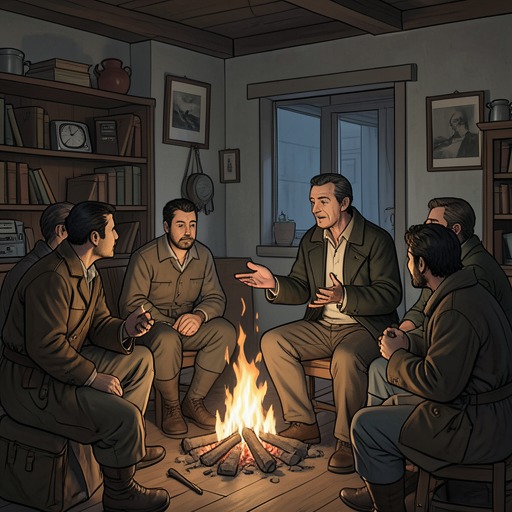
After asking for Em to rejoin them, the four adults stand in silence, feeling the threat as something immediate and defiling. Ish recognizes that he must take the lead again. Their first point of agreement is that The Tribe has a right—and an obligation—to protect itself. They do not look for a precedent or a developed legal code; they rely on the basic principle of self-defense, extended from an individual to a community.
That principle does not itself determine what to do. A warning, they conclude, would probably be useless and could not guarantee protection. Punishing Charlie after the fact would amount to social vengeance, not a means of stopping the diseases from spreading. Imprisonment is not a practical alternative: the small community has no jail, and maintaining an improvised one indefinitely would impose a burden it cannot enforce. Banishment seems feasible, but it carries its own limit. If Charlie returned, they agree, the penalty would be death.
The Vote
The decision narrows to two choices: banishment or death. Em states the alternatives directly, and the group uses what is at hand to make the decision formal. She finds four pencils and small ballots in the living-room desk, where the children keep paper for drawing. Ish tears a sheet into four slips and gives one to each voter. With only four votes, a tie is possible.
Ish writes a large B on his own ballot, then pauses. He realizes that the other three could outvote him, leaving him able to say that his own conscience was clear while Charlie was banished. Instead of relying on that possibility, he asks for the slips. Laid face up on the desk, all four ballots read death. The unanimity makes the decision collective rather than Ish’s alone, although it does not remove his responsibility: he has led the deliberation, prepared the ballots, and taken part in the vote.
The Execution and Burial
When the group goes to find Charlie, Ish carries his hammer. It has no practical use in what follows, but he holds it like a badge of office. The boys flank him with their rifles leveled; Ish speaks the words that announce the decision, and Charlie begins to curse. George supplies the practical skill needed to carry out the killing, knotting the rope and setting up the ladder. The rope and ladder, the armed escort, and Ish’s formal announcement give the act the character of an organized community judgment, not a private quarrel.
Afterward, the group shovels dirt back into the grave beneath an oak tree. They drag branches and carry heavy stones to cover it, protecting what lies beneath from burrowing coyotes. On the mile-long walk back, they stay close together as if they need one another’s support. Ish swings the hammer in his right hand. Its weight seems to keep him grounded, though he has had no use for it during the execution itself.
The event leaves Ish physically sick when he thinks about it, and he is certain that he will never want to remember it. George’s practical steadiness has mattered: Ish doubts they could have gone through with the act without George’s solidity. The burial closes the immediate scene, but it does not restore the community’s earlier innocence or ease.
A Beginning Founded on Death
Looking back, Ish understands the twenty-one years before Charlie’s execution as a kind of idyll. The group had faced troubles and death, but those hardships had seemed simple beside the decision it has now made. The difference is political as well as emotional: what had been scarcely more than an extended family has become, in Ish’s view, a State, with a long road ahead of it.
That new authority carries a sharp irony. Ish imagines the State as a nourishing mother, protecting vulnerable individuals and permitting fuller lives; yet its originating act is to bring death. He considers whether primitive political power may often have begun in crisis, when a community had to crystallize authority and express it through violence. He keeps telling himself that the execution was necessary and justifies it by the safety and happiness of The Tribe. The justification does not erase the ugliness he acknowledges. Instead, the event establishes the tension at the heart of the community’s new order: collective protection begins with a unanimous judgment, but its first decisive exercise of power is irreversible killing.