Child of the Blessing
Earth AbidesChild of the Blessing is Ish’s conception of the rare person who sees beyond what already exists and can imagine what might come to be. The idea links individual vision to the survival and needs of a society, but Ish’s recognition of Joey remains a hopeful judgment rather than a certainty.## Definition and Conditions The concept describes an exceptional kind of human capacity, not simply learning or competence. Its defining figure sees what is not, and from that perception imagines what may be. The distinction matters: most people, in the passage’s account, apprehend existing conditions, while the rare visionary can conceive something that has not yet taken form. The text presents this capacity as consequential to humanity: without such people, it suggests, people remain as beasts, unable to envision a life beyond what is immediately given.
The passage complicates any idea that genius alone is enough. First, two unlike halves must meet, each carrying the perfect half of genius; then the child must be born at a time and place suited to the world’s need. Even those conditions do not guarantee fulfillment: the child must also live in a world where death walks daily. The concept therefore rests on a sequence of contingencies—complementary inheritance, historical circumstance, and survival—rather than on talent in isolation. It makes extraordinary vision both precious and vulnerable.
The reflection invokes Koheleth’s observation that people do not know how bones grow in the womb. That allusion places the Child of the Blessing within the limits of human understanding: the origin of a visionary cannot be reliably explained or engineered. The narrative acknowledges the conditions it imagines while admitting that the process by which a remarkable child comes into being remains obscure.## Rarity in a Scattered World The idea becomes more urgent because of the scale of the population Ish imagines. When children are born in millions, the passage says, an infinitesimal chance will sometimes produce greatness and vision. Ish then confronts the harder question of what happens when people are broken and scattered and children are few. The concept is thus not only a reflection on individual promise; it also measures how precarious that promise becomes when the community that might produce and sustain it has been reduced.
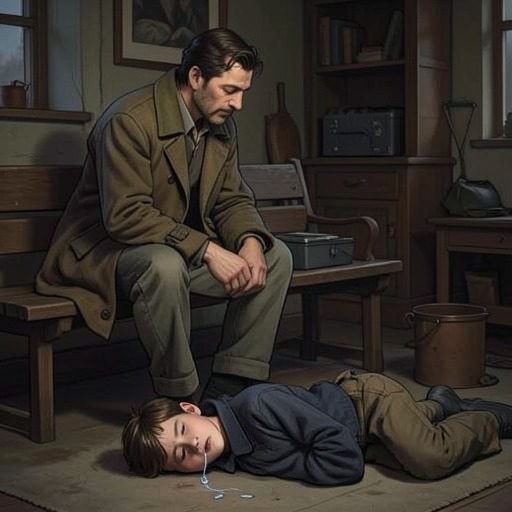
This pressure informs Ish’s response to the disaster. While George is speaking, Ish is overwhelmed by the recognition of Joey and does not hear the words that George has finally begun to say. The realization arrives before any explanation: Ish thinks of Joey as the one. Almost at once, he finds himself standing and urging the people gathered in his living room to act. Though he knows he is addressing only a few people, he feels as if he were speaking to a nation or to the world. The scene connects his private recognition to a public crisis: the possibility of a visionary child makes the future of a diminished population feel immediate.## Ish’s Recognition of Joey Ish’s conviction begins on New Year’s Day, when he becomes suddenly sure that Joey is the Chosen One. The narrative later returns to that moment as the origin of a belief that changes Ish’s conduct toward his youngest son. After Joey wordlessly senses that his father is unhappy, Ish is touched and a little humiliated by the sympathy. Joey may not understand the larger issues troubling Ish, but he has noticed his father’s state without an argument or explanation. Ish takes this small act of perception as evidence that his earlier certainty may have been right.
Joey’s response is significant to Ish precisely because it is not a speech or a display of authority. It is an attentive reading of another person. The scene gives Ish a concrete reason for associating Joey with unusual understanding, while leaving room for an ordinary explanation: a child can sense a parent’s unhappiness without being a figure of extraordinary destiny. The moment strengthens Ish’s belief but does not settle its truth.## Teaching and Doubt Since his New Year’s Day conviction, Ish has pressed Joey’s lessons, and Joey has absorbed them eagerly. His quickness in study reinforces Ish’s hope, but it also raises a concern: Joey could become a learned pedant rather than the leader Ish might expect a visionary to be. Joey shows little ability to lead the other children, and Ish sometimes doubts his judgment. The concept therefore does not make every trait point in one direction. Intellectual speed supports Ish’s belief; limited leadership and a possible retreat from other children complicate it.
Ish recognizes that Joey’s closeness to him may have more than one meaning. The boy might seek his father’s company because Ish appreciates him, while avoiding peers who are better at games. Ish hopes the other children do not notice how strongly Joey has become his favorite, and he knows that a father should not play favorites. Yet his preference has arisen suddenly and involuntarily, following the conviction that Joey has a special future. The belief is consequently bound up with a risk of partiality: Ish may be identifying a genuine capacity, or allowing the idea to magnify the qualities he most wants to see.
His private explanation to Em preserves that uncertainty. Ish recalls how sure he felt on New Year’s Day, then admits that the feeling has blurred. Perhaps, he considers, it is only the feeling a father has for a small son; perhaps Joey and he will later quarrel, as Ish does with Walt. He still sees Joey as exceptionally bright and quick at lessons compared with the other boys, but he cannot tell what those signs mean. He resolves to keep trying rather than claim that he knows.## Narrative Significance Child of the Blessing gives form to the tension between a community’s need for future possibility and the difficulty of recognizing it in a particular child. Ish’s belief makes education feel urgent: Joey’s lessons are no longer merely instruction, but a way of nurturing a capacity that might matter to a world with few children. Yet the narrative repeatedly checks that hope against the limits of Ish’s knowledge. Joey’s sympathy and quickness are observable; his destiny is not.
The concept also joins large historical uncertainty to intimate family feeling. Its account ranges from the obscure formation of a child to the survival of scattered people, while Ish’s evidence consists of a son’s attentive gesture and eager response to lessons. That scale-shift does not resolve the question of whether Joey is the chosen visionary. Instead, it shows how the possibility takes hold: Ish reads signs, teaches in response, and remains aware that love may distort his reading. The Child of the Blessing is at once a theory of rare human vision and an uncertain hope through which Ish tries to imagine a future.